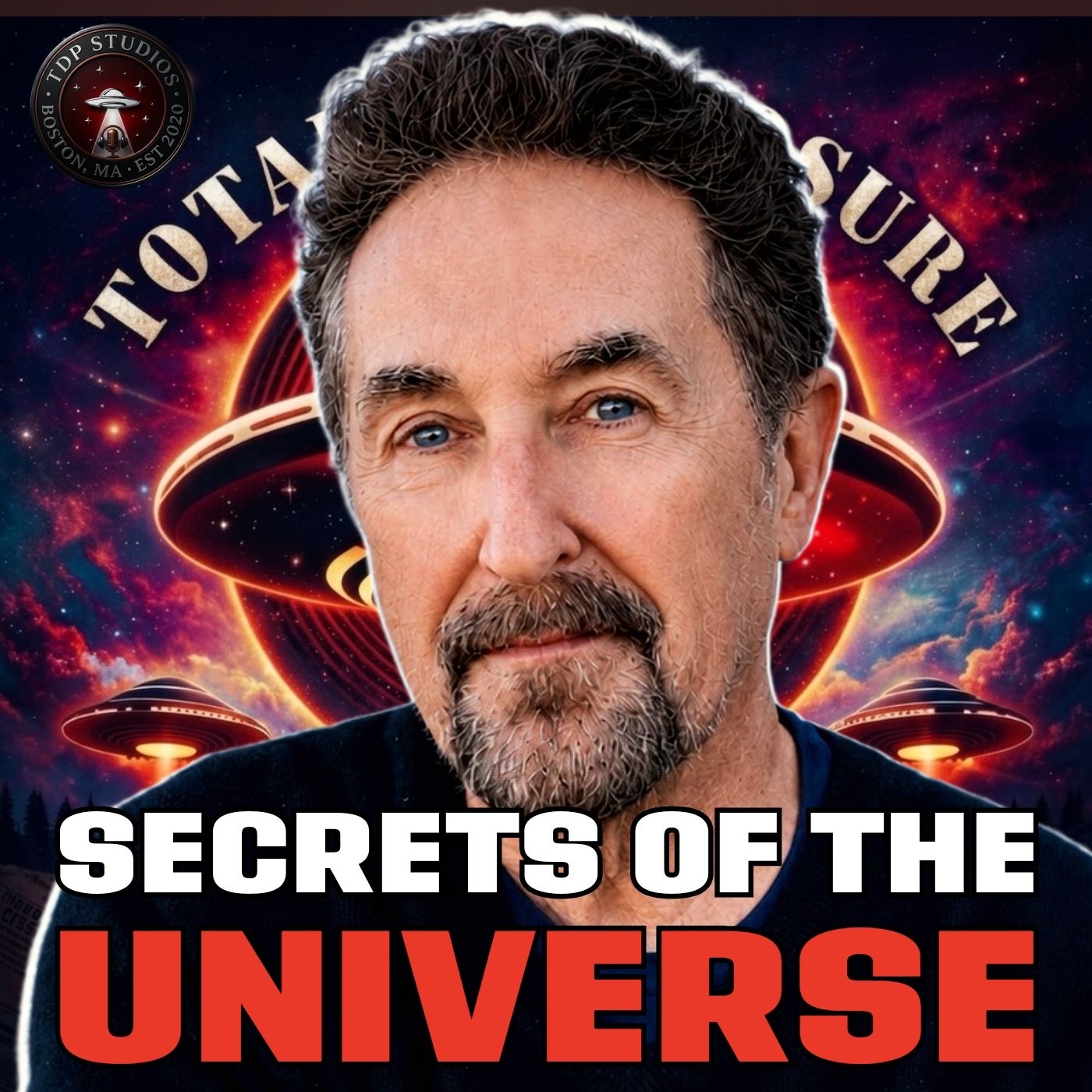
A Naval Intelligence Officer Handed Him the "Secrets of the Universe" | FT. Bryce Zabel
Emmy-winning television creator, former CNN investigative correspondent, and former Chairman of the Television Academy Bryce Zabel joins Ty Roberts in person at The Safehouse (Waltham, MA) to talk about the ONI approach and the formula, the 1995 "WE ARE WATCHING YOU" postcard, why he believes the U.S. government has craft and bodies, the former Secretary of Energy who said he'd seen the aliens and cried himself to sleep, Dr. Phil's box of UFO documents from President Trump, A.D. After Disclosure with Richard Dolan, near-death experiences — including his own...
Bryce Zabel: brycezabel.com • hollywoodufos.com • soundlightfrequency.com • needtoknow.today • darkskies.today • X @BryceZabel • Instagram @brycezabel
Total Disclosure: totaldisclosure.co • YouTube @totaldisclosure • @DisclosurePod
Welcome to the Safehouse
Speaker 1: Welcome back to Total Disclosure.
Speaker 2: I am your host, Ty, and we are here broadcasting from the safe house.
Speaker 1: I am so excited about this episode.
Speaker 2: I've personally looked forward to this for more than I even thought I was looking forward to it because you're, you know, Bryce, you're a huge part of my childhood, you know, my connection with my mother. You're such a heavy hitter in every sense of the word. You're an Emmy-winning television creator, former CNN investigative correspondent, former chairman and CEO of the Television Academy, and again, gave us the groundbreaking 90s sci-fi series, Dark Skies. You also co-authored the definitive roadmap for a post-disclosure world with AD After Disclosure with the great and powerful Richard Dolan.
Speaker 2: And most recently, you wrapped an incredible first season of your podcast, Sound, Light, and Frequency with with brent friedman from the corridors of hollywood power to the deep trenches of the ufo cover-up have spent years not just looking at how stories shape our reality but telling those very stories.
Speaker 3: And i still don't know what's going on so i don't know what does that tell us i don't well it tells us we're we're dealing with a pretty vast and deep mystery and uh You know, maybe we'll figure it out while we're all alive here and maybe we won't. Maybe it's bigger than we can possibly imagine. I love there's a quote from a physicist. I believe his name was H.S. Haldane. I may have that wrong, but he said the universe is not only stranger than we imagine, it's stranger than we can imagine. And if that's actually true and there are things going on right now that may make us believe that, then all we can do is knock on the door of the mystery and see what we can reveal.
Speaker 1: Absolutely. So have you always been interested in the phenomenon?
Speaker 2: I know from some of the other interviews that you've done, you've been on great shows like American Alchemy, The Y Files, who's a friend of ours, AJ and Gina over there,
Barney Hill and the McMinnville photos
Speaker 2: some great episodes. I didn't realize that you really did pursue this topic from a young age.
Speaker 3: Well, sort of. I mean, although you lay out all those credits and I feel incredibly old to have that many credits. So from the very, I can't say that that's true going back to that young of an age. Although I do remember that one of my first, I guess, UFO mystery memories would be watching to tell the truth with my, my parents and Barney Hill was on. And, and, you know, and all of us kind of wondering, gee, is it him? Is it him? You know, and then they go, well, the real Barney Hill stand up. And I remember being kind of fascinated by that story back then, but, And to be honest with you, I guess there is a kind of an early age thing.
Speaker 3: My friends and I used to roll up Look and Life magazines, you know, the large format into tight little wads and have magazine fights in the basement because we couldn't afford lightsabers, nor had Star Wars even come out. So we would be down in the basement fighting with those things. And one of them had this beautiful French actress on the front. I was like 12 years old thinking, maybe I'm interested in women. Maybe I, what's going on and looking through that magazine. And there were the McMinnville photos that it was the issue that the Trent's photos were in there.
Speaker 3: And the thing is where I was growing up was just a few miles from McMinnville where the Trent photos were taken. And so my friends and I were like, we quickly went from, the beautiful French actress to these photos. And we're saying, what could this be? And how could this be so close to us? And I guess that got my attention. Yeah.
Speaker 1: So would you say that you followed that case?
Speaker 3: I have followed the case. Well, let me put it this way. They're either fakes, which they're not, or they're some of the best UFO photos ever taken. There's not much interim to explain it. And certainly they've been looked at by professionals, Bruce McAbee. And of course, I believe Blue Book looked into that or was it the Condon? Not the Condon, but somebody else looked into them. They've been looked into. And the thing is, they're just really great photos. And the Trents, I literally went to high school with some people that were part of their care taking help.
Speaker 3: And they said that Trents were the most decent people around. Hardly bent on fabricating stuff. And the most fascinating thing is, here this guy takes these two incredible photos. And what does he do with the roll of film? Nothing. Okay? Nothing. Because he's still got photos on it. And they're frugal people. And they wait until they can take. Here today we take a photo of our breakfast. You know? But they, you know, back then it was like, well, film is expensive. Let's wait until we have a good reason to develop it.
Speaker 3: And then they did, and those were great photos. So yeah, that kind of got my interest.
Speaker 2: And that is such a very, very fun case to just dissect and look at. And it's spawned a pretty successful festival that happens each year, I believe.
Speaker 3: Yeah, I've actually never attended the McMinnville Festival.
Speaker 1: Oh, you should.
Speaker 3: Possibly. You know, it's funny, though. For a speech I was giving once, I made a fake Time magazine cover with the McMinnville photos on it. OK. And for the speech, I was saying to people, you all remember this magazine and everybody, people are raising hands, go, I remember that. And I went, no, you don't, because I just made it up. And this is why we have to be careful in the UFO field. Well, guess what? The McMinnville UFO Festival has that magazine on their website. And I have written them repeatedly saying it's not real and they've not taken it down.
Speaker 3: So if you want sort of an example of the things we have to deal with to get to to tell ourselves what the truth of this story is yeah half of it is um obviously uh failures to communicate basically and i feel bad about my own part in that but it was meant to make a point that uh and it's easier now ty as you know than ever to make up anything you want about almost anything so.
Speaker 2: Yeah a sentence right a sentence can paint you this picture that not only tricks the eye, but it's almost veering away from having that uncanny valley. Because that's how I've recognized it for a long time, is that uncanny valley that it always has. But in the next couple of years, if it's already here, I mean.
Speaker 3: Although I have to say, that's one of the reasons why I like the older cases, because they exist outside of the space we live in now where People can create their own evidence that may or may not be real evidence. So that's why, for example, I do love the Betty and Barney case. My wife and I have written a pilot for a TV, limited TV series about it. I'm compelled by it. We think it's a great story that deserves to be told in more detail, but also why I'm interested in those photos from McMinnville.
Speaker 3: Why? Because they were taken at a time on a, on a, with a good camera, but with, regular film, and it was before people were faking things. I'm also compelled by the John Lennon UFO case from 1974. It's one of my passions. And all of this before AI is making evidence of.
Speaker 2: Yeah. So essentially the pre-AI cases are inherently going to,
The day after the election: is disclosure a jump ball?
Speaker 2: they're going to gain tremendous value because of the world that we're heading into.
Speaker 1: And that we're coaxing into.
Speaker 3: You know, by the way, speaking of the world we're heading into, here we sit the day after the election, and I couldn't help but ask myself today in the aftermath, because I ask myself this about everything, as I'm sure you do, it's like, well, what does this have to do with disclosure?
Speaker 1: What does it do?
Speaker 3: And I find it, it's a jump ball right now.
Speaker 1: Well, yeah, I mean, let's dissect that a little bit.
Speaker 2: So as we know right now, Our understanding right now is that the Democrats have taken both the House and the Senate. And, you know, what do you think that leads to in terms of things like the Secrets Task Force with Luna and any other effort that's been made? You know, we call it a bipartisan effort, but the Republican Party representatives were leading that.
Speaker 3: Well- Because they were in power and now we'll see. I don't know. I find it. It's a compelling question. The biggest wild card of all is, is Trump going to continue to play a role in this or will he fade back from it? I mean, he's clearly used his presidential... authority to allow documents and videos to be released. Will he continue with that interest? Another question that I think looms large is if he's unrestrained and you've got unfettered Trump, what might he do on this topic? I don't think we know.
Speaker 3: But I'll tell you something, Ty, that I thought was very interesting. And I'm sure you already know this, but maybe some of your listeners and viewers may not. But I was kind of interested to say, OK, given all this kind of started in modern times in 2017, we're almost a decade past that. So you would think that this would, if it's the real deal and people in authority are talking about it, it ought to be an election issue of some kind. But it wasn't at all. The only thing I could ever find that showed that anybody cared about it in this election cycle at all in a real way was that Luna, who you mentioned, Anna Paulina Luna, was in a very, very tight race, which she just won by a percentage and a half, I think.
Speaker 3: But to the best of my knowledge, her opponent is the only one who actually waved UAP at her and in interviews would say, I'm interested in keeping costs down.
Speaker 1: Healthcare.
Speaker 3: All this stuff.
Speaker 1: The buzz ones.
Speaker 3: But she is interested in space aliens.
Speaker 1: She got her head in the clouds, literally.
Speaker 3: Sort of like the Kucinich stuff from years ago. I don't think that her opponent paid for ads or anything about it. So it was, you know, she used it. But on the other hand, Jared Moskowitz, for example, who also is active, I don't think his opponent had anything to say on the topic. So.
Speaker 2: I agree that it should be a bigger, like it should be a more talking point, but the fact that people are involved and they're not getting it used against them, aside from maybe one candidate, that's also kind of a good sign.
Speaker 1: You know, the silver lining, I would say, right.
Speaker 2: Is even though they're involved heavily, they're not getting scrutinized because it is kind of becoming more regularized and um, the stigma is fading away, whether we like it or not.
Speaker 3: Although if, if anything's fading away, it feels, as I sit here today, it just feels like, well, maybe it's all fading away. I, because if this is a national security issue, as people would like to say, and we're also, we're, we're here, we are in the shadow of the election, but we're also in the shadow of Jay Stratton's book out of the shadows, uh, which obviously is making the point, this is a national security issue. It's been treated that way by the government. I've been in charge of that investigation.
Speaker 3: If all of this is true and all these reports that you and I are aware of and, and, and all the machinations about testimony and whistleblowers and all that, if that's all real, why is it not an issue? And, and, and I find that to be, uh, Well, it's not as compelling as the mystery of what UAP really are, but it's still a compelling mystery. And someday, Ty, when we know a little bit more and historians are revising all these history books and they write about the period we're in now, they're going to have to write about why, if this thing was as crazy and real as it appears to be, that the entire body politic could just slough it off.
Speaker 3: So I think the questions going forward in the next two years will be, will Trump find it to his advantage to change the subject? Or will he find it ego satisfying to be the guy that says this is real, possible, don't know, would hate to speculate beyond raising the question. But then the other question is, there are Democrats who have been very active in this. Chuck Schumer, for example, And he's in a position of increased power times 10. So will he use that authority in any way to pursue this further?
Speaker 3: Who knows? But the one thing the Democratic Party is going to be doing is setting up committees and investigating. This won't be Luna's committee anymore. It'll be somebody else's if they do it. And I really don't know. I mean, honestly... I've only had a day to think about this. I'll probably have different thoughts in a week. But right now, I just kind of have to shrug and say, might be important,
Sound, Light & Frequency: season one
Speaker 3: might not be. Don't know.
Speaker 1: Yeah. And need more information.
Speaker 3: Need more information. And need time for this to develop, I guess.
Speaker 1: Oh, absolutely. So kind of segueing here.
Speaker 2: You and Brent Friedman just wrapped a massive 36-episode first season of Sound Light.
Speaker 1: And frequency.
Speaker 3: Yes.
Speaker 1: And you had referenced this, you'd referenced this.
Speaker 2: In our last talk, in our last conversation we met at Contacting Desert 2025. And you had said to me, don't worry, something's happening.
Speaker 3: Yeah.
Speaker 1: Something happened.
Speaker 3: Yeah.
Speaker 2: And you kind of, the cat's out of the bag, if you will. You've released the formula.
Speaker 3: We did.
Speaker 1: Any update that you can give?
Speaker 3: Well, listen, Brent and I, sort of resolved when I heart said that they wanted us to produce this series. We did, as you said, 36 episodes, we just said, let's let it all hang out. I mean, we're not getting any younger. Uh, let's whatever we've got, whatever our piece of the mosaic is, let's bear witness to that and then, and see what happens.
JC: the Naval Intelligence man at the premiere party
Speaker 3: And for people that, um, you know, may not know that I'll give the very basic satellite and frequency goes back to this TV series that, You mentioned Dark Skies, which is something Brent and I created for NBC. And during the premier party for Dark Skies, 200 people are in my backyard.
Speaker 1: Okay.
Speaker 3: And that includes the actors and the directors and the executives and the crew. And we knew them all. And the show had not aired yet. Some guy introduces himself to me and says he's from the Office of Naval Intelligence and that we got a lot right. And, you know, they want to make a deal with us. And he said, I said, what do you mean we got a lot right? And he said, well, they'd seen the pilot and that's what they thought. But the pilot had not yet been released. So I challenged the guy and it turned out that he had seen it.
Speaker 3: He knew the details of it. And, you know, what I'm saying right now is hours of sound, light and frequency.
Speaker 1: Of course.
Speaker 3: And I'm telling it in two minutes. But at the end, at a certain point, I said to the guy who called himself JC, I said, you, you really have to leave because I didn't invite you. And I have 200 people here and I have other obligation.
The formula on the back of an envelope
Speaker 1: You should go.
Speaker 3: And he said, okay, I will. Absolutely. Does anybody have a pen and a piece of paper? This is getting to your, your intro there. And what he said was my, my partner, Brent, his wife did have the back of a bank envelope and the guy wrote in his, on this thing for about 30 seconds and gave it to us and said, you know, put this in a bank, in a, in the safety deposit box for 10 or 15 years. And if we don't make a deal, maybe you'll know that we were on the level. And we said, what is it? And we looked at it.
Speaker 3: It looked, I don't know. You could call it a formula. You can call it an equation. You can call it anything you want. And by the way, if anybody wants to look at it right now, they can go to soundlightfrequency.com and look at it. So they don't have to, And you can put it on your show right now because we have released it. And we said, what is it? And he said, Secrets of the Universe, Sound, Light, and Frequency. So Brent and I have had that for years. And we finally said, we're going to trust the wisdom of the crowd.
Speaker 3: So we released it this year. And people have taken us to heart. And I think we know a little bit more, a lot more about what it actually is than we did in 1996 when it was written. But the question is, why would a guy from the Office of Naval Intelligence give it to us? Because, Ty, it's really about consciousness. If you look at it, it looks like a description in graphic detail of a Kundalini rising event. It's a consciousness thing. And, you know, some people have said, well, gotcha. Okay. That's what it is.
Speaker 3: Well, okay. That's not a gotcha. The gotcha for me would be, why would they owe and I give it to us? Why would you approach two guys with the TV series and draw this for them and tell them it's the secrets of the universe? And those questions have been very interesting. So yes, that's one of the things we talked about, but the overall thing about that podcast that I find
"Slow-drip disclosure": Hollywood & the government
Speaker 3: so interesting is we We couldn't just talk about that formula for 36 episodes.
Speaker 1: Of course not.
Speaker 3: Right. So we enlarged the story because it was a story about perhaps government and secrecy trying to intervene in Hollywood to use Hollywood. The guy actually used the phrase slow drip disclosure when we met with them. So why would they want to do that? Well, because as it turns out, as we detail in our investigation, the government has been involved with other people over the years, going back to the 50s, going back to the Robertson panel, where in 1953, they said, you know, we really got to get in touch with Walt Disney about this, you know?
Speaker 3: So it's not just me and Brent that we're, that we're part of this other people have. And so I urge people that actually want to know the details to check that out because we, we spent a year of our lives putting, trying to put that in perspective.
Speaker 2: And it's, I highly recommend people tune into that. I'll put the link for it in the description below. You know, what was, what would you say the single most surprising revelation or thread that emerged from this deep dive that you did into the experience?
Speaker 3: Well, I, let me put it this way. Uh, when Brent and I decided to do this, we had a lot of agendas, but one was, it would be fun to look into UFOs and aliens as they've been treated in film and TV. That was the superficial, superficial way into the show. Um, But in terms of learning about it, we realized we had always said, well, we know what happened to us because it didn't end, by the way, at that party. This guy brought a superior officer out to the show later and other things happened, all of which we detailed.
Speaker 3: But we went, we've had this experience. But, you know, people have over the years said, well, maybe Spielberg was he also offered a deal before close encounters. So we started thinking. thinking if we build it, they will come. In other words, if we bear testimony, bear witness to what we experience, maybe other people will come forward. And that has happened. We have had several people come forward because they saw and heard the podcast and say, you know, something happened to me. And those stories make me feel, well, as Brent and I joke, we are not alone.
Speaker 3: Right.
Speaker 1: Right. Yeah.
Speaker 3: Other people have had other experiences in Hollywood.
Speaker 1: Well, even even going to the most obvious case being the Robert Emmenegger.
Speaker 3: Yeah.
Speaker 2: Film, of course, UFOs past, present and future, where the was it the was it the Office of Naval Intelligence?
Speaker 3: That I'm not sure of for him, but I do know that the the O & I pops up a lot.
Why Naval Intelligence cared about consciousness
Speaker 1: They do.
Speaker 3: And one of the one of the reasons that so it. Why I say it's not a gotcha to say that the formula has something to do with consciousness. That's not the gotcha. The gotcha, why do they do it? And part of the answer is the U.S. military, including the Navy, in the 90s in particular, and prior to that, had been involved in remote viewing and other consciousness-related investigations. And clearly, people... who have sort of studied this, the historian part of it, and also people who have been insiders have come to me and Brent and said, yeah, this doesn't surprise me at all because these guys were very, there was at least a group, whether all of O and I was interested in it or not, I don't know because they had other things that they obviously needed to be paying attention to like nuclear submarines that the Soviets were off the coast with.
Speaker 3: But at least a group within it seemed to be interested in the whole consciousness angle. So I guess the revelation for me was I felt better after doing these 36 episodes that what happened to Brent and I was not a lark. It was not a piece of disinformation. It was an authentic approach of some kind, of some kind, and that we are not the only guys that ever got approached.
Speaker 1: So- Like one part vindication, second part.
Speaker 3: You know, vindication is a powerful word. I don't feel that I was under attack, so I don't need to be vindicated. I just feel like, Ty, and this is probably something that I'm sure you're doing with your own show.
Speaker 3: There is a giant mystery. It doesn't sound like any one of us has the whole thing solved. And so if you look at the whole thing as a mosaic, then those who have a piece of of that mosaic, bear witness to it.
Ancient technology & suppressed human potential
Speaker 3: Eventually, historians and journalists will be able to find the connections between things and maybe all of us together are smarter than any one of us and we can bring this thing to resolution.
Speaker 2: Well, and you know, so I was just at a, I was just in Austin for, and I interviewed guys like Hugh Newman, Dan Richards, And, you know, we got to talking about like, it was more ancient civilization stuff. And I got to wondering about this idea of consciousness, right? And what is technology? You know, because we think of technology as something that is like this, right?
Speaker 1: And what if an ancient civilization, you know, less distraction. They were more in tune with the world around them. And they knew that inside of each of one of us was the key to the universe, right?
Speaker 2: All you had to do was tap into it. And then all of a sudden you could lift stones. You're not lift stones, but sound like, you know, people have talked about this.
Speaker 3: Absolutely.
Speaker 1: Right.
Speaker 3: I think my partner, Brent Friedman, that's his take on it.
Speaker 1: Yeah.
Speaker 3: That, that the, There are secrets to the universe, but Brent's take that I find refreshingly interesting is that we don't need, that all of us individually have the ability to tap into that and into those secrets and that force.
Speaker 1: And I think that is what, you know, SRI, right? I mean, go down the list, right?
Speaker 2: I think one of the biggest secrets, one of the biggest rug pulls in the disclosure and if there is a disclosure, will be, I think many people would be surprised at how much of it is suppression of what human beings can be.
Speaker 3: Probably very true, which sort of takes us back to just this discussion of President Trump. Because if all that was to be revealed, for example, was, by the way, that Roswell thing, yeah, we got a craft and there's some bodies and they're on ice someplace. I think Trump could probably... get his way through that but if if the disclosure in in fact is something a little more mysterious like yes that's all true but so is this other stuff and by the way it has to do
Dr. Phil, Neil deGrasse Tyson & Trump's handwritten note
Speaker 3: with you know the nature of reality yes well then he's probably the wrong messenger to be delivering nature of reality to to all of us at this point yeah.
Speaker 2: And and i mean i forgive me forgive me for asking But is that why we are seeing flips in guys like Dr. Phil, Neil deGrasse Tyson? Because they're getting, you know, essentially slow dripped in, right? To be those people that can have those conversations, right? Because they're a little bit more of stout and, I mean, stable.
Speaker 3: Listen, I've met both of those guys. And it's a complicated conversation. And I can't speak to their own motivations too deeply. I do have issues with Neil deGrasse Tyson and how, you know, listen, I'm an admirer of his intellect and his ability to popularize science. I don't take anything away from him. I do think, though, on this issue, he's been a little condescending and he's had his talking points. And he's used those, whether he's on CNN or his own show or whatever. And it's at the expense of people who have had actual experiences.
Speaker 3: And I don't like that. Now, Dr. Phil is a separate issue. I've been on his show twice, once with Lou Elizondo and once with Chris Mellon. And the first time, a little over a year ago, Phil comes on and his take is, well, you guys... I'm not going to do a Dr. Phil. But his take was, you guys are the experts, right? I'm just here to learn. I don't know anything about this topic. But a year later, when I was on with Mellon, Phil is breathing fire. And he starts by saying, we've been lied to for 79 years.
Speaker 3: And he's become this advocate. At the end of that show, after we're wrapping, you know, it's like the end of the show. You're like, well, let's make sure we got everything and all that. So why that's going on. I had heard going into that show that Trump had, well, he had been saying it, that, that Trump and had given him access to the trench of documents before they'd come out. So I asked him about that. I didn't want to embarrass him on his own show. I thought, I asked him off camera and he said that he had gotten before that trench was released, these documents and a kind of, I think he described it like a box of stuff, you know, and he opened it up and it was probably just Reports and things.
Speaker 1: Right. Just paper copies.
Speaker 3: But there was a buck slip from the president in that Donald Trump black Sharpie that said, have some fun with these. So I think if you believe that Donald Trump thinks Kid Rock is the face of modern music, then it's not impossible to believe that Donald Trump may feel that Dr. Phil should be the face of disclosures. He likes people that he knows and he's comfortable. I'm not blaming him for that. I mean, we're all comfortable with some people over others. It seems like Trump may be comfortable with Phil, or at least that Phil thinks that he should be the guy.
Speaker 3: That makes sense. It's very clear that he's embraced this topic in a way that few have. And clearly more than Neil deGrasse Tyson, Neil deGrasse Tyson, I think is simply positioning himself. If there is disclosure, he can go on CNN and say, yeah, I always said that aliens could be here. I, you know, so I feel like he may be just setting himself up and he's probably wise to do that.
Speaker 1: I said that.
Speaker 3: Yeah. Cause his current position, his previous position, which is it's all a big joke was clearly not going to play in, in a post-disclosure world. Um, So he seems to have modified it. But Phil, I think Dr. Phil thinks he may get to grab a video camera and go to Area 51 and show the world a craft and some bodies. I mean, that's what I think.
Speaker 1: Well, I'm all for it.
Speaker 3: I am too.
Speaker 1: If he can get it done.
Speaker 3: I hope he takes me with him.
Speaker 1: Yeah, get it done.
Speaker 3: I hope he thinks I'm his friend. Phil, if you're listening to this, I just want you to. I'm ready to go. I'm ready to go.
Speaker 1: And Phil, I will.
Speaker 3: He'll go too.
Speaker 1: I'll go.
Speaker 3: I will go as well. We'll be part of your team.
A.D. After Disclosure: where are we now?
Speaker 3: We'll even carry the camera here.
Speaker 1: I will carry his coffee.
Speaker 3: Yes.
Speaker 1: I will carry your coffee. As well we should. So,
Speaker 1: speaking of something large, you wrote this really, really, you co-authored this book, AD After Disclosure with Richard Dolan. I got to ask, with that being even still to this day, like the quintessential, like post-disclosure read. Yeah.
Speaker 2: Given what you researched, how you put the book together, where are we right now in your, your, that's a really.
Speaker 3: That's a good place to, to, to talk. I will say this when Richard Dolan and I wrote AD after disclosure and We did our first draft in 2010, and then there was another version that came out in 2012. So that's 14 years ago. And I think if you'd ask us then, if we thought that in 14 years, we'd still be the only guys that ever wrote an entire book about a post-disclosure world, we'd have said, of course not. Other people are, but it looks like we are. People do talk about post-disclosure all the time, but I think that book is probably still to this day, the only one that's all about it.
Speaker 3: Now, uh, that doesn't mean I think today that Dolan and I got everything right. We talk about this all the time. Uh, we would, we would love the opportunity to revise it and we would have to throw out a bunch of stuff and add a bunch of stuff. Cause think about what's happened since 2012. You've got everything from the, the, the Nimitz case and, and, uh, The whistleblowers and David Grush and all this stuff. So you'd have to think of it. However, however, the one thing that A.D. gets right is, well, I have I've always said everyone who's seen it remembers Dr. Strangelove.
Speaker 3: General Buck Turgidson and Dr. Strangelove is giving advice on what would happen in a nuclear war. And he tells the president, I ain't saying we're not going to get our hair must. And I always felt like that pretty well describes what you would have to say about disclosure. It's probably not without content and it's not without disruption. It is the ultimate disruptive act. But then the question becomes how disruptive. And to that, the answer remains today what we said it was in twenty twelve. which is it depends on what is disclosed.
Speaker 1: Yes.
Speaker 3: If the disclosure is, hey, you know what? They're just some friendly space brothers who are sending scientists here and everything is cool. Don't worry about anything. That's one thing. If the other is, guess what? There are six or seven different types of them and they are interested. Some of them are interested in our nuclear weapons and there's even some reptilians out there. Well, that's... And they're all about mind control. Who knows? I mean.
Speaker 1: They're fighting each other.
Speaker 3: Yeah. If what Jay Stratton just said in his latest book, that you've got NHI fighting other NHI, then yeah, that's a different kind of disclosure. And the one thing that Rich and I thought that I think is still instructive, if you want to understand what the post-disclosure world looks like, look to the previous world. Certain things, you know, Roosevelt put us on a bank holiday in the 30s. After 9-11, we closed down the airports for a while.
Speaker 1: Yeah.
Speaker 3: Okay. I think you can look to certain things that we've done before and say, yeah, some version of that is going to happen. And then, you know, people say, well, I think most people will take it, will handle it. And my attitude is I actually think that's largely true unless it's really bad news. Yeah. Which I can't comment on. Too much, because I don't know.
The 10% problem: how disclosure disrupts daily life
Speaker 3: But the issue for all of us, though, is it doesn't have to affect all of us to have the ramifications of it affect all of us. The only example I could give you is like, OK, right now, all of us that are listening and watching to this, watching this show, realize we can get in our car and drive to the gas station and get a new tank of gas, despite the fact it costs more than we should. But we can go get some.
Speaker 1: We can.
Speaker 3: Right. We can go get gas. Now, you have disclosure and most people handle it. But say 10% don't handle it. Well, 10% of those are people who drive gas trucks. And they don't show up for work because they're freaking out. Yes. Suddenly, you have some gas rationing or something. And then the news media sends reporters down to the gas stations where there's 50 cars in line, which freaks everybody else out. And now there's a run on gas and now there's a gas crisis. Well, so I think you're going to have some of that stuff, no matter what, no matter what the disclosure is.
Speaker 1: Whoa. I didn't even think about that. Like the guys running the nuclear power plants.
Speaker 3: Yes. Yeah. You know, it's just 10% of people don't handle it.
Speaker 1: 10% of 8 billion is quite a bit.
Speaker 3: Yeah. I'm not good at math, but I'm going to go with 800 million.
Speaker 1: Yeah.
If they walk among us: McCarthyism times ten
Speaker 1: That is a lot of people that if they didn't go to work. Yeah.
Speaker 3: Or, or, or, or, or say, or, but let's, let's go to, you know, to something that has certainly been speculated about what if, uh, all of this that's happened over the last 80 years has led to some kind of hybrid, some kind of, some kind of non human intelligence actually walks among us and passes as human. Right. I don't know that that's a fact. I've, I'm just saying, what if that's a fact?
Speaker 1: Robert Bigelow said it on 60 Minutes, right?
Speaker 3: Exactly. So if that was a fact, then you have McCarthyism times 10. Instead of you ratting out your neighbor and saying, I think he's a communist. You know, I think my neighbor's going to communist parties. Well, OK, that's one thing. But if you now say, I think my neighbor is one of them.
Speaker 1: Yes.
Speaker 3: I don't know what that means. But the whole world, all I'm saying is I'm fascinated by it. Because in some respects, it's not just about who else is here. It's about how are we going to handle it.
Speaker 1: Yeah. And really, you know, part of me really wants to think that it would be this uniting thing.
Speaker 3: I'd like to think that I'd like to think that.
Speaker 1: I don't laugh at it.
Speaker 3: Honestly, I don't think that's, I don't think I would listen. We would all like to believe. And it certainly has a logic behind it that right now we've got how many wars going on on the planet and how many people don't like their neighbors and how many people, you know, discriminate against people based on race or religion or, or, national origin or anything. And you would like to think if it turned out that there's somebody else here who's not human, that it would make us realize that our differences were smaller than we think they are.
Grusch "unleashed" on Rogan
Speaker 1: Yes.
Speaker 3: But history doesn't really give a lot of support for that idea.
Speaker 1: No, it doesn't.
Speaker 3: So I don't know. I I'd like to believe it. I don't know.
Speaker 1: Do you think that. Grush goes on Rogan.
Speaker 3: Yes.
Speaker 1: Talks about. I mean, reptilian and graze and.
Speaker 3: He came that that was a grush. Unleashed.
Speaker 1: I mean, I didn't even know what to think after that episode.
Speaker 3: Because what did you think after that episode? I'm curious. What was your take?
Speaker 1: My take was that rather I either died.
Speaker 2: And I'm living in some like chemical makeup of like the things I wanted to happen to happen.
Speaker 3: Yeah.
Speaker 1: Unless this is my heaven or, you know, when CERN, I don't know, like something like that.
Speaker 3: Yeah. You were in dark matter.
Speaker 1: Yes.
Speaker 3: You've gone into one of the, you went through the wrong door.
Speaker 2: Short of some sort of like really weird paradox like thing happening.
Speaker 1: I'm just sitting here going, is this the new world?
Speaker 3: Yeah, I do find it. I found it very strange. I mean, because David Grush has cultivated carefully the reaction to him. which is he's a grounded whistleblower who measures his words carefully. But the guy that was on Grush is dropping F-bombs and talking about reptilians and NHI on NHI. And honestly, if that's all true, you kind of wonder, why are they letting. If this cover-up is this trillion-dollar cover, why do we let Jay Stratton write the book he wrote? Why does Lou Elizondo get to write his book?
Speaker 3: What process is allowing that if supposedly the idea is to keep the lid on? How is David Grush?
Speaker 1: Who knows?
Speaker 2: And if that's the stuff you're able to say, what do we need the skiffs for? Yeah.
Speaker 1: That's what I'm really interested in.
Speaker 3: I guess the answer is this, though. He's not allowed to cite the classified information So in other words, he's expressing what could be considered his opinion that there are reptilians, but he's not saying, and I've seen a document dated February 12th, 2007. From ODNI, yeah, yeah, right. He's not saying that, which is classified. And certainly, as I understand the DOPSA process for the books that Elizondo and Stratton wrote, the people who go through and give them the permission to publish are not stipulating that it's true by letting it be published.
Speaker 3: They're simply saying it doesn't violate a classification,
Jay Stratton's book & the 12 craft
Speaker 3: which is a nice dodge, if nothing else. But boy, you read particularly Stratton's book and you just say to yourself, wow, I mean, have you read his book? I'm sure.
Speaker 1: I'm halfway.
Speaker 3: I always tell everybody, well, if you're short on time, just read chapter eight.
Speaker 1: Yeah.
Speaker 2: Yes.
Speaker 3: He goes and he talks to the guy from Lockheed.
Speaker 1: Lockheed.
Speaker 3: Yeah.
Speaker 1: Which is the, that's the story.
Speaker 3: And he just lays it all out. Yeah. So, so who knows? And, you know, and that guy says, I can't, I'm, I'm blanking on the name of the Lockheed Martin guy right now. He's passed away. Anyway, he says there were 12 crafts.
Speaker 1: Saucers.
Speaker 2: Yeah.
Speaker 3: Yeah. 12 craft. That's a lot.
Speaker 1: Well, where do we hear that before?
Speaker 3: That's a good question. Where?
Speaker 1: Balthazar.
Speaker 3: Yes. Did he say 12? Nine.
Speaker 2: No, but like, so it seems a lot of people are alluding to these, like these.
Speaker 1: These really, like, we don't just have one. No, we have many.
Speaker 3: I mean, I, I, I think Stratton is talking also about that situation.
Bigger on the inside — Bryce wrote it in 1993
Speaker 3: Maybe I'm confusing stories because a lot comes at you in this business. Sometimes you misinterpret, but I believe there's that story about someone is looking at a small craft and there's a small opening into it that he has to belly crawl into. But once he gets inside, it looks like the size of a couple of football fields.
Speaker 1: Right.
Speaker 3: And he can't even see the ends. What accounts for that? I don't know. I will say this, though. I put that in a movie I wrote in 1993.
Speaker 1: Yes, you did.
Speaker 3: It was made for the Sci-Fi Channel. So that's one thing that I wonder. One of our guests on Sound Light and Frequency said, maybe what writers really are at the end of the day is remote viewers. They're just remote viewing. You know, when they come up with these ideas that they put in, Are they remote viewing from.
Speaker 1: A different dimension?
Speaker 3: Yeah, whatever. Because, you know, I had not read anything at the time that I put that in official denial. I just thought it would be a good idea.
Speaker 1: Wait, really?
Speaker 3: Yeah.
Speaker 1: You had never heard of that concept?
Speaker 3: I had not. Well, this was a long time ago.
Speaker 1: Not knowingly.
Speaker 3: No, not knowingly. Yeah.
Speaker 1: Interesting.
Speaker 3: So I just thought, well, but that was true of a lot of, when I started to write official denial, which was Sci-Fi Channel's first original production film. I just thought UFOs would be a good story. So I started, I started reading everything I could get my, just trying to do research. Right. And so, you know, I included everything from abductions to majestic 12, the crash recovery and reverse engineering and aliens and, and all, and autopsy.
The 3 a.m. moment: "This stuff is real"
Speaker 3: I put all the, core issues, the lore, if you will. I put it all into one movie. And I will say that during that process is when I had my aha moment. Now, a lot of people have their own stories about it. And when I say an aha moment, I just mean that moment in a person's research or thought process where you realize, Well, I just described my situation. It's about three in the morning. My kids are asleep. My wife's asleep. I'm up still cramming for authenticity in this story. And I remember just putting a book down and going, this stuff is real.
Speaker 3: That moment where you go, like for me, I was writing a fictional story that seemed like it was based on certain things. But when you realize... no, there's something real going on here. And I think a lot of people have that moment. And to cycle back to what happens after disclosure, the reason that is so interesting is that instead of it being an individual having an aha moment in his home at 3 a.m., which is one thing, because then I still
Kevin Day's warning: ontological shock
Speaker 3: go to breakfast the next morning. I still hang out with my kids. I still do my job. What happens... when 8 billion people have an aha moment in a week.
Speaker 2: You know, that's one of the first interviews I ever did in the subject was Kevin day of the Nimitz.
Speaker 3: Yes.
Speaker 2: And he, you know, like the last question, which I'll probably even ask you is, you know, what's one thing, you know, I, I forget what I asked.
Speaker 1: It was a very general question, but.
Speaker 2: I was like, you know, what's one thing you you're, you're worried about in terms of the phenomenon. He said, every single person experiencing what I did at the same time, at the same time, like you ubiquitously, he said the ontological shock alone in that moment.
Speaker 3: Right.
Speaker 1: He can't see how things like, how it would, how it would not end in a disaster or some, you know, a lot of disaster.
Speaker 3: It's George C. Scott playing Buck Turgidson. It's saying we're not going to get our hair must. That is exactly what we're talking about here. It will be interesting. It doesn't have to be society ending. It doesn't have to be completely negative. It's just going to, you know, we live in a time where, if you work in Silicon Valley, you're all about disruption. Everything's disruption. Well, it's disrupted. That's true. We can't get around that. But on the other hand,
"Reality should not be classified"
Speaker 3: if we are not conscious currently of the extent of our reality, then it's time to get on with that. I mean, why should that be a secret?
Speaker 1: Reality should not be classified.
Speaker 3: Reality is not I mean, I get in a dangerous world why certain things can be still classified, but I don't think the ultimate idea that we're not alone should be classified.
Speaker 1: Right.
Speaker 3: And suppressed because, you know, if you look at the history of this, there are a lot of suspicious incidents where it looks like it was suppressed in either at the point of a gun or through blackmail and bribery and things like that. So that's not good. That shouldn't be happening.
Speaker 1: No, no, no.
Speaker 2: And I don't, it really, really makes me wonder what, because again, like you said, if we're talking about.
Speaker 1: Just the idea of not being alone, I think most people can handle that.
Speaker 3: Most people think we're not alone.
Speaker 1: Right.
Speaker 3: See, that's the thing, but that's the, the ontological shock though, isn't that, Because if you ask the average person, if we if we just walk out of your studio right now and start stopping cars on the street and say, hey, we just want to ask you a quick question. Do you think we're alone in the universe or not? About 90 percent of them are going to go. I don't see how we could be alone. I don't give it a lot of thought, but it's a giant universe. So probably we're not. OK, that's not the ontological shock.
Speaker 3: The ontological shock is realizing we're not alone and they're here.
Speaker 2: Yes.
Speaker 3: Now.
Speaker 2: Right.
Speaker 3: That's the shocker.
Speaker 1: Or something even.
Something is in the oceans: USOs
Speaker 2: That plus, oh, they also, you know that, remember that missing link you guys are talking about? Well, turns out that they genetically engineered our DNA. That's why our brain doubled in size, right?
Speaker 3: So is this idea of what's in the oceans. I mean, something is in the ocean.
Speaker 1: Yeah.
Speaker 3: Our oceans. And it appears to be might be something else, but it's large. And it's been reported for hundreds of years and maybe beyond that. And Richard Dolan, who you were kind enough to say, talking about our book, he's also written two books about USOs, unidentified submerged objects. And I think it's pretty clear that there's something down there.
Speaker 1: Well, for me, when I talk to guys like Mark D'Antonio, I ask, why in the oceans? Well, the obvious, right?
Speaker 2: 70% of the Earth, the surface of the Earth, it remains relatively constant through the universe if it is in a liquid state, right?
Who discloses first — America or a rogue player?
Speaker 1: If it is in an H2O. So you can plan ahead for that.
Speaker 2: You can't always plan ahead for atmospheres and the variables that might come with that. But one of the things that's scares me is the idea that someone, a rogue player discloses before the United States.
Speaker 3: Right. Well, I think that's, isn't that a fairly reasonable assumption that it could happen?
Speaker 1: Yes.
Speaker 3: And in fact, isn't it, almost incredible to believe that it hasn't happened.
Speaker 1: Yes.
Speaker 3: Because we know this is a global issue. We know that every single day, somebody somewhere on earth is having these experiences and seeing these things. So you kind of have to ask yourself, how is it possible? Because the United States is not the respective country it used to be. So post-World War II, you could understand how the United States could say, guys, we're not talking about Fight Club here.
Speaker 1: Yeah.
Speaker 3: We don't talk about Fight Club. Everybody keep it to yourself. I could see that post-World War II, but in 2026, 2027, I can't imagine that we get to tell everybody, do we get to tell North Korea what to do about that? Do we get to tell Putin? By the way, don't say anything about UFOs. Do we get to tell China? I don't think so.
Speaker 1: I think that is the evidence right there.
Soviets at S-4 & Element 115
Speaker 3: Yeah.
Speaker 2: That, among other things, like, For instance, when Luigi was here, Venditelli, he made the SFAR.
Speaker 3: I really enjoyed that.
Speaker 1: So, so good. Lazar and my producer, Gene, his father-in-law, Soviet scientist.
Speaker 2: Yes. Lazar said that he was told that the Soviets were inside Area 51, in S4.
Speaker 1: And then some major breakthrough happens. They're kicked out.
Speaker 2: The only reason they would be in there is if they had something we needed and we didn't have, right?
Speaker 1: My guess is it's element 115.
Speaker 3: Well, and also, yeah.
Speaker 2: But to finish this thought real quick, I mean, they synthesized Moscovium.
Speaker 1: What are the odds?
Speaker 2: So it leads me to believe, to think that no matter what war is happening, no matter what public.
Speaker 2: Conflicts are going on, there is a group that transcends national borders.
Speaker 3: It appears that way.
Speaker 1: It appears. So that was my closing.
Speaker 3: No, I mean, it, it, it clearly, well, it's intuitively a good bet. Yeah. And, and it seems to go with the evidence as we, we can see it right now. But again, it's odd. It must be a powerful, powerful secret to get these people who don't get along on any other level. But think about, you were talking about Lazar and possible Soviet scientists at Area 51, or S4. S4, yeah. Yeah. Think about that. Lazar was having his experiences in the 80s. Yep. Okay.
Speaker 1: Late 80s, yeah.
Speaker 3: Which is when the Soviet Union is falling apart. Uh, but that means that there are Soviet scientists at S4 at a time when we each have 10,000 or 20,000 nuclear weapons pointed at each other. Right. And yet we're working surreptitiously with each other. That's just mind boggling, but might, might be true as well.
Speaker 2: It, for me, you know, again, it, it, it does
Breakaway civilization? Bryce pushes back
Speaker 2: speak volumes because I, again, I, I call it a breakaway civilization because, call it whatever you will.
Speaker 3: Yeah.
Speaker 1: Because Daniel Inouye stood in front of the UN and speaking about it. There's a shadow government that exists outside of standard law. They have their own fundraising mechanisms, their own army, their own Navy and their own agenda.
Speaker 3: Okay. But I don't want to be the guy that believes everything I've ever heard. And so when you say, well, they've got their own army and their own Navy, I go, Really? Where? Where are those armies and navies that that somebody has? I mean, we know the Russians have an army and a navy and we know the Chinese do because we see the evidence of it. You can't hide an army and a navy, can you?
Speaker 1: In plain sight. In plain sight. The guys like Barber, the retrieval teams. Right. That we always hear about that are, you know.
Speaker 3: I would prefer to say then they have their own assets that they call upon.
Speaker 1: Okay, fair enough.
Speaker 3: As opposed to a standing army or a Navy. Because, you know, Jake Barb, I mean, look, if you believe Stratton's book, which I do actually, you tend to believe that people get called upon to do things. They may be contractors. They may be from various militaries. They get called on to do things and they do them. And they're told what they should do with this knowledge, which is probably not share it. And then quite often they go back into wherever they were.
Speaker 1: Yeah, their regular job.
Speaker 3: Actually, now I remember. I don't think it was a Jay Stratton story. It was some private contractor who was on a retrieval team. Might not even have been a private contractor. Gosh, I'm sorry. I'm blanking.
Speaker 1: It's okay.
Speaker 3: But let's just say that the story as I heard it was this person was part of a retrieval team, but not for UFOs. He was retrieving, you know, if the Soviets or the Russians crashed one of their planes, we want it. Yeah. We want to look at it.
Speaker 2: Yeah.
Speaker 3: Or the Chinese. What's their tech? We want to know. So he was part of a fast reaction thing. And then as the story went, he was pulled into a retrieval of some kind of NHI technology that was so small. And when he went in it, it was so large. That's the story as I heard it. And I'm trying to remember the source. And maybe you'll figure it out before you wear this.
Speaker 1: I will. I will. And I'll insert it here as well.
Speaker 3: This is the problem of just freelancing these things here. You don't have any notes with me.
Speaker 2: The next thing I want to do in here is, like have a screen to pull things up.
Speaker 3: Oh, I know. But you know, you watch Rogan and I feel like, okay, that's one reason I don't want to go on Joe Rogan because I'll say something careless and he'll.
Speaker 1: Go, I want to see that. And then he'll go, Bryce, what.
Speaker 3: Are you talking about? that i that that i that would give me nightmares to think of being embarrassed and joe rogan but we probably neither one of us would turn it down so joe if you want.
Speaker 2: Us we're available joe yeah i was just at the club.
Speaker 1: Yeah um so um Is it of your belief?
Does consciousness survive death?
Speaker 2: Yeah.
Speaker 1: Are you a religious man?
Speaker 3: Not, well, I mean, I don't, I guess I would call myself, and it sounds like a cop out, but I'm spiritually concerned and aware and a seeker of that kind of knowledge, but not organized. Okay. Yeah.
Speaker 2: What do you think about the connection between like, near death experiences and the phenomena and, you know, the, like the paranormal and the, like.
Speaker 1: There seems to be this, you know, if you look at it like a Venn diagram, there's overlap.
Speaker 3: I don't think there's any doubt that part of the answer to this mystery involves the survival of consciousness post death. Right. And I, and that some way, shape or form, it's probably involved in, in the phenomenon itself. So, yeah, I mean, I think so. I hope so. I'm closer to it than I'd like to be than I used to be. So I hope, I'm hoping.
Speaker 1: Fair.
Speaker 3: But I think, let's face it, those are the big questions. Are we alone? We'd like to see proof of that. And we'd like to know what happens after we die. And honestly, think what a blessing it would be for most of the people in the world if they understood that no matter how hard their life was, it wasn't over at death, that they still maintain some consciousness and awareness and identity. It would be lovely. It would be a great parting gift, as they say.
Speaker 1: I think so.
Speaker 3: Yeah.
Speaker 2: And, you know, I find it fascinating when people who
Bryce's own near-death experience
Speaker 2: do have near-death experiences come back, they're no longer afraid of death.
Speaker 3: I don't know about that. I've had a near-death experience that, that, and I, I'm still not. What was it like? I was just in a car accident.
Speaker 1: Did time slow down?
Speaker 3: Well, I was unconscious for, I was told for eight minutes, but I, what, what I remember during it is sort of looking down on the accident from a, another perspective. Now that could be chemicals in your brain, I suppose, but, But I remember it. And what was ironic, this doesn't prove anything. You asked. Here's the quick version. I was a young guy. I was the anchor of the 11 o'clock news. I was driving home. I got hit by a big car. I'm unconscious, I guess, but I'm sort of aware that there's a crowd gathered around the car.
Speaker 3: And I hear this one guy saying to his girl, the windshields crashed in on me and everything. And I hear this guy go, that's him. That's the guy that used to be on TV. And I remember thinking to myself, I used to be, am I dead? You know, maybe I'm dead. And then right after that happened, a paramedic is shaking me and he's going, son, just stay awake and you'll be okay. So then I was not, not looking down, but I was now I'm back in. So I don't know what that means. I could, I don't know that it means anything easily be chemicals released at the point of impact or something.
Speaker 3: I don't know. But I will, but I'm, I'm more open to it, especially after we've decoded the formula that I gave us. I mean, obviously people, Brent, my sound light and frequency partners had, numerous experiences of that kind and he had a kundalini rising experience so you know we we do separate from our our physical bodies from time to time and come back to them yeah it happened to me.
Speaker 2: Completely like sober as well yeah you know with no with no dmt involved or anything like that absolutely but
The Herrington affair: the Secretary of Energy who saw them
Speaker 2: you know it's our so you brought up brent yeah there's something i want to talk to you about a little bit of a.
Speaker 1: Public battle, if you will.
Speaker 3: Oh, the Harrington.
Speaker 1: Yes.
Speaker 2: So Harrington Brent's always told, and I'm having Brent on this month too. I would love to, I want to have it so that you guys hit back to back. So like that's a baseball reference.
Speaker 1: I don't know. Hit back to back. All right. The three and four slot.
Speaker 3: You don't have to do that, though, because I've been hitting back to back with him for 36 episodes. So I don't know. But, you know, listen. Well, he's got a great story to tell about his encounter with John Harrington.
Speaker 1: What do you make of this back and forth?
Speaker 2: I mean, I mean, it seems like Harrington went on American Alchemy.
Speaker 1: I'm not sure how this came up.
Speaker 2: I mean, I'm not sure how that interview because it seemed like there was nothing told.
Speaker 3: Well. I mean, first of all, a lot of your audience is saying, what are they talking about?
Speaker 1: Right.
Speaker 3: Okay. John Harrington was in the first Reagan administration, someone who worked for the Navy, and then in the second term became the Secretary of Energy. And he was a neighbor of Brent Friedman's as a kid. And in 1981, Harrington hired Brent to drive two of his cars to
Speaker 3: Brent and a couple of friends to drive two of his cars across the country to deliver his cars to him in Washington, D.C. And Brent has in 1994, the first time I met Brent, his wife was my assistant at a show called Mantis. And the two, Brent and myself and our wives, my wife, Jackie, and I all went out to lunch. And while Patricia and Jackie talked, Brent told me this story about how John Harrington, the night that he delivered the cars, took him out on the back porch, basically. And Harrington told him that he had been briefed at an underground facility in West Virginia and that aliens were real.
Speaker 3: He'd seen them. OK, now
Speaker 3: you're going to have Brent on, so I'm not going to tell the story. other than we tell it in very big detail in Sound, Light, and Frequency. But the surprise you're saying is that, obviously, John Harrington has kept his counsel over these years, right? And we never thought that if I thought John Harrington would have come on our show, we would have invited him. But he obviously wasn't talking. And then suddenly he shows up on American Alchemy with Jesse Michaels.
Speaker 1: Which is shocking. Right after you and.
Speaker 3: Right after Brent and I sort of out him. And so it was very strange. And the explanation as it was offered to me that I have no reason to doubt is that his grandson was a fan of American alchemy.
Speaker 1: Showed him.
Speaker 3: Right. Or told him, yeah. So then Harrington goes on American alchemy and ends up stating... that he barely knew Brent. He knew him as a baby, maybe. And that he, you know, really didn't know the kid very well and all that. The truth of the matter, and he had told Politico, a Politico reporter in November of the year before, that he didn't know Brent really at all. And his son-in-law drove the cars. So when he's on American Alchemy, he changes his story. So you asked me what I think about John Herring.
Speaker 3: Look, John Harrington is a deeply classified guy. He was secretary of energy. There's no reason in the world for Brent's never changed his story in the 30 years I've known the guy. And John Harrington changed his story in a few months. And by the way, Brent has pictures of himself as a six-year-old with Harrington's kids. They were at the end of a cul-de-sac. They played together. Harrington threw a party for Brent's mother, For her 33rd birthday. I mean, this is not something you do for people who you don't know.
Speaker 1: Who you're like, ah.
Speaker 3: And by the way, I see your dog running around here. So let me just ask you a question.
Speaker 1: Yeah.
Speaker 3: Would you hire somebody you don't know at all to drive your car across the country with your dog?
Speaker 1: No.
Speaker 3: I don't think so. So my answer to you is really quick here. John Harrington's not telling the truth. And Brent is. But Brent said at the time when he told me this, He said to Harrington, I don't know why you're telling me this. Aren't you worried that I'll say something? And Harrington said, I'm sure you will. I'll just deny it. I mean, who's going to believe you? You're just a kid. So I guess that's what he did.
Speaker 2: If you, you know, again, this community, and I hate to talk at the community, but what they do, what we do is we, take it and we, we get wrapped up in it and emotions and step back for a moment, step back, look at it. Just like whatever, everything he just said, the little, the little details, the devil is in the details, right?
Speaker 1: And, uh, The dog, the dog part, the throwing a party for the mother. All these things.
Speaker 2: Him changing his story. Brent being very, very stand up and a very stand up guy. You know, you've only spoke highly of him. He's never changed his story.
Speaker 3: But people have every right to question Brent. And Brent has an obligation to tell this story to them, which
"I cried myself to sleep every night"
Speaker 3: he's done. And by the way, the thing that Harrington said that stuck with me from the very first time I heard this story, he told Brent after he'd been briefed, he said, and I cried myself to sleep every night. And Brent said, why would you cry yourself to sleep? And he said, because I have two daughters and this is the world they're going to grow up in. Okay, so I just want to tell everyone, if you really want to know more about it, go to Soundlight and Frequency, episode four, The Man Who Cried Himself to Sleep, and you can hear Brent in his own words tell it, or you can listen to your show with Brent, which I'm sure will tell it equally as well.
Speaker 3: But the point that I would say is, whatever he's going to tell you is what he tells what's in that episode, The Man Who Cried Himself to Sleep, And it's the same as what he told me in 1994. And it's, the man's never changed his story. It's remarkably clear. When he doesn't remember a detail, he'll state it. So, you know, and yet John Harrington, if you think about it, is a guy, Secretary of Energy is the guy in charge of the nuclear weapons. He's highly classified.
The door opens by itself — live in the Safehouse
Speaker 1: And you know what it seems to me?
Speaker 2: It seems to me That what happened was, what just happened?
Speaker 1: The door just opened by itself.
Speaker 3: Did you see that? That's the phenomenon, and you're just going to have to go with that. Well, we've had- You're a witness to it.
Speaker 2: We've had- Oh, I'm sure. My dog stood up on his back legs and started walking. We've had microphones explode.
Speaker 1: He passed out.
Speaker 3: Okay, back to Harrington for a moment. Here's what I would urge people to do. To the extent they're interested, John Harrington tells his version of events to Jesse Michaels. You can listen to it. Brent tells his version on sound, light, and frequency, and it's an original version. You can listen to it. He's going to talk to you. You can listen to it. You know, people have to make up their own minds about it. I have made mine up. Because everything he's told me squares away. Whereas we've already caught Harrington.
Speaker 1: In misstating the truth.
Speaker 3: And why he would have gone on American Alchemy is what befuddles me. And I only have one good reason for it. The story was gaining traction. I mean, here we were putting out before hundreds of thousands of people who were then telling other people about it and then posting clips about it that were being seen by millions of people. If, if Harrington was still involved in, uh, as he, you know, you never quit. So if he was truly one of the top guys in, uh, in 1990, uh, in 1981 when he told this to Brent, uh, he would have been more of a top guy after being secretary of energy.
Speaker 3: Right. And so my take is he, this is what happened and he had to deny it. And, and somebody might easily have said to him, John, this Friedman guy is telling his story and we don't like it. Go deny it. And he did.
Speaker 1: We have.
Speaker 2: Yeah.
Speaker 1: And, and I hate to even say this.
Speaker 3: Yeah.
Speaker 1: Maybe I won't. Maybe I won't say it.
Speaker 3: Come on. Okay. Now folks, I'm begging this man to say it because he, you just don't get to do that.
Speaker 1: All right.
Speaker 3: You got to say it.
Speaker 2: So what are the odds that he ends up on Jesse Michaels? And obviously Jesse's, whether we want to look at it or not, he is funded through guys like Peter Thiel.
Speaker 3: Yes.
Speaker 1: Um, And it seems that there might be some sort.
Speaker 2: Of, like, it's like, Jesse, how are you pulling these guys? Because that whole podcast was literally just to go on the defense of Brent's comments.
Speaker 1: You can listen to the rest of the show. It's about nothing.
Speaker 3: I know.
Speaker 1: It's literally about nothing.
Speaker 3: It's a denial. By the way, that's what's so great about podcasting. I was two hours away from recording a show about, I don't even remember. It was just something that was not Harrington. And then the Jesse Michaels interview broke and Brent and I dropped everything and just recorded something that we called the Harrington denial. And we let Brent respond in real time to what he had just heard. And, you know, again, this is not going to prove or disprove the whole thing. But if you believe that Brent's story is a real story, which again, I do, and most seems like people are about 95 to five in favor of Brent's story being the real one, then you can at least start to use it to interpret what's really been going on, which is, you know, there's a widespread relationship between the government historically, but also contractors and so forth.
Speaker 3: And that there are things to be briefed about and that some of them are so disturbing that, you know, people cry themselves to sleep.
Speaker 2: And this is, we have DOE, which is again, you know, Grush does talk about it. It's like the born classified stuff.
Speaker 3: Yeah. Right.
Born classified: the DOE angle
Speaker 1: And, you know, there's in the lure, if you.
Speaker 2: Will, like we talked about earlier, a lot of these crafts have radiological signatures. So anything that crashed would then be born classified.
Speaker 1: So it would already.
Speaker 2: Fall into classification on DOE side, which is separate to even military classification.
Speaker 3: And then....
Speaker 1: Not only that, but seemingly we.
Speaker 2: Have this guy who is doing exactly what he said he would do, deny it, A, but also.
Speaker 1: He tells a.
Speaker 2: Kid that he's definitely close with, has definitely done things for their family, and was probably, if he's crying himself to sleep every night, he probably just wants to tell someone.
Speaker 3: He wants to tell somebody probably. That's what I've always assumed.
Speaker 1: So that's what happened.
Speaker 3: And the thing is, what Harrington also lied about is an essential thing, which is the nature of the relationship.
Speaker 1: Yes.
Speaker 3: It can be shown that the Harringtons and the Freedmans lived at the, were next door neighbors at the end of a cul-de-sac. Their kids, because they were at the end of the cul-de-sac and were roughly the same ages, played all the time together. That recollection is that Harrington taught him how to throw a football. He used to watch football games with Harrington. Harrington denies all this. Now, that's not talking about UFOs. That's just, why would a guy deny that? What struck me was that he got the denial wrong.
Speaker 3: What Harrington should have said, if I was advising him from a PR point of view, I would have said, just say that You loved the guy. He was a great kid, but he was into sci-fi and he had an active imagination. End of story.
Speaker 1: Guy went into Hollywood.
Speaker 3: Yeah.
Speaker 1: Right there.
Speaker 3: But instead, to deny things that literally other people know to be untrue, because Brent has never been shown to be telling anything untrue, and Harrington has. But again, we can't solve this here.
Speaker 2: I almost feel bad for Brent because that's probably going to hurt a little. if he did, you know, teach him how to throw a football, that's a, that's a big moment.
Speaker 3: I think what Brent's take is he said he was going to tell me. So he told me what, what Brent also says though, that I think is kind of more apropos. He said his brother and his mother are hurt yeah because they thought we're very close friends with these people and now he's there on a show denying that that relationship exists.
Speaker 2: Even existed yeah it's a little what's the thing that you guys uh or um is there something that brent has that like it's like nail in the coffin yeah he's he's looking for it what what I remember in the episode.
Speaker 3: When dark skies went on the air, uh, Brent got, uh, again, we're back to buck slips, you know, for people that don't know, buck slip is a little kind of piece of thick, uh, paper that says from the desk of, or something. And, uh, that's what Dr. Phil got from Trump.
Speaker 1: Yeah.
Speaker 3: Okay. Well, Brent got one from, uh, Harrington at the beginning of dark skies when it was coming out and, and the Harrington vote, uh, uh, something about glad to see you got to tell your story or something and and you know the problem is 30 years later a lot of things get thrown in boxes and they're hard to find prince looking for it i hope he finds it because that but again smoking gun i don't know but it will prove that errington is lying again which by the way though more apropos though that i that i find so interesting when we started to do this show we sort of knew what our story was but then like good reporters and storytellers.
Speaker 3: We started going through the boxes of our shit that we had to look through it. And I found these two postcards that I had forgotten that we got, but a year before Dark
"WE ARE WATCHING YOU":...
Speaker 3: Skies aired and it was shooting, but it was in prep and it had not yet started shooting. I got a postcard and it showed on one side, the cover of a book that had been written in 1966. called Flying Eyes. And it was sort of, these eyes were looking at people. It was like surveillance or whatever. Anyway, on the back of the postcard, this is 1995, the year before the show aired.
Speaker 1: Okay.
Speaker 3: Typed in a manual typewriter, you know, with a very dark black ribbon, all in caps, but not written across, you know, but one word, one word, one word, one word. And it said, You may have already heard this story, have you?
Speaker 1: No.
Speaker 3: Okay, here's what it said. We are watching you.
Speaker 1: Whoa.
Speaker 3: And it's pretty cool. And all I'd say is that, again, we're trying to be transparent. That's on the soundlightfrequency.com website. You can go there and look at it right now. And the way the human memory works, it's like, you know, we were in the middle of production. So I got this postcard. I went and showed it to Brent at the time and said, what the hell is this? And we both were disturbed, as you can imagine. And then we started producing the pilot. There's no time to think about postcards. So I just threw them in a box and found them again years later.
Speaker 3: And it was disturbing.
Speaker 3: We are watching you.
Speaker 1: How did I miss this?
Speaker 3: Who knows? Well, there's a lot of episodes and I don't expect you to, I don't expect anybody to actually, you know, when we do these shows, Ty, sometimes you, but it's interesting. We are watching.
Speaker 1: That's crazy.
Speaker 3: Yeah.
Speaker 1: So I gotta, I gotta ask.
Speaker 3: Yeah.
Speaker 1: Point blank.
Speaker 3: Yeah.
Speaker 1: Cause I know you have to go, you have to pick, you have things to do.
Speaker 3: I got things.
Speaker 2: And the safe house is, safe house needs to close up.
Speaker 3: It's always good to be in the safe house though. Don't get me wrong.
Speaker 1: I appreciate it.
Speaker 3: I feel very secure in the safe house. Yeah. And I'll feel very nervous getting in that car, but I'll do it.
Speaker 1: We got you protected.
Speaker 3: Yeah.
Speaker 1: But point blank, I just want to ask you a couple rapid fire. Do it. A, do you believe the U.S.
Speaker 2: Government is in possession of non-human intelligence, biologics, or bodies of non-human intelligence?
Speaker 3: Yes. Yes, yes, and yes, if there were three. Yes, they have craft. Yes, they have bodies.
Speaker 1: So they have craft and bodies.
Speaker 3: Yeah, oh, for sure.
Speaker 1: Okay, okay.
Speaker 2: Number two, do you believe that there is a Majestic 12 or was at one time something called Majestic 12? Yes.
Speaker 3: Okay. I don't know that it, I don't believe it's currently in existence by that name. I think it modified itself, but for sure. Yes. And I've written about it and I made it a sort of a character, if you will, of the dark skies series and my movie official denial.
Speaker 1: I mean, most of dark skies is, well, it's, it's the lore.
Speaker 3: Yeah. We, you know, we were writing it for a broadcast network. So the idea was if you believe everything, then you'll have one experience. And if you just look at it as a piece of science fiction, It's still enjoyable.
Speaker 1: Absolutely.
Speaker 3: Right? Absolutely. But yes, I do believe that it existed.
Speaker 2: Okay.
Speaker 3: Yes.
Speaker 1: Whether or not that non-human intelligence could be and probably have been here much longer and maybe even since the inception of the Earth, who knows? Do you believe that when.
Speaker 2: we split the atom in anger that we, we, we rang a bell that couldn't be unwrung.
Speaker 3: Well, I've certainly written as if that's true in, in some of my dramatic projects, including one I'm doing for Lionsgate right now called undeniable, which people will be hearing more about. And it's very much.
Speaker 2: You always drop something to me. And then it gives me another good excuse.
Speaker 1: To interview you.
Speaker 3: Do I know that? I don't know that, but. I would say the circumstantial evidence me to me proves it's a pretty good theory that there's something about it. Yeah.
Speaker 1: Alien abduction. Obviously it's dark.
Speaker 3: Yeah.
Speaker 2: The implications, a little scary, lots of it scary.
Speaker 3: Yeah.
Speaker 1: Is it happening?
Speaker 3: It has been happening. Uh, is it happening today? Is that the question?
Speaker 1: It, uh, You know, you choose.
Speaker 3: Well, first, I believe certain things were, I believe the Betty and Barney Hill case. That's why I've written about it.
Speaker 3: So I know that abductions have happened. I don't know to the extent they're happening now. That I don't know.
Speaker 1: Okay. Psionics. It's been in the news lately. Yeah. They dissolved the psionics, whatever. I don't want to get too drama-y, but do you believe that human beings can.
Speaker 2: Contact craft right now and are doing it right now with their mind?
Speaker 3: I suspect it may be true. I don't have enough personal experience. I don't have a personal experience that says it's true. I know people whose opinions I value. say it's true. So I think that it's possible. And why wouldn't it be possible? If we're really talking about the phenomenon being this related so directly to consciousness, then that might make sense. Although, Ty, the thing I would say then is I'm unclear of why that's the case and why they're showing up if they're so advanced and why they're allowing themselves to be potentially fired upon or otherwise disposed of.
Speaker 3: I don't know. It's just a mystery to me.
Speaker 1: Much like the entire phenomena, right? Yeah. It seems like it's a mirror.
Speaker 3: It may very well be. It's not A, B, or C, but all of the above.
Speaker 2: Exactly how I was going to put it. That is exactly how I was going to put it. The moral of hitting you with all this is I feel like we're really brought up in this world where it's black and white.
Speaker 3: And it's not.
Speaker 1: It's so gray.
Speaker 3: Shades of gray. Yeah. I just, well, let me put one thought out there. People routinely have said over the years, well, why would something intelligent want to come and be concerned about us? You know, Stanton Friedman used to say that.
Speaker 1: Yeah.
Speaker 3: He would imply that You know, we're just this backwater place. Okay. I disagree.
Speaker 2: Me too.
Speaker 3: I feel this. I feel intuitively. I don't have proof of this. This is my intuitive thought that all intelligent life is probably interesting to all other intelligent life because certainly it is to us. So probably it is to other intelligent life. And then I also think we're interesting because of intelligence, but the earth is also extremely interesting. because of the phenomenal biodiversity that we have here. And I believe life, well, well, life may exist throughout the universe and maybe in an infinite universe, it may exist in abundance and various places, but we've got billions and billions of species running around this place.
Speaker 3: It's probably very interesting and it might be important. If in fact the nuclear angle is a true angle, then yes, if you think the earth is worth protecting because of its biodiversity, then you probably would not want us having a nuclear war.
Speaker 2: And do you know a fun little caveat here? Do you know what most of the species on Earth are?
Speaker 3: Bacteria?
Speaker 1: Yeah, but insectoid. Yes, that's true. Life seemingly got started here right as soon as it could. There was no delay. It was like right when it could happen, it did.
Speaker 2: And complex molecules started to be formed or complex.
Speaker 1: Atoms started to be formed. Really brilliant.
Speaker 2: Again, I have to agree with you that you look around and a lot of people, they're like, they worry so much about the future or the past and what comes after. It's like, look around you. We've been given paradise. Look at the biodiversity, the landscape difference. In one state in the US, you can go skiing, skiing down a mountain and then jump in the ocean.
Speaker 3: Yeah.
Speaker 1: Right. All one day.
Speaker 3: If you, I live there. Yeah.
Speaker 1: You live there.
Speaker 3: Right.
Speaker 2: Yeah.
Speaker 1: Um, so it's, it's, it's amazing to me.
Speaker 2: We have paradise here and I feel like we get caught so caught up in the minute minutia of life and the day to day that we forget to look around us and like remind ourselves why we fight, right. Why, why we do what we do. Um, cause I think disclosure, uh, is something I've said this many times, you know, it's, it's going to be.
Speaker 1: What it, what it really is. I can't, I can't have your disclosure.
Speaker 3: Yeah.
Speaker 2: We're each going to have to sit with ourselves and say, this is real.
Speaker 1: What does it mean to us?
Speaker 3: A lot of people won't care. I mean, you've no doubt seen this phenomenon. You can, be talking to people and talking about the deepest of the deep here. And then they'll say, yeah, and you know, there's this great Italian restaurant on main street. And, and so I don't know.
Speaker 1: Yeah.
Speaker 3: I don't know how it's going to play out. None of us do. I don't know that we'll get the whole thing revealed to us. None of us do. I hope, I hope it's not bad news, but again, why would you cry yourself to sleep at night? There must be some, dark aspect to it that we're unaware of.
Speaker 1: So John Harrington.
Speaker 3: Yeah.
Speaker 1: Why'd you, why'd you, are you still crying yourself to sleep?
Speaker 3: He didn't look on Jesse Michaels. He did not look like he was losing sleep. It looked like he was.
Speaker 1: Who else said that? Was it, was it Jimmy Carter?
Speaker 3: Jimmy Carter was like, who had received some kind of briefing and was seen crying in the Oval Office. Right. Dolan tells that story and other people have told it. But I don't know that it I don't know the primary source for that. And certainly it would seem inconsistent almost with Carter also being the guy that said he couldn't find out what was going on.
Speaker 1: Right.
Speaker 3: So I don't know. Right. I just hope we do get to know sooner than later.
Speaker 1: Yeah, I think it's time. I think it's I think it's time. Yeah, I think. God, I could, I could continue talking to you for hours upon hours, just about, I mean, so much, you have done so much good for this community. Um, you don't get involved in the, in the, the little, you know, scuffles. You're a very big picture guy.
Speaker 2: You, you've almost been a, for a lot of people you've been, and you've given representation of this community. On a scale that most people don't have the opportunity to do. And you've, you know, whether you did it for your career or whatever, you still did it.
Speaker 3: I think you could argue that most of us who've fallen into this are not doing it for our careers. It's not the greatest. I mean, a few people have succeeded with it. Obviously, Steven Spielberg's done very well for himself by doing it. But the rest of us are just curious. yeah anyway i've really enjoyed the conversation and you know we'll.
Speaker 2: Do it again we absolutely will you because i know you come around uh and i'm always the the door is always open and i think um now that we've had this one we can we can mark this as our.
Speaker 3: First love to be in the safe house yeah and for all of those of you who are watching this going hey could i be in the safe house you'll have to ask ty yeah because i don't know.
Speaker 1: You have to ask um You have to gain clearance.
Speaker 3: Yeah, not everybody can be in the safe house.
Speaker 1: It's a limited hangout.
Speaker 3: Anyway, thank you, my friend.
Speaker 2: So how can people get Season 2, Sound, Light, and Frequency?
Speaker 3: Well, you know, we're talking about how best to do that. I would just say, for people that want to actually watch those episodes, we set that up at HollywoodUFOs.com, which is sort of the YouTube. It's got all the episodes on it. of course, as they always tell you to do it, uh, tell people to go, uh, listen wherever they get their podcasts. So I, you know, you say that, I say that we all say that.
Speaker 1: Yeah.
Speaker 3: So there's that, but for the evidence that we're talking about these postcards and the photos of Brent with the Harrington kids and stuff like that, um, we've sort of turned our, uh, sound light frequency.com into a clearing house for that stuff. Um, Because if you do a podcast and you're talking about something visual, you've got to have a place to show it. So that's why we do that.
Speaker 1: Great, great, great stuff. One final thought.
Speaker 3: Yeah.
Speaker 1: Just a yes or no.
Speaker 3: Yeah.
Speaker 2: Could we ever see a Dark Skies remake or continuation?
Speaker 1: Is it ever?
Speaker 3: The answer has to be yes or no. You can go. You know what?
Speaker 1: We can get a maybe.
Speaker 3: Well, then that would be the easiest. I'm going to say yes. Yes.
Speaker 1: All right.
Speaker 3: But then I'm a wishful thinker.
Speaker 1: Yeah.
Speaker 3: So who knows?
Speaker 1: All right.
Speaker 3: All right. Thanks for asking, though.
Speaker 1: I appreciate that. I was like, I don't think anyone's asked him yet.
Speaker 3: I mean, listen, the real honest answer is it's not for me to decide. I don't own it.
Speaker 2: You know, I mean, I'm a sign.
Speaker 3: Off the rights. Sony owns it. So Sony could do it. But they could also hire somebody else to write it.
Speaker 1: Yeah.
Speaker 3: I don't get that decision. I think they'd want us to do it.
Speaker 1: Yeah.
Speaker 3: And maybe if people are talking about it because of Sound Light and Frequency, maybe there will be a reboot.
Speaker 1: Who knows? Guys, let Sony know. Let Sony know. We want a revival. We want a continuation.
Speaker 3: But there's no shortage of great television and film on this topic. Although a lot of it is not grounded in the lore.
Speaker 1: Well, that's what you guys did so great.
Speaker 3: I do like my lore.
Speaker 1: Yeah, you guys did. That's what you did so great.
Speaker 3: My sweet lore.
Speaker 2: And you, you know, between Dark Skies and then Supernatural, those two shows really bonded me and my mother. And not that we didn't bond just as mother and son, but those shows were really like, it just, that was our time. And She's connected to both things that happened to me. One was a clear, broad daylight sighting. The next was her death, which is unfortunate. But she's up there watching.
Speaker 3: We hope.
Speaker 1: Yeah, we hope. But thank you so much for doing this, my friend.
Speaker 3: Yes, sir. Thank you.
Speaker 1: You are an amazing, amazing person. You are such a humble, humble person. I saw you. You were just out like, was it the Emmys?
Speaker 3: Yeah, I go to the Emmys. My wife and I go every year because I used to be the CEO of the TV Academy.
Speaker 1: From the red carpet to talking about UFOs. I love it.
Speaker 2: You are an absolute treasure in the community. Don't stop doing what you're doing. Soundlight Frequency, season two. Let's go, iHeartRadio. We'll see you guys on the next one.
Speaker 3: Stay humble.
Speaker 1: Stay kind. Most importantly, stay vigilant.
 Apple Podcasts
 Castbox
 Castro
 Goodpods
 Moon FM
 Overcast
 Pocket Casts
 Podbean
 Podcast Addict
 Podcast Republic
 Spotify