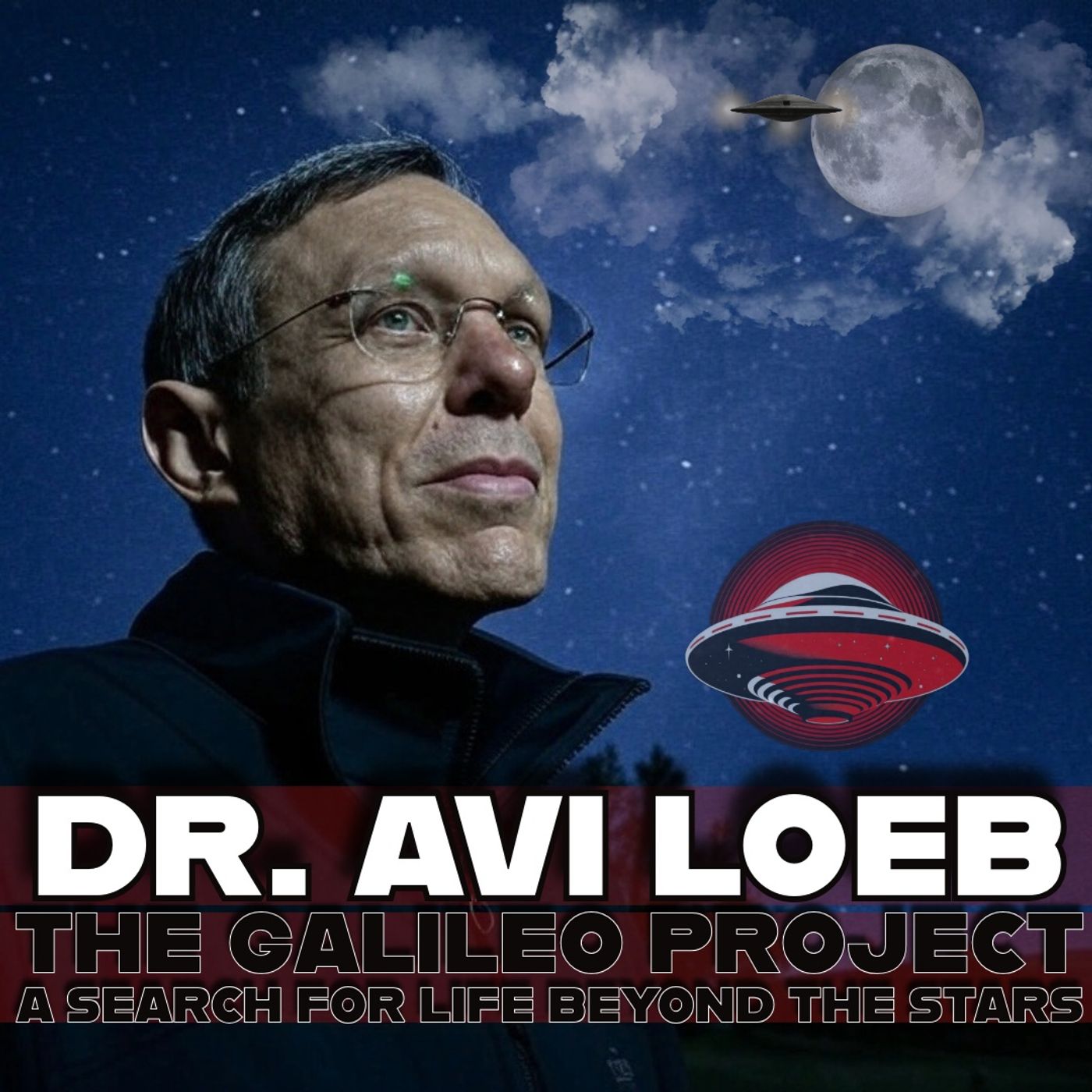
DOCTOR AVI LOEB- Hunting Alien Artifacts & Interstellar Visitors!
As the mastermind behind the Galileo Project, he’s leading the charge to hunt for extraterrestrial artifacts and redefine how we search for life beyond Earth.
In this exclusive 1-on-1 interview, we dive deep into the biggest questions in astrophysics and the search for intelligent life.
From the mysteries of ‘Oumuamua' to the possibility of alien technology hiding in plain sight, Dr. Loeb shares his bold insights, unfiltered.
Are we alone? What’s out there? And what if we’ve already been visited? Tune in for a mind-expanding conversation that challenges everything we think we know. #UFOs #UFOsighting #UFOpodcast #DrAviLoeb #AlienLife
LINK THREAD—https://allmylinks.com/total-disclosure
Subscribe to the channel on YouTube—— www.youtube.com/@totaldisclosure
PATREON MEMBER—https://www.patreon.com/Total_Disclosure?fan_landing=true&view_as=public
YOUTUBE MEMBER—-https://www.youtube.com/channel/UCy2Cra7aLAAMVxkA9rSYCxg/join
Support TY and TDP Studios directly VIA PayPal (No FEES)— https://www.paypal.me/TDPstudios767?locale.x=en_US
GET YOUR “TOTAL DISCLOSURE” UFO/ALIEN INSPIRED MERCH, OR A GIFT FOR YOUR FAMILY MEMBER, FRIEND, OR TREAT YOURSELF!—- https://pop-culture-corner-store.creator-spring.com/?
Become a supporter of this podcast: https://www.spreaker.com/podcast/total-disclosure-podcast--5975113/support.
CONTACT TDP DIRECTLY For Collaboration, Use of Segments/clips, or any other media produced by “TDP” —[email protected]
Special Thank you to all of our PODCAST/YouTube Channel Members for your continued support, and dedication to seeking the truth, together. We can’t do this WITHOUT YOU!
-COPYRIGHT-2020-
Copyright Disclaimer: Under Section 107 of the Copyright Act 1976, allowance is made for "fair use" for purposes such as criticism, commenting, news reporting, teaching, scholarship, and research. Fair use is a use permitted by copyright statute that might otherwise be infringing. Non-profit, educational or personal use tips the balance in favor of fair use. Total Disclosure Podcast Copyright 2020 and … segments, early access to interviews, and a yearly gift autographed by yours truly!thank you in advance now, Let's explore the unknown together!
Speaker 1: We just constructed an observatory at Harvard University. We are monitoring objects that fly overhead and trying to make sense with them.
Speaker 2: This collection of instruments is part of Harvard's Galileo Project.
Speaker 3: The Galileo Project is developing several sites that are spread across a geographical region, where each site has an array of sensors, optical cameras, infrared images. There's audio from infrasound to ultrasound. There's radar.
Speaker 2: It's a wide.
Speaker 3: Array of instruments to basically look at the sky all the time to see if you find any anomalism.
Speaker 1: Behind the window there is a camera and they overlapped and so they get a full picture of the entire skides all the time. So far, we have been operating this observatory for several months and we saw hundreds of thousands of objects in the sky. None of them appears to be anomalous. But even if one in a million came from outside of this Earth, that would be big moves to humanity and change our future. And that's what drives my sights.
Speaker 2: Being interstellar materiod Welcome back to Total Disclosure, the podcast that dares to unravel the universe's deepest mysteries. I'm your host, ty Roberts, and today we're tackling a question that's haunted humanity for centuries. Are we truly alone out there? Before we blast off, do me a quick favor. Hit that subscribe button on YouTube or follow us on your favorite podcast platform. Your reviews and ideas light up my day, So let me know what you think or who you'd like to see on the show net.
Speaker 2: Want in on the action. Join our exclusive membership for ad free early episodes, sometimes weeks before they drop, and help keep this cosmic journey alive. You pitch in what you can and I'll take it from there. Now, let's get to the main event. We're sitting down today with doctor Avi Lope, a fearless astrophysicist from Harvard University who's rewriting the rules of the search for life beyond Earth. He's not just a professor, he's the mastermind behind the Galileo Project, a cutting edge mission to hunt for signs of extraterrestrial technology or non human technology in our skies and beyond.
Speaker 2: With a resume boasting black holes, the dawn of the Universe, and hundreds of mind blowing papers, doctor Avilobe has grabbed the world's attention with his book Extraterrestrial, The First Sign of Intelligent Life Beyond Earth. In it, he makes a bold case we might have already glimpsed alien intelligence and it's time to stop ignoring the evidence. Today we're diving deep into his revolutionary idea, the Galileo Project's quest to scan the cosmos for UFOs and interstellar visitors, and what it all means to us and for us if the answer to are we alone turns out to be a resounding no.
Speaker 2: So strap in this is total disclosure, and you're about to embark on a one on one journey through the stars with doctor Avilobe that'll leave you questioning everything. Thank you so much, mister Avilobe. It is an honor to be in your beautiful home today, and I just really want to say, from the bottom of my heart, thank you for everything that you've done, not just for you know, the science community, but for the UFO community and bringing your caliber of scientific rigor to the community.
Speaker 1: Because you know, it's my great pleasure. I mean, I'm driven by curiosity and this is a subject that is fascinating in the public and we have to address this scientifically.
Speaker 2: Absolutely absolutely so. So today, obviously we're honored to sit down with doctor A. Vlobe, a renowned astrophysicist and professor at Harvard University. We're excited to dive into this one on one session and you'll also be speaking at Contact in the Desert come late May.
Speaker 1: That's correct, awesome.
Speaker 2: So I just want to start off doctor Lowe with an introduction and background. Your career has taken you from theoretical physics to leading the charge in search for extraterdustrial life. Can you tell us about your background and what sparked this passion for the unknown.
Speaker 1: Well, as a kid, I grew up on a farm and was mostly interested in philosophy about the fundamental questions of our existence. And then since I grew up in Israel, there is a mandatory military service, but they allowed me to pursue physics and that was a good approximation for philosophy. It was useful for the defense of the country. In fact, the President Rigan initiated at the time, which was the mid nineteen eighties, the Star Wars Initiative, and I proposed the project that was first to be funded by the US as an international project.
Speaker 1: And that brought me to Washington, DC. We were funded a few million dollars a year, and in one of my visits I went to Princeton where they offered me a five year fellowship under the condition that I'll switched to astrophysics because before that I was doing plasma physics, the physics of very hot gases. So I agreed to do that. It was an offer that I couldn't refuse, just like in The Godfather. Then after that I received an offer from Harvard University for a junior faculty position, and three years later, to my surprise, I was tenured.
Speaker 1: And at that point it became clear to me that even though it was an arranged marriage with astrophysics, it's actually a marriage to my true love because I can address fundamental questions about our existence in the universe using the scientific method, and so here I am very different than my colleagues because I tend to think about the big picture, and the most important question that we have is are we alone? I mean, we see our house that we live in, and then through the windows we see other houses very similar to our house on the cosmic street.
Speaker 1: These are sun Earth analogs, and we know that there are hundreds of billions of stars like the Sun in the Milky By galaxy, and at least a few percent of them have a planet the mass of the Earth roughly the same separation. So you know, the many houses like our own. And the question is whether they have residents, and that is the most fundamental question, because if they do, you know, there might be a smarther kid on our block that we can learn from. And I'm not surprised that most of my colleagues dismiss that possibility and argue that we are probably alone until we find evidence.
Speaker 1: You know, it would be an extraordinary claim to imagine something like us. But I think that it's much more likely that we are not alone. And you know, other civilizations existed billions of years ago, because the Sun is a late bloomer. It only formed in the last one third of cosmic history, and most of the stars formed billions of years before the Sun. And you know, I just remember how my daughters, when they were very young, they used to think that they are the center of the universe, you know, And at some point they went to the kindergarten and they were shocked to find other kids like them and even smarter.
Speaker 1: So my colors and yeah, and different abilities. So I think out of sense of humility, we should assume that there are things like us that existed, and most of them, most of the civilizations probably died by now, but we should search for them. You know, new knowledge would not fall into our lap. We should invest time, effort and money to look for them. And that's what I'm doing.
Speaker 2: So, you know, what really brought you on the map, And I don't want to say this like, you know, in a drogatory way, but for the UFO community and the related phenomena, what really brought you to the map was more and the interstellar object and what you theorized. Can you explain your what you were talking about with a more and more and the ridicule of your peers that soon came after.
Speaker 1: Yeah, So, for the first time, seven years ago there was an object discovered from outside the Solar System that astronomers recognized in a survey telescope. Before that, we've never seen a big object coming from outside the Solar system. And it was found just because it came close to Earth. And that was named because the telescope was in Hawaii and it means a scout in the Hawaiian language. It was roughly the size of a football field, about one hundred meters, and the the amount of sunlight reflected from it changed by a factor of ten as it was tumbling every eight hours, and that's a huge change in the surface area of this object projected on the sky as a result of its spin.
Speaker 1: And in fact, the most likely shape for the object was infaird to be a flat shape like a pancake. Yeah, despite what an illustrator made it look like more like a cigar, but that's not true, that's in projection. In fact, it was most likely flat, and moreover, it was pushed away from the sun by some mysterious force without showing any cometary evaporation. It wasn't a comet because we didn't see a tail of gas or dust around it that reflects sunlight. And that's the way you recognize a comet now most recently, and there is a long history of astormers trying to explain it as a natural object.
Speaker 1: I suggest that is pushed just by reflecting sunlight. And in fact, three years after a moment was discovered, there was another object that was definitely pushed by reflecting sunlight, and that happened to be a rocket booster from a nineteen sixty six launch by NASA, and it was given the name twenty twenty s O. Discovered by the same telescope in Hawaii. It was not discussed much because people realize it's actually technologically manufactured by US. And in fact, just recently, on January second, twenty five, there was a points source of light near Earth that was recognized by an amateur astronomer as a near Earth object new asteroid, and so the Minor Planet Center, the official center for documenting Near Earth objects, gave it a name.
Speaker 1: Then seventeen hours later astronomers said, wait a minute, this orbit of this new asteroid matches that of the Tesla roadster car that Elon Musk launched in twenty eighteen with a dummy payload and the Falcon Heavy It was his own car, and it's now an orbit around the Sun. And just last week I submitted a paper saying that
Speaker 1: you have to be careful when you call something a comet, because there was a paper three months ago published in the Proceedings of the National Academy of Sciences that claimed here are fourteen objects that do not show any cometary tale so, and nevertheless, they have some additional force acting on them in addition to the force of gravity. And they said, well, these are comets, but their tail is not visible, so they call them dark comets. And the acceleration that they exhibit is really small relative to the gravitational acceleration.
Speaker 1: And I looked at them, and I asked my post doc to check when each of these objects was closest to Earth, and then I went back and looked online for whether there were any spacecraft launch So one of them, for example, came closest to Earth around November nineteen sixty five, and I checked which spacecraft were launched at that time. It turns out that the Soviet Union launched a spacecraft named Venera too towards Venus. And I look at the orbital parameters, and I see that this object that was classified as a dark comet actually went straight to Venus after being close to Earth, and it matched the roughly speaking, the orbital parameters, and the acceleration in addition to the force of gravity that it exhibited was just as a result of reflecting sunlight.
Speaker 1: And so I wrote a paper just a few days ago saying that and my point is that you have to be careful not to call animals that. Suppose you want to identify all animals as zebras, and then you see an elephant. You shouldn't call an elephant a zebra without stripes, right, And for the same reason, you shouldn't call a spacecraft a dark comet. And that is the tendency of people to just for scientists to feel comfortable with objects that they cannot explain. And they were arguing that perhaps was a dark comet, and I said, you have to be careful about that, because we haven't seen a commentary tale.
Speaker 1: It's just like Hans Christian Andersen's tale about the boy that was looking and saying, the emperor has no clause. In this case, the object doesn't have a cometary tale. That's what I was saying. But they said, no, no, no, it's invisible. The Emperor has closed. You just can't see them.
Speaker 4: So it's you know, for me, the science community is you know, like, wouldn't this excite the community, wouldn't you know people rally around the idea this could be possibly something.
Speaker 2: Why are they so quick? We can't explain it, We're just going to slap the name dark on it. So dark matter, dark dark comet.
Speaker 1: You know, it's just you know, the mind of a scientist at is that it's really not anomalous because you call it a comet with an additional adjective, so it feels something that is familiar. I mean other explanations where maybe it's a hydrogen iceberg we've never seen that before, or a nythogen iceberg, or perhaps a dust bunny, all kinds of ideas that were never related to any object we saw. And we're trying to explain the normalous properties of this object. And I'm saying, okay, well, you're allowed to think whatever you want, but let's leave on the table possibility that is artificial, because you know, it behaves in ways that are different than the rocks we have seen in the Solar System.
Speaker 1: And the issue is really if you brush it under the carpet, then you are not curious enough to explore that possibility about other objects. So I just a month ago after finding this venera to spacecraft, I realized that there is a whole population of objects that are called empty trash bag objects. These are objects that are being pushed around by radiation from the sun and the light cell. Well, so the belief is that all of them are just broken pieces of satellites or in the vicinity of Earth. I mean, they're too small for us to see at a large distance, so we see them only around the Earth.
Speaker 1: And indeed, there could be objects that were just broken pieces of satellite. But one should be open minded because I found one object that was doing zigs motion and I thought, well, that's the definition of an unidentified anomalous phenomena. But so you say, nobody in the scientific community is looking into UAPs. But when they find the UAP and they call it an empty trash bag object, and do not look into it, do not try to model it. And I'm saying, you know, we should look at all anomalies because they would signify perhaps something that we've never seen before that can teach us.
Speaker 1: And not all the technological debris that we find in our vicinity were launched by the Soviet Union, or by NASA, or by anyone else on Earth. Some space trash may have originated from another star. Why should we assume that il Musk was the most accomplished space entrepreneur since the Big Bang thirteen point eight billion years ago. There could be a lot of cars just like the Tesla roadste car floating an interstellar space. And by the way, when a star like the Sun ends its life, it will end its life.
Speaker 1: The Sun will die in seven point six billionaires. It will expand and there will be a very significant wind coming out of it, and that could sweep all the technological debris that we have around Earth right now into interstellar space. Even if we don't launch it, eventually, it may end up there because the Sun will brighten before it ends.
Speaker 2: The exploding, sending everything outward.
Speaker 1: Yeah, sending its envelope outwards. So there could be a lot among the rocks, and I don't deny that there should be a lot of rocks in interstellar space. There could also be some technological objects, and they would fall into two types. One is space trash. These are pieces of broken structure, or even like Voyager, because Voyager is now losing its ability to communicate with Earth and you know it will exit the Solar System in ten thousand years and it will be just a piece of junk at that point.
Speaker 1: So you could have a lot of devices that are not operating that are billions of years old floating through space. But you could also have things that are operational and those could be close to Earth monitoring what happens here, and we should be open minded and just search the sky without any prejudice as and.
Speaker 2: I could not have said that better. So, like you know, many people are familiar with Seti's or the search for extraterrestrial life, their approach to listening for radio signals. You're the head of the Galleyo project. How does the Galileo project carve its own path in the search for intelligence and what makes it focus so groundbreaking in its approach?
Speaker 1: So SETI, for about seventy years have been searching for radio signals, and that's just like waiting for a phone call at home. Nobody may call you when you're waiting. And even if you do it for seven years, you know, the age of the universe is thirteen point eight bi millionaires. And you know, why would they specifically call you when you're listening. They may have called us a millionaires ago. We were not listening back back then, and the signal is now a million light years away. And therefore, you know, one thing that Albert Einstein said is, you know it's not smart to keep doing the same thing over and over again and expect different results no more of insanity, right yeah, And I mean we can continue to do that.
Speaker 1: There are lots of stars that we can monitor for radio signals. But another approach is to search for a tennis ball in your backyard or an object that came from a neighbor's yard. And this is something that we only started doing over the past decade when astronomers found the first interstellar object. And then after that, together with my student, we discovered a meteor, an object that was half a meter in size that collided with Earth in twenty fourteen. Uh, and then we UH decide, I decided to lead an expedition to the Pacific Ocean to search for the materials from this object, and we did retrieve from the impact site.
Speaker 1: We retrieved some tiny molten droplets that we analyzed in the laboratory of my colleague here and have a Steyn Jacobson, and we found some materials that are not represented in the Solar system that have a composition of elements, chemical composition that includes a very high abundance of beryllium, lanthanum, uranium up to a thousand times more than you find in the materials that made the Solar system. So yeah, so we don't know where this material came from, and you know it's possible that it came from some natural source, natural origin.
Speaker 1: The goal is to go again for another expedition where we can retrieve bigger pieces of the original object. That would require placing a robot on the ocean floor, which is about a mile deep at that location, so that we can pick up bigger pieces. And that expedition will cost more than the previous one, which was one and a half million dollars in cost. The new one would be probably six and a half million dollars and we are currently in the process of seeking fundam. Yeah, so that's one branch of the Galileo project.
Speaker 1: And then another branch is to look at the sky. Following the all the reports from the Director of National Intelligence that there are unidentified and normalous phenomena in the sky that military personnel report about and the word congressional hearings. There is also the Old Domain and a normal irresolution office in the Pentagon, and so we are just doing the scientific study of whether there are any unusual objects in the sky. We built one observatory at Harvard University which is collecting data and about one hundred thousand objects every month, and we published the paper that analyzed the first half a million objects that we analyzed with machine learning software.
Speaker 1: We're trying to find out if there is anything unfamiliar among these objects, something that doesn't look like a bird, a plane, Superman. Yeah, yeah, yeah, if it looks like a Superman, that would be really amazing great. But the goal is to also have multiple units of the observatory looking at the same objects, so we can figure out the distance. That's called the triangulation.
Speaker 2: An array of yeah, two or three of them.
Speaker 1: We are now in the process of building that at Harvard. But I also received funding recently for another observatory in Pennsylvania, another in Nevada, and find only one in Indiana. So it's altogether. Over the past couple of months, I received about five million dollars in funding committed. We still need to build those things, and hopefully by summer. By the end of summer twenty twenty five, we'll have two additional observatories working and they will provide us with millions of objects in the sky every year, and then we will try to assess whether any of them is unusual and not from this Earth.
Speaker 2: Can I ask you now this is maybe this is going to involve a little bit of speculation. Say the Galileo project analyze is something and you really don't know what it is. What would what would be the process that is initiated, and what do you tell the public?
Speaker 1: Right, So we will approach it the same way that any astronomic observations follow, which is to first look at the data, make sure that it's not an artifact of the instruments, make sure that we can trust the data, and then if it looks really anomalous in the sense that something is moving in the sky faster than any human made technology is, then we would write a scientific paper just on this object. That's what I tell my team that, as you know, people should not be too excited if we just write about millions of objects.
Speaker 1: If they see a paper about one object, they should be excited because then it means that we did find something, and of course the data will be public because the sky is not classified. The difference is most astronomers are looking at objects that are very far away, and they focus on a smaller part of the sky. We had to build an observatory from scratch that looks at the entire sky all the times and also does it in the infrared, optical, radio, and audio. Something like that was never built before, but now we know how to make it, so we can make multiple observatories of this time.
Speaker 2: Amazing, amazing. So when we talk about intelligence beyond Earth, it's a concept that's kind of hard to pin down. How do you define in your work and what specific clues like artificial structures or signals are you hoping to uncover.
Speaker 1: So I'm just seeking something that is not familiar. In other words, I don't want to imagine what it may be like. I would be really surprised if it has some pilots that are biological. I would expect it to if it's functional, to have artificial intelligence that operates. But I don't want to imagine because you know, when we go on a date, we can imagine what the partner might look like, but that's because they share the same DNA as we do. But when you meet something from another star, all bets are off and it could be well beyond our imagination, which is shaped by our past experience.
Speaker 1: So even science fiction writers, you know, they cannot imagine the unknown. They can just think about what they experience and try to expand that a bit, but I prefer to learn from nature. In other words, whatever nature brings to our front door, we should examine and try to figure it out. And that's why, you know, people ask me how should we respond if there is a visitor in our backyard, and my answer is that we should not appoint committees that try to envision or imagine what it might be like to meet a visitor, because the visitor would look probably very different than we imagine.
Speaker 1: So let's wait when the visitor arrives. We'll collect as much data as possible, try to figure out the intent of the visitor, what brought the visitor in, and only then respond to it. And one example that I like to mention in this context is one day my wife noticed someone standing on the street looking at our house for an hour, and she said, I'm really worried about that person because maybe it's one of your fans, and I'm not sure why that person is creepy. Yeah, yeah, So I said, no worries, I'll go and speak with that person.
Speaker 1: And I went to him and said, why are you staring at our house for an hour? And he said, well, I used to live in this house fifty years ago as a kid, and I said, oh, in that case, why don't you come with me. I'll show you the backyard and so, and then he pointed to a place where he said that, you know, fifty years ago he buried a cat named Tiger there, and I said, yeah, the name looks familiar because actually saw the name Tiger on a tombstone there, and I thought, maybe there is a tiger buried. So the lesson from this is that, you know, a visitor could have much longer history with the place that we are currently inhabiting, and we can learn much more from the visit.
Speaker 1: But in order to figure out the intent of the visitor, we really need to watch it and learn more about it and.
Speaker 2: Not make maybe snap judgments exactly right, ask ask the obing questions, find exactly a data driven approach.
Speaker 1: Well, in fact, there is a new movie that just came out Mickey seventeen, and yes, it's all about the way that humans interpret So in that case, alien life in a way that is inappropriate given that that alien life might be even smarter than humans. And you know, we will be shocked to meet artificial intelligence that superseds our own intelligence, probably within the coming years, we will have the ability to interact with such AI systems, and that would be appreparation for US meeting alien intelligence in a way, because artificial intelligence is related to chips, is enabled by chips that are made of silicon and are very different than flesh and blood.
Speaker 1: The way our brain operates, our brain uses about twenty watts of power, whereas these systems AI systems use jigawats of power, and they are clearly a very different beast than our brain. We are training them on human content, so they when they give us answers sounds familiar, but the way they think is quite different. And you know, when we try to consider them as imitators of human intelligence, it's just like trying to put lipstick on a pig. It's it will not make the pig human. And so I think it will be the first experience of US encountering alien intelligence, but the surprise will really come from another star because there they may have had, you know, billions of years or millions of years of technology.
Speaker 1: We just had one hundred years since quantum mechanics was discovered, and that's when you know the physics that we are currently using to make those silicon chips were understood, we would not be able to make artificial intelligence systems now unless we had one hundred years ago, the discovery of the the principles of quantum becas just think about how much more we will know in a millionayears from now.
Speaker 2: Right, And it's I mean exponential growth factoring in you know, just in the past one hundred you know, we went from horse and buggies. In that same one hundred years, we're landing on the moon right right.
Speaker 1: So in fact, the question is how to save humanity from a single point catastrophe. So Earth might go through a catastrophe either because of self inflicted wounds that we create as a result of climate change, or nuclear war or biological war, but also it could be a natural phenomenon like a big asteroid colliding with Earth or the Sun erupting in a way that we've never experienced, and so it's created it would make sense for us to go to space, and in fact, is advocating going to Mars, I'm not sure that's a good idea.
Speaker 1: It's just another rock, not very far away, not doesn't have an atmosphere. It's actually more dangerous to live on the surface of Mars. It would make sense to design a space habitats, some platform similar to a space station which can maneuver and go places. Okay, And that is just like Knox arc when not try to prevent catastrophe so that you know, the Great Flood was threatening many lives, so he put in an arc the forms of life that he wanted to preserve. And we can do the same with a space station platform that goes to space.
Speaker 1: And I think it would make a lot of sense to try that. But we could also send ambassadors of humanity in the form of AI systems that would keep the torch of what we care about life into the distant future because they will not be bored in very long journey journeys through interstellar space. And eventually when they reached some destinations they could serve as gardeners. They would see other locations other planets with the kind of things that we want them to recreate there. And so there are two ways for us to maintain heavity.
Speaker 1: One is to lift some people out of this Earth. Another one is to send AI stef and maybe other civilizations did that already and we could be inspired by meeting their products.
Speaker 2: Right, And you know, this is going to be going down on Avenue. But a lot of people, I'm sure you have heard of the grays, right, the little gray aliens, the archetypal alien, no, so the arc type alien, the gray guy with the big eyes and big head. Right. Oh, A lot of people have speculated that maybe there's some sort of advanced form of artificial intelligence meets biological advancement. Right, it's not alive, But it's not not alive, I think, right, And it's an ambassador from a different universe, right, and.
Speaker 1: It also represent our future, that's what you're saying.
Speaker 2: Absolutely right, because we as creatures, as biological creatures, again, we're subject to boredom. You know, we need to eat, sleep, whereas these don't, and they can travel for thousands of years, right, with the objective of getting to where they're going.
Speaker 1: Yeah, with an advance enough technology, there may be a way to extend the lifespan of humans indefinitely. In principle, just like a car, you can repair it again again, and that could happen, especially thanks to AI. Right now, now, AI could integrate itself into our brain because we would be hooked to information coming from AI systems. And so I think it's inevitable. Even if you don't put electrodes in our brain, the interaction with AI will change the human the way humans think, not necessarily for the better, because right now we have to think about solving problems or getting information that would help us.
Speaker 1: But AI could fit us with that information, and we wouldn't need to think too much at the risk of the AI using us as tools.
Speaker 2: You know that, right, right?
Speaker 1: Right?
Speaker 2: So, I mean obviously such a discovery, if it were made, could ripple through every facet in part of society. How do you envision it reshaping religion, culture, or even our sense of identity as a species.
Speaker 1: I think it would make the biggest change ever that the humanity went through. So if you think about the early humans, you know started millions of years ago, they were in Africa, and then you know, if you had to find them, you would find them in jungles, on trees and so forth, because they came from the same an ancestry as the chimpanzees, for example. And eventually, right now what you find is humans in high rises in cities. And I would argue that going from a jungle to a high rise is actually more of a leap than going from a high rise to space.
Speaker 1: So eventually, you know, I think we will make that second phase where we go from Earth to space this way. But we can in fact be inspired in terms of recognizing the potential of interstellar travel by meeting whatever aliens sent our way, and because they may represent our technological future, we can get a shortcut into viewing that future. Now, this is just in terms of science and technology. We might realize new technologies we haven't yet imagined. We might figure out something about science that we don't know right now.
Speaker 1: For example, we don't know how to unify quantum mechanics and gravity, and maybe they are using it for propulsion. We don't understand what really happened before the Big Bang, and maybe they have a theory of quantum gravity that allows them in principle to create a baby universe. Just think about it. It's just not making a cake. In order to make a cake, you need to know the ingredients that unnecessary and how to put them together and then apply heat. And once you have the recipe, the only thing you need is an oven that would allow you to create those conditions and make a cake.
Speaker 1: Now, if those aliens are able to understand the recipe for a baby universe, what happened before the Big Bang. They can in principle be regarded as playing the role of God. You know, they can apply to the job of God, because the basic requirement is you should be able to create a universe.
Speaker 2: Right.
Speaker 1: What I'm saying is that the very advanced level of science is could provide an approximation to what we associate with God in religious texts. And in fact, if you just think about Moses, you know, in the Old Testament, there was this burning bush that was never consumed, convinced Moses that miracle, that God exists, that there is a superhuman entity. And if you were to show Moses a cell phone today, he would be even more impressed than with a burning bush.
Speaker 2: Right.
Speaker 1: It just and of course this is not super human, because we are descendants of those early humans, and it's just that we have better technologies. And what I'm trying to say is that for us it might look like miracles. I mean some of the things we encounter, in fact, they represent a higher level of science and technology. And this is a way of bringing together religion and science, because perhaps all these stories and myths about superhuman entity is all about a very advanced scientist and a white lab code that created things that we regard as miracles.
Speaker 2: And you literally you said exactly what I was thinking. And you know, for me, I think the problem with scientists or science maybe the science community is with religion. They tend to throw the baby out in the bathroom right now, They separate themselves when I think there's an approach that if you come together right and there's another way forward. I don't definitely.
Speaker 1: I mean that's the other important significance of an encounter with some aliens, because you know, we are if you look at the news every day, we are focused on conflicts, often about territories or about status, and so we tend to look down and we spend two point four trillion dollars every year on military budgets, one third of that in the US. It's a huge amount of money. I calculated if you use this money for space exploration, we can send a CubeSat towards every star in the Milky Way galaxy within this century if we just use the same amount of money.
Speaker 1: But instead we are trying to either kill others or prevent others from killing us. And I don't think that the solution will come, you know, from people singing John Lennon's song imagine all the people living in peace. I think it will come through shock therapy, where we would realize that there is a better way, and that is looking up, not looking down, looking up and realizing that there is a smarter kid on our block that actually managed to achieve much more, and that will change our focus. And once we realize there is someone else, you know, on the cosmic street, there is another house that has residents, then we would feel as if we are part of the same team, you know, because we are all in the same boat, the Earth, sailing through space, and we better you know, work together rather than fight each other, right, you know.
Speaker 1: I had this sense of teamwork when I was on the ship during the expedition to the Pacific Ocean. All the members of the team were helping each other for the success of the mission, and that was a very good metaphor for how humanity should work. But instead, what you find is even within the US, you know, just one nation, you have this polarization where you have two camps clashing rather than everyone working together for the benefit for the benefit of the nation in this case, right and by the way.
Speaker 1: It wasn't that way if you look back closer to the Second World War. I mean, there was a sense of a community that everyone should contribute to, and back then there was appreciation of science as well. Because the Manhattan Project had political implications, it ended the war, and right now science is not appreciated as much. It was funded for a while because of the Manhattan Project. And one event that made me wonder whether something like that could have brought science back to the focus of society is there was an asteroid recently that had the three percent chance of colliding with Earth, and NASA mentioned it, and then they realized by better measurements of the trajectory of this object that it will not collide with Earth.
Speaker 2: Probably, I think, if I'm not mistaken, this is asteroid twenty twenty four. Y are four exactly, and so again three percent, I mean that's all was at.
Speaker 1: The peak three percent, but now it's down to a few times teno mans five, so it's really negligible. Maybe it will hit the Moon. There is still a one percent chant. But the point is I was a bit disappointed that it's not a threat. Actually, as much as it sounds paradoxical, and the reason is that if suppose the likelihood for a collision with Earth would have risen to one hundred percent, Okay, then immediately we would calculate where it may hit on Earth, and real estate value would go down in those locations, you know, all these oh yea and people would migrate away from there.
Speaker 1: So it would become a big international issue. And then scientists, you know, astronomer would have the highest status in society because they could inform us about the whereabouts of this object and about the ways of deflecting it. And young adults would be attracted to science because they can contribute to humanity, and so that would have elevated science to the forefront. And you know, there was a society where astronomers were at the highest societal status, and that was the Mayan culture and culture.
Speaker 1: And because they believe that the positions of the planets or the stars are correlated with the success, let's say of a war, and so the politicians of the day said they want to have astronomers priests that advised them when to go to war based on the location of Mars and various other stars. And so that was a period of time where they collected future amount of data on the sky and astronomers were highly regarded as I think we should go back to those to that situation. And one way to bring a stormers to a high societal status is by discovering a threat or something from the sky that affects all of all humans on Earth and it will bring people together.
Speaker 1: So of course you can think about a big rock that may hit the earth, just like you know, in the case of the dinosaurs, they were not smart enough to look up and they died. But we are smart enough to perhaps notice it in advance and do something about it. But it could also involve finding a neighbor, you know, something that is not just a rock but actually a device manufactured technological civilization.
Speaker 2: Right these are then that's really an amazing it's an amazing way to like you said, it would take the conversation rather from Americans and Russians and it would be earth right, we need to protect Earth. And you know, you know now that you say, and while you were talking, I was kind of thinking to myself, you know, that's kind of what I really love about the UFO community in itself, is because when we're talking about UFOs and potential life beyond Earth. What we're doing is we're bringing everyone on Earth to a level playing field.
Speaker 2: Like you had mentioned, right, we're all one. There's no more nationalism or racism. It's we're talking about Earth as earthlinks right.
Speaker 1: And in fact, the President rigan mentioned that in his speech in the United Nations, and I think it's often forgotten. And yes, even when we notice anomalous things in the sky, then astronomers my colleagues immediately classify them as rocks, even if it's rocks of attack that we've never seen before. And then my point is we should be open minded and in fact, we should invest resources in doing the search. So after the last elections, UH, Peter Till appeared on a podcast and he said that you should never bet against Elon Musk because he's right.
Speaker 1: And a day later I placed the public bet against Elon mask Yeah, and I posted it on medium dot com, where I post my essays every couple of days. Uh. And the idea was that Elon I argued that we have responsibility for our cosmic future. Therefore we should go to Mars because we are probably he said, alone, and I argued, no, I don't think that we are probably alone. I think it's the other way around, because there are you know, hundreds of billions of stars like the Sun, with planets like the Earth, maybe a few percent of them or more and moreover, the Sun is came late to the scene, and those civilizations may have proceeded been around billions of year before us.
Speaker 1: It takes Voyager just a billionaeires to go from the Solar System to the opposite side of the Milky Way galaxy, so they had plenty of time to reach us. And I'm willing to put one percent of my net worth against one percent of ellun masks and networth, and that would make the sum of the two four billions text to him primarily, and we will use this money to search for the next decade for any technological debris that came from another civilization near Earth. And I actually came up with a concept for a space telescope that can do that.
Speaker 1: By looking even from objects that are ten meters in size, ten times smaller than a mumua was, we could attack them if they come closer to the Sun within the orbit of Mercury. They are close enough to the lamp post for us to see. So I said, if within ten years we don't see such a technological object. I'm willing to give it on another one percent of my networth, But to get it started, we really need billions of dollars before we can claim that we don't find anything. Right. So the point is that for other scientific projects, you know, we invest funds at that level.
Speaker 1: For example, we invested ten billion dollars in the Large Hadron Collider to discover the Higgs boson. We haven't found supersymmetry. And we invested ten billion dollars in the Web Telescope to find the first stars and galaxies. That's a subject that I pioneered about thirty years ago. Amazing, And then we should invest a similar amount of money on a question that is far more exciting to the public. Right now, there plans to invest, you know, in such that are not as exciting to the public, like the nature of dark matter or other questions.
Speaker 1: And I argue that, you know, we should listen to the public and we have the tools to conduct the search. Given that over the past decade we found the first interstellar objects, that some of them look anomalous, implies that you know, we should trace all the interstellar objects near the Sun. There are right now of the order of a million objects within the orbit of the Earth around the Sun that are roughly the size of a person. You know, that a huge number, and we just cannot see them because our existing survey telescopes cannot detect the amount of light reflected from it by given their size.
Speaker 1: But if we build special purpose telescopes, we can look for them. And of course every now and then one of them collides with Earth and appears as a meteor, but that's very rare because the cross sectional area of the Earth orbits the Sun, it's very small.
Speaker 2: So right, and and I think that's one part of scientist's job is to get the public excited. So it's not it's not just enough to say we want to do this, it's you need to get the public involved. You need to get them excited. You know, we look at the early space race, right, it was a competition. We all everyone was involved and wanted us to be the first, right, right, So you know, with a more and more, I think you did that. You excited people and you people wanted to figure it out. But we only had a certain time frame.
Speaker 1: Because it was it was limited, and we didn't get as much information as needed. By the way, the thing that would make me happy is getting as much data as possible, because once we have a flood of data, there won't be a way for my colleagues to argue, oh, it's a rock of the type that we've never seen, because it wouldn't be clear if it if it is a technological gudget, it would be very different than any you career. Yeah, So all we need is very high quality data. And my hope is if we get funded to the next expedition, we might find, you know, in the wreckage of that metia, or perhaps there would be some kind of a technological object, maybe with buttons.
Speaker 1: And the question is should depress about it? But if we image the sky for long enough, we might see something unusual near Earth. Or there will be the Rubin Observatory in Chile that will start operations this year and we'll monitor the entire southern sky every four days with the camera that is unprecedented with three point two gigapixels, and so that could discover uap and it could discover or more muli like objects every few months. And so my hope is in twenty twenty five that will have exciting results coming out.
Speaker 2: Right and so pardon me if maybe this doesn't sound as scientific as maybe you would say it.
Speaker 1: But it's my.
Speaker 2: Understanding that when we look at when we go and we look at early solar systems and star systems, we expect them to be a certain way, but we're finding the opposite, that they're more right.
Speaker 1: No, so right now, first you have the techniques that we are using are selecting systems that are not necessarily the same as the Solar system. And in nineteen fifty two there was an astronomer named Ottos Truve who said, imagine having a star with a Jupiter like planet very close to it. This is called the hot Jupiter that is getting hot by the illumination from this the star. And he said, if that happens in nature, we could find such systems because this very massive planet, Jupiter like planet would tug the star back and forth, so we can see that it's moving.
Speaker 1: But also if it comes in front of the star, it will block a significant fraction of the light because Jupiter is ten times smaller in size than the Sun, so it blocks at least one percent of the light from the star. But then for about forty years people ignore that suggestion. They said, we understand why Jupiter is so far from the Sun. It formed in a region where ice water ice could form, and there is no reason to suspect that Jupiters may exist close to their host star. And then, by so time allocation committees on telescopes did not allocate observing time to look for such systems even though they were detectable, until in nineteen ninety five there was such an observation that discovered forty years.
Speaker 1: Yeah, more than forty years, and of course it received the Nobel Price for the first discovery of a planet closed to a Sun like star. But I looked at their paper from nineteen ninety five and there was no reference to the paper by autos true in that paper. So what does it tell you about the way science is done? That Very often scientists do have a set of priors. They assume something about what they might discover, and they are not taking any risks. Why waste time and look for how jupiters when we don't think that they exist.
Speaker 1: I mean you you might argue, okay, well, put ten percent of your observing time and search for this. I mean you wouldn't lose too much. No, But it was zero four years later, and then once it's found, then whoever proposed this method is forgotten. You know. So science is not very efficient because there is a lot of resistance to taking risks. And the whole idea of tenure in academy I was invented to allow people with job security so they can come up with new ideas and go against the mainstream. But it's not being practiced because people just want to amplify their status by getting honors awards and also getting money for their students and post docs by committees which are dominated by people who don't take risks that are thinking alike.
Speaker 1: And so as a result of that, you don't see much innovation as much as you might want to have. And there is often a lot of resistance to anyone that deviates from the beaten path. So if there was an object that is anomalous, like and I try to say, let's open the possibilities because right now we don't understand it as a rock that we have seen before, then people resist and invent rocks that we have never seen before as the doctrine or dark comments just not to discuss the other possibility. And I say, let's collect as much data as possible before we converge on anything.
Speaker 1: But in order to be curious, in order to seek the data, you have to allow yourself to find something new. If you don't allow yourself to find something new, you will be in the same situation as when Ottos Truvez suggested looking for Jupiters. Nobody would believe you, and then for four years nothing will happen. Now there might be a miracle four years later and someone would just try it and then find it. So things like that can happen, but the time delay is so significant that you know it would be more than a generation before we know the answer.
Speaker 2: Right now. Now, I think if we you know, if we had found that planet when proposed, yes, right, how far along.
Speaker 1: We be exactly exactly? And think about Galileo. He was putt in house arrests for really yeah, looking at the four moons of Jupiter. And by the way, a few weeks ago I received a donation from the most accomplished sculptor in the US called Greg Wyatt. He created sculptures that are that are in New York City, Washington in Arlington Cemetery, he created one of Galileo looking at the four moons of Jupiter and gave it to me as in recognition of the Galileo project. So it's now in my office. And he also made watercolors that he's sending my way that I will put there.
Speaker 1: And then, you know, so Galileo suggested the fact that you have moons around Jupiter imply that we are not at the center of the universe that are not circling us Jupiter, and he was put in house arrest because he wouldn't comply with the doctrine at the time that the Vatican publicized. Then in nineteen ninety two, the Vatican admitted that Galileo was right. And that was two decades after humans landed on the Moon. I mean, so eventually they admitted that they were wrong, but that was like three hundred and fifty years after Galileo was died.
Speaker 1: Yeah, And so the point is that the process is very inefficient because people just don't want to deviate from their belief system. And the best way not to deviate from a belief system is not to take new data, not to seek new knowledge. Basically, if you say I don't want to look for hot jupiters, you will never find them. And then the fact that they don't exist would be supported by the fact that you don't have any any data on such an object. And then you can argue that it's even an extraordinary claim to say that there are hog jupiters, and it requires extraordinary evidence.
Speaker 1: But if you don't seek it, you will never find it exactly. So that's a circular argument that is often made in the context of looking for technological debris or objects near Earth from another civilization. It's not an extraordinary claim to think that there are things like us near other stars. That's not extraordinary at all. In fact, to me, it sounds like common sense, like the most ordinary thing to think about, right, And ordinary claims require ordinary evidence. You just need to invest the time to look evidence.
Speaker 2: Right. So, with that being said, looking ahead, what is on the horizon for the Galileo Project, What breakthroughs or milestones do you hope to see in the next few years that could bring us closer to these answers.
Speaker 1: We just need as much data as possible about the objects that surround the Earth or within the Earth's orbit around the Sun. And so the Galileo Project observatory is there will be three of them operating by the end of summer twenty twenty five, and hopefully within a year we will have a million, you know, millions of objects that we monitor, and perhaps one out of a million will be extraterrestrial. And the point is the US government is focused on national defense, and obviously they are happy if they identify maybe ninety seven percent of the objects, but that's not good enough for a scientific search, because even if one in a million is from outside the Earth, that would be huge news.
Speaker 2: The implications all like I said, all it takes is one exact implications are tremendous, exactly.
Speaker 1: And then moreover, you know, it's my day job to find objects from outside the solar system, it's not the government's job. And then if they are puzzled by something they cannot understand, they would prefer to keep it under wraps because suppose it's made by an adversarial nation. They don't want to show the weakness of their intelligence, and so they would prefer nobody to know about it. You know, they would prefer not to release it to the public or to scientists.
Speaker 2: But then you know, there's hinders that hinders science, and just I.
Speaker 1: Think it does, because I think that any information about the universe at large, especially our cosmic neighborhood, whether we have neighbors or not, that should never be hidden from the public's eyes. I mean, everyone should know about it. It may be shocking, but at the same time, you know, it's just like suppose you live with your family at home and you don't know whether you have neighbors, but then you go out one evening and you find a tennis ball that was thrown by a neighbor. Then you have the dilemma of whether to bring it up during dinner with your family members.
Speaker 1: And you might think that it's better for the family member to sleep well and be at peace not to know about it. But my advice is to let them know about it, because one day the neighbor may show up in your front door or backyard, or may affect your life in a way that is significant and your family needs to know about it.
Speaker 2: Might I say that you are very good at painting a picture like using real world examples, This is just off key, but you're very good.
Speaker 1: At that well, because I explain only things that I fully understand, and I don't think very differently than a common person. You know, I don't I ended up as a scientist, by chance, by coincidence, as a result of circumstances. But the way I think is trying to use common sense. But what surprises me is not that it is the fact that some scientists regard it as controversial, which to me implies that common sense is controversial sometimes in academia, which is really demonstration what a notion.
Speaker 2: And you know, for those of us who are inspired by this quest, not just maybe the search for life, but what you're doing specifically, how can the public join in and what role could everyday people play in supporting the Galileo's project mission?
Speaker 1: Right, So, one thing I hope to do is one of the observatories will provide data that can be viewed by the public in real time, so that we could get reports if our machine learning artificial intelligence software is unable to recognize something quickly, but the public notices something, we can look into that and whoever identifies that kind of a thing would be recognized in the paper that we write about it if it ends up being an interesting object. So that will hopefully happen with one of the observatories that we will build.
Speaker 1: There is another one that is planned for a STEM education center that will be built in the future, and I hope they're to train students and young people to be excited about science discovering something new. In terms of public helping the mission of the Galag project, I think funding is really essential. So for example, in order for us to use a robot and go to the expedition to the Pacific again to find bigger pieces of the original metea or from interstellar space, we really need the six and a half million dollars.
Speaker 1: And if there is a way for the public to provide that, we will fulfill our mission and report back whatever we find. If a single donor gives us that that the donor is most welcome to be on the ship and see what we find. I mean to be part of the of the team. This is one example of making something really happen. And I hope we also have another meteor that we identified from interstellar space and that could be the next expedition after that one.
Speaker 2: Right and.
Speaker 1: As far as the Guarilleo observatories are concerned, you know, we are able to build observatories if we have proper funding for that, So that's another opportunity for helping us. Right And as of now, we are mostly missing scientists that can be engaged in the data analysis, and for me to hire people, I need to have the funding
Speaker 1: to do so. And for the hardware. We received enough funding to build these three additional observatories to the one we have, but we still need people that will be able to analyze the data. For that, I really need the financial donations in addition to what we have right now.
Speaker 2: Absolutely so, I want to end with a bit of a wonder. So, if you had the chance to ask an extra chest of civilization, one question, what would it be?
Speaker 1: What happened before the Big Bang? And the reason is, first, it represents our cosmic roots if we want to understand it. You know, it's the first chapter of Genesis in the Old Testament in God. But obviously there would be a different version there because they probably, I mean, if they are very advanced, they would know the details. You know. And by the way, you know, the breaking news is that the universe was not created in six days. It took thirteen point eight billion years, and God did not rest after the six days, because we would find evidence if God rested, we would see a pattern, a special pattern in the cosmic microwave background brightness fluctuations.
Speaker 1: We don't see that. You know, six days after the Big Bank there was nothing unusual according to the data that we have as of now. So clearly you know, the story that was written thousands of years ago or was delivered thousands of years ago, it's not accurate in the details, but it had one insight, which is everything started at one point in time, the Big Bang, which is what the modern scientific version says. But the aliens may know much more about it, and I would like to understand because it will also suggest how to unify quantum mechanics in gravity, and that's something we don't have have and perhaps if we had that knowledge, we could have designed new ways of moving from different one point to another.
Speaker 1: For example, people talk about wormholes, or about red drives or anti gravity propulsion. All of these concepts require new physics beyond the current understanding of gravity and quantum mechanics. We need something that unifies them in a way that perhaps can be engineered. And then if they tell me what happened before the Big Bang, I could reconstruct the theory of gravity that may do that.
Speaker 2: Right. Wow, thank you, and I really do want to say thank you for setting down with me today contact in the desert. What are your plans for what you'll be presenting.
Speaker 1: I will discuss the latest findings of the Gerilla Project and the plans that we have for the coming year, making twenty twenty five very exciting year.
Speaker 2: Right from everything that you've said, sounds like twenty twenty five is going to to really be let's say, you're the gallet or project and things coming together. So I just want to say thank you again for doing this, and it was truly a pleasure to sit with you today. You know, as a boy, did you ever think that you'd be doing this?
Speaker 1: No, because but in a way, I haven't changed in the way I look at the world. You know, as a kid, I was full of wonder, I was curious. I wasn't afraid to ask questions, and I remained the same way. I refuse to surrender. What I often say to young adults is never pretend to be the adults in the room. Maintain your childhood curiosity, Because at the dinner table when I was a kid, I remember asking a question and then the adults in the room would dismiss it or say something that didn't make sense. I thought that by becoming a scientist.
Speaker 1: I could answer the question myself, and that applies also to the UAP subject. Rather than listening to all the noise that you hear around, let's just figure.
Speaker 2: It though, right. That's a wonderful great note to end on. Thank you, doctor Low for your time today, and I really can't wait to see what you have in store for contact in the desert. I'll be there. I'm probably gonna interview you right off the off the stage. I think that's what they have me set up doing. So here's to the next tide.
 Apple Podcasts
 Castbox
 Castro
 Goodpods
 Moon FM
 Overcast
 Pocket Casts
 Podbean
 Podcast Addict
 Podcast Republic
 Spotify