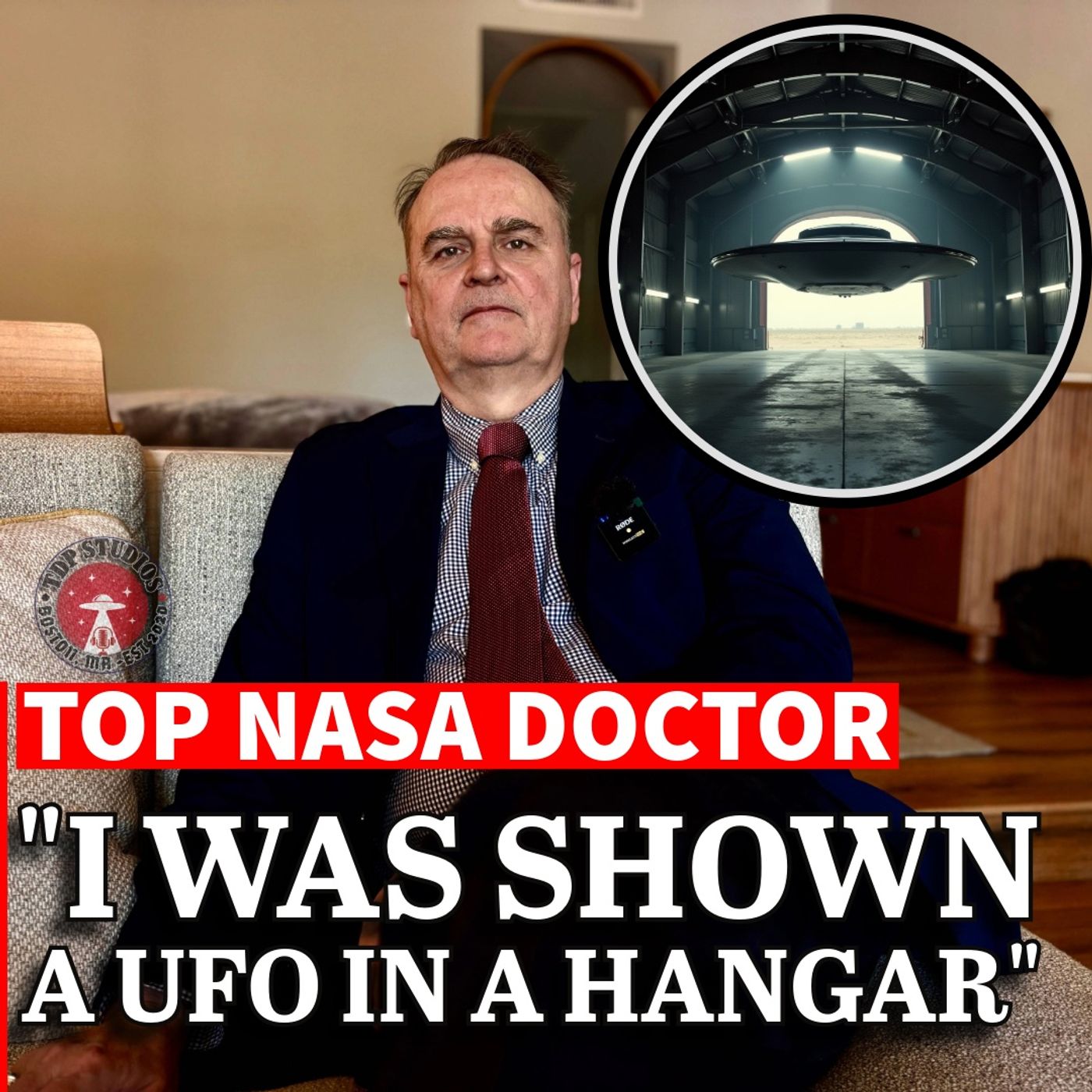
Former NASA Chief Reveals UFO Sighting | Exclusive Interview with Dr. Gregory Rogers
🚨 Don’t forget to Like, Share, and Subscribe for more deep dives into UFOs, cover-ups, and disclosure.
🎧 Listening on Apple Podcasts or Spotify? Please leave a review and Follow the show — it helps us reach more truth-seekers like you.
👉 More exclusive content & updates: CLICK HERE
#UFO #NASA #Disclosure #UAP #DrGregoryRogers #TotalDisclosure #ContactInTheDesert #Podcast #TDPStudios
LINK THREAD—https://allmylinks.com/total-disclosure
Support TY and TDP Studios directly VIA PayPal (No FEES)— https://www.paypal.me/TDPstudios767?locale.x=en_US
YOUTUBE MEMBER—-https://www.youtube.com/channel/UCy2Cra7aLAAMVxkA9rSYCxg/join
PATREON MEMBER—https://www.patreon.com/Total_Disclosure?fan_landing=true&view_as=public
EDITED BY KARI LINDSAY-FOLLOW KARI ON X (FORMERLY TWITTER)
Become a supporter of this podcast: https://www.spreaker.com/podcast/total-disclosure-podcast--5975113/support.
CONTACT TDP DIRECTLY For Collaboration, Use of Segments/clips, or any other media produced by “TDP” —[email protected]
Special Thank you to all of our PODCAST/YouTube Channel Members for your continued support, and dedication to seeking the truth, together. We can’t do this WITHOUT YOU!
-COPYRIGHT-2020-
Copyright Disclaimer: Under Section 107 of the Copyright Act 1976, allowance is made for "fair use" for purposes such as criticism, commenting, news reporting, teaching, scholarship, and research. Fair use is a use permitted by copyright statute that might otherwise be infringing. Non-profit, educational or personal use tips the balance in favor of fair use. Total Disclosure Podcast Copyright 2020 and … segments, early access to interviews, and a yearly gift autographed by yours truly!thank you in advance now, Let's explore the unknown together!
Speaker 1: Hey everyone, ty Roberts here with Total Disclosure, brought to you by TDP Studios here in lovely Boston. Today we've got something truly special, an exclusive one on one conversation that I had at contact in the desert with none other than NASA's doctor Gregory Rogers. Now, doctor Rogers isn't just anybody. He's the former NAST Chief of Medicine, a chief flight surgeon, and he's flown with some of the greatest pilots in history from our space program. But what makes this story stand out is the day he was shown something that he wasn't supposed to see on a CCTV monitor that changed everything for him.
Speaker 1: Yes, a UFO, this case is now becoming more widely known, and I was fortunate enough to be a part of his initial decision to come forward, and I am so grateful for that. Today you get to hear the story directly from him in person. He has now been featured on Jesse Michael's Channel story.
Speaker 2: On the fourth May, Josh Boswell came out with an interview from the UK Daily Mail, and then ty Roberts came up with one for both the International UFO Bureau and also.
Speaker 3: For Total disclosure. It's part of both of those, you know. I need to say that I am on the board for the buck.
Speaker 2: Yeah, Greg, International UFO Bureau, I'm from Oklahoma.
Speaker 1: I guess what.
Speaker 3: It's head quartered in a plumb of city. Yeah, so that comes out here. And Andrew, were you in the UFOs before the sighting at all?
Speaker 1: Coast to Coast and a plethora of other large platforms. I'm so glad that I'm able to call him not just a colleague, but a friend and part of the family. Judy, that means you as well. We have so much more in the works with doctor Rogers on this channel, but today's episode is an insight into who doctor Rogers is and what makes him a credible witness in the first place, what makes his story so important. I do also want to address something in this episode. I do mention the International UFO Bureau and how I was at the time the chief marketing officer.
Speaker 1: This is no longer a true statement. I have my but I have left the organization and truly I wish the best for them in the future, especially in UFO reporting and UFO investigation efforts. It has the chance to be something special as long as they work with the right people. Apart from that, this episode was edited by Carie Lindsey. Their links are in the description of this video, as well as all other relevant links. Before we dive in, make sure you smash that leg button, subscribe to the channel, and hit that bell icon so you don't miss what's coming next.
Speaker 1: And if you're listening on one of the amazing podcast platforms like Apple Podcasts or Spotify, please leave a review and hit follow. It really helps us bring these stories to even more people and a large broader audience. All right, guys, let's get into it. This is NASA whistleblower doctor Gregory Rogers. You're not going to forget this one. Let's go. I'll see you on the other side. Hello everyone, we are here at Contact to the Desert twenty twenty five event Horizon and I am representing not only Till the Disclosure the International UFO Bureau as a chief marketing officer.
Speaker 1: We did an episode recently with a whistleblower who has come forward after retiring from the well, from NASA, from the DoD, from government in general. Doctor Gregory Rodgers. Thank you so much for coming out to Contact and being a part of this community.
Speaker 3: Now I've enjoyed it.
Speaker 1: How has it been How has the reception ben since your story has come out?
Speaker 3: As far as the people here, I've received very worth worthwhile representation of the thanks that people have because you know, in the United States, we know what is real. We've known what is real for decades, but we still have the government saying, no, you're not smart enough. We're smarter than you, and we're telling you this isn't real. But when the people are hungry to hear what's going on and someone says, okay, look, I'll tell you what's going on, it's been very well received.
Speaker 1: And do you think that, given the way that your story has been received that do you would you would you say that the world is ready because now, now if the government is saying, if the government in the midlitory are saying, there's nothing to see here, but we know that there is, that means what we're dealing with is something that is paradigm shifting. Do you believe the world is ready for that paradigm shift?
Speaker 3: Yes, I think we've actually been ready for a while. You know, look at the government. How many years did they say there's nothing a tone upon Nevada there's no area fifty one, there's nothing to see here, and so for decades they'd lied to us, even when you can go on Google Earth and see an Air Force. So this is the kind of mentality that we're dealing with inside the government. You know, I hate to give credit to the Navy, but the Navy has been much more forthcoming. The faighteen videos were a big part part of why I decided to speak up, especially as the evidence was presented before Congress.
Speaker 3: For the United States Air Force, it's a whole other story. The Air Force is still pretty much not releasing any information whatsoever. So having been in the Air Force, I'm just a little disappointed that the Air Force has chosen to be so reluctant to admit what people know.
Speaker 1: And I have to ask myself. We know that the Air Force, even their intelligence, they think they're above they Maybe they are, maybe they are the best in the business. Maybe they are, you know, above the CIA, above the FBI, above you know, n say, and maybe they are the best of the best, But they seem to operate under their own guidelines and they do not conform to you know, what Congress is asking or you know, or demanding in a way is we want all the evidence. You have all of it. And the air Force, like you said, has been notoriously quiet, very quiet.
Speaker 1: Where the Navy has been, you know, pretty vocal. Even Border Patrol is putting videos out there and saying, guys, we don't know what this is.
Speaker 3: A department of onland security department.
Speaker 1: And so that it makes me wonder. You know, the quietest person often has the most to say. What I want to go back for people who didn't watch the episode of the Daily Mail or read that article, or watch the episode that we did. I want to walk through what you saw because or what brought you to be a whistleblower, what what that event was, And then I want to dig into why this is a full circle moment because it is included it's the air Force.
Speaker 3: Yes, well, actually we have to go back to the Navy. Commander Fravor was a highly respected commander of an eighteen squadron and I have nothing but the greatest praise for what he has done. His aircraft and similar aircraft in other settings have all seen and shown heads up display video of what we know are not our aircraft or spacecraft. According to what you want to call it. So I was very impressed with that. In November of twenty three, I was going to I was already planning the lecture I was going to give to the Navy Professional Development Symposium in April of twenty four because I'd done that like seven or eight years in a row.
Speaker 3: And so
Speaker 3: I contacted had the commander of the Professional Development Symposium and I said, since the Navy has released information and it is public knowledge, it's declassified. In my lecture, I would like to discuss UAPs and how they relate to the Department Defense and the personnel within the Department of Defense. So after several emails, he gave me authorization to do it as long as it was professional. So once I had the presentation completed, I sent my so I presentation back to the PDS personnel and they approved it.
Speaker 1: So, now, what is the difference between what you did and say what Grush and others have done with DOOD pre Publication office difference.
Speaker 3: There's a huge difference. I'm an expert that has lectured on things like introduction to explosives for medical peoples. So I went through what are shaped charges? What what you know? Tn T is trinitro taluine what's the difference between T and T and tritonol. Well, you put a luminum powder in it. As the aluminum burns at a higher temperature, increases what's known as the brazonce or the breaking ability of the detonation warhead. So I gave lectures on all of that stuff. I've given lectures to the PDS about one called entomology one O one.
Speaker 3: So I was teaching the medical people throughout the Department of Defense. And you know this was observed live, so and then also it was taped and people could watch it later. So people who were stationed in Okinawa or anywhere they watch anywhere in the world. They were in there, and you know, I would have a lot of the lectures didn't do so well, and they'd have like twenty people watching it, but I would always have like at least one hundred and fifty watching mine. And then a couple of the videos that I made were felt to be of such high quality the Navy contacted me and said, would you release all claim to this because we want to use it in training our personnel.
Speaker 3: So this is the quality of work I had produced for several years. So when I was planning my lecture in twenty twenty four. I wanted to speak about UAPs, so I got authorization to do it, and then just to make sure, I sent the slide deck to the public affairs officer at Fort Seu in Oklahoma and also the Mcowister Army Ammunition Plant, and so I have written authorization from both of them that this lecture is suitable. I actually gave an official lecture to the Department of Defense with authorization by the Department of Defense, to talk about the effect of UAPs and to give guidelines on how medical people should interview people who had witnessed UAPs, and so that was my lecture, and so the last fifteen or twenty minutes was all about UAPs and how we need to treat people who have seen UAPs, which would include our pilots, our personnel.
Speaker 3: So I gave an authorized lecture to the Department of Defense about UAPs.
Speaker 1: So do you now if they're using this for training? I mean, we have to assume that they want these The quality of your work, it speaks for itself and who you are as you know, as the former chief of Aerospace Medicine, surgeon and nature and ability and now you're talking about, you know, what, how to approach as a medical professional, a pilot or someone in the service who has either come in contact seen a UFO. So how to approach that is basic essentially.
Speaker 3: Yes. In fact, the first part of the lecture was
Speaker 3: keys to observation. For instance, if we have someone who is observing an event, what are the kinds of visual effects that can cause them to get confused about what they're seeing. So most of the lecture was about all this kind of stuff. I didn't include lecture for the military dealing with drones and how they operate, but of course I can't discuss that of course. And then in fact, this year's have you ever heard of COSPAS or SARSAT?
Speaker 1: Is that the latter?
Speaker 3: Yeah, okay, well, the SARSAT is the American version of COSPAS is the Russian version which started first. But in the meantime, France, England, I believe, Japan, and China have all gotten together with this. We started with lower th orbit satellites and so as a satellite passed over, it could see a beacon, and so at first they were using different kinds of frequencies, and so we've now gone to four hundred and five megaherts and as the satellite goes by it is it will be looking for four or five megaherts as the beacon as the beacon.
Speaker 3: But the problem is that lower th orbit satellites can see real clearly where somebody's at, but only at the timeframe that it's over. So when there were only a few satellites, they might have to pass six times before they would finally see the location. So what they did was they started hooking up the four h six megahart attenuators to the geostationary satellites. But the thing is, geostationary satellites can see half of the world at the time, but they didn't have the detail to say, okay, they're located right here.
Speaker 3: So what we've done now is gone to the mem R satellites, the medium orbit or satellites, and so we've already got a bunch of them up. There's going to be thirty four of them. And because they have continuous surveillance of the world. If you're in a boat that sinks in the middle of the Atlantic Ocean, if you're climbing a mountain in the deserts of Utah, you know, if somebody disappeared it was hard to find him. It's always has been. So I've done a number of search and rescue missions where we had to spend a lot of efforts to try to find the people.
Speaker 3: Well, if you if you have one of these transmitters, you have to register it and you give your name, your address, your telephone number. You also give contact personnel and their telephone numbers. Now, then say the boat sinks, you initiate the four or five megahartz beacon and within two seconds you're going to be spotted to within ten meters. Within thirty minutes, you'll be spotted to within two meters. Now then they it will also say, okay, this beacon belongs to Greg Rogers. Here's his address, and here's the telephone numbers that we need to call to notice by his emergency contacts.
Speaker 3: And we are also transmitting this by satellite to the mission control centers all over the Earth, and so whichever one is closest will immediately send out a rescue team to that location.
Speaker 1: It's a it's like a global commercial security system.
Speaker 3: Yes, and so so now you know I'm old enough that I've done lots of search and rescue missions, and so somebody's down and you go into this large pattern that takes you an hour and a half for two hours to complete the pattern, and if they're not in there, you have to go to another sector and do it all over again. So that was the search part of the search and rescue, and the search was always the most.
Speaker 1: Difficult, difficult.
Speaker 3: Yeah, well, now you hit the four or five megaherts and we know where you're at, so we don't have to search right now. It's just rescue, right. So this is tech. This is the technology that I just lectured on in April of this year, and that.
Speaker 1: Cuts a lot of money out of spending on search because search, again is the hardest part. So you've done and you know, I'm glad you told that story because it's just a credit to who you are and what you've done for our country that people would never even expect. You know, you are the nations, uh you know you you are the protector of the men and women and people that left earth to be our national Euros and and all the things. And you're doing all this post having seen what you saw in ninety two. So I want to I want to shift the focus because you're giving these lectures on U APS, you're getting a lot of eyes on it.
Speaker 3: Let's go back one thing. I even got a letter recommendation from the commander who's said that he had a positive result from it and he enjoyed the lecture.
Speaker 1: Wow wow's And.
Speaker 3: The lecture was about u APS, so officially presented to the Department of Defense.
Speaker 1: And it's really odd. I really want to we could talk about ARROW in a few minutes, because clearly the d ID has more information and more detailed information the ARROW is willing to say out there, and I do want to talk about that. But after so, let's go back to ninety two. Can we recap what happens to you on that day.
Speaker 3: It was supposed to be just a regular ordinary day. So about once a month I would go up to keep Canaveral from Patrick Air Force Base, where my flight medicine clinic was, and so I would be responsible for contacting the contractors, which was E. G and G. So they were the contractor that ran the operations. Now then like lockeed Martin they're building rockets, Boeing they're building rocket parts, but also satellites, and so there's all these companies doing all of these things. But someone from the Air Force has to oversee what they're doing.
Speaker 3: So I had a contact with the doctor at E G and G, and so I told him I'm coming out. He was busy, so they had another guy I didn't know take me out, and so I think we went to three buildings that day, and so the third building was the one where this happened. I'd gone into this clean room to see the processing they were doing, and as I was coming out, I had on booties that were non an electrostatic, and you didn't want to carry debris in. So I had a a little hat on, sort of like a surgical cap, right, and I had had a mask on, and so when we came out, you take all this off and dump it, and then I was going to go back to work.
Speaker 3: So the guy that was escorting me we finished inside there, because he did it all the time, he just swipped it off and he was gone. So I took a little bit longer, so maybe one minute difference. But as I walk out through these double doors, there's this guy standing there, and it turned out he was a fellow major. I was a major at the time, and he was an Air Force officer. Now, I did flight physicals and gave medical care for about eighteen hundred people at that time. So there's no way I can remember every one of the eighteen hundred people, especially if i'd done his flight physical, you know, a year ago.
Speaker 3: Right.
Speaker 1: It's easier for your eighteen hundred people to remember you than for you to remember all eighteen hundred people.
Speaker 3: Especially considering the fact that for a lot of them I held their careers in their hands.
Speaker 1: Right, that's a dynamic.
Speaker 3: Just as an example, we had this one kernel and he was on flight status, but he was mainly flying a desk at this point, but he still had to adhere to all of the rules and regulations for flight status. Well, I got a medical record back from a doctor in Melbourne about a treatment he had put my patient on, and it turned out the colonel had not wanted that doctor to communicate with us at all because he had a medical condition which was disqualifying from flight, so he was not going to admit to us what was going on.
Speaker 3: But as soon as I saw that medical record, I called him in my office. Even though I'm a major, he's a colonel. I had him standing and attention, and I read him the Riot Act and I told you he needed to provide me all the medical records that he had been hiding, and if he didn't do it within ten days, I was turning U into his chain of command and they would be taking administrative action against him.
Speaker 1: And I want to preface this, and again we'll go full circle with this. You are willing to make that hard call I did. You've had You've had to.
Speaker 3: He was forced into an early retirement in lieu of court martial.
Speaker 1: So let's go back. That's a That was a great example because that that it shows that you're you will, you do the right thing, You follow protocol. So when this day happens, you're taking your you're taking your booties and head gear off.
Speaker 3: Yeah. So I'm walking down there. But let me say this real quick. I once had an argument with the four star general and I won because I was right and he was wrong and the people advising him were wrong and they were giving him bad advice and I was the only person that was telling him the truth. Anyway, going beyond that, as I walked out, there was this guy. He seemed to me to be sort of insecure, and he said, hey, Doc, I want to show you something that you've never seen before, so.
Speaker 1: You thought he was insecure.
Speaker 3: Yeah, I think he felt insecure, and looking back on it now, I think he was trying to build himself up by showing me how important he was. Well, the only thing is I didn't know what he was doing. So he said, I need to show you something. So I stepped into the office. There there were windows and then a door, and so he shut the door, locked it, and then he closed the little louver mini blinds on the door and then also on the curtains.
Speaker 1: So was this common to do?
Speaker 3: Not as far as I was concerned, I thought, what what is going on here? What's the guy up to? And like I said, I already had some concerns about him being because of the way he was behaving. Uh, And I said, uh, you know, what are you doing? He said, I got to show you something. This is going to knock your stocks off. So he sat down at the computer station and did whatever he needed to do to bring up this video. Because I don't know if it was a file, whether he was cooking into another location or or what.
Speaker 3: But all of a sudden that the screen came up, and so he moved to the chair right next to it, to the left and had me sit down in his chair. So I'm looking at this video screen, and it looks like a typical hanger.
Speaker 1: Uh, an air force hanger.
Speaker 3: Yeah, it could have been an air Force hangar, could have been a marine hanger, Navy hanger. Yeah, it was absolutely typical. But what was in the hangar was not typical. Because I'm sitting there and I look at it and it's a flying saucer.
Speaker 1: Is that the best way you could describe it.
Speaker 3: Yeah, that's what it was. You know, I know spacecraft, I.
Speaker 1: This was it.
Speaker 3: I had a lot of training from the Air Force and NASA. You know, I know what spacecraft looked like. I know what artig's looked like, radio isotope, thermal electric generators. I knew about the inertial upper stages that we would launch higher altitude or geosynchronous satellites out of this space Shuttle, and this was nothing like that. It was a flying saucer. I mean there's no interpretation needed. You know, like if you said, I see a GMC pickup, Well, how do you know it's a GMC pickup, Well, it says GMC and it's a pickup.
Speaker 3: Yes, So I look at this, it's a flying saucer. So you know, that really surprised me. So I made a comment to him about, you know, why on Earth would we design something like this, and you know, he didn't really give an answer that I recall anyway, And then I said, well where did we get it? And he did this, He said, we got it from them, from them, from them, So that obviously meant outer space, so it had to it had to be a vehicle not made by human intelligence or the design. The design was now that we designed this one based on something else, is what I believe.
Speaker 1: So he's saying that we either got it from the gods or we got it from a non human intelligence.
Speaker 3: Yes, well God would be a non human intelligence, so we know for sure it was a non human intelligence.
Speaker 1: Right.
Speaker 3: This was not anything that I was familiar with in the way, shape or form, and I knew the aircraft.
Speaker 1: So was it was it held up by a crane?
Speaker 3: No, it was actually just sitting on this floor. It looked like it was a concrete floor with some sort of protective surface on it and it's just sitting there. So over to the left there were two guys that were in lab coats, so I assumed they were engineers. There were three guys over on the right side, and they were walking around, you know, enclosed in tibek suits is what I would call it today.
Speaker 4: So I clean room potentially, yes, Well, these technicians were obviously working with something that you don't want dust, you don't want their.
Speaker 3: Hair falling out, you don't want parts of your clothing, the threads from your clothing getting on it, any kind of thing like that. Well, just very shortly after it started, there was a warning sound that came up, and so the two engineers went this way, the technicians went that way, and then it's just sitting there.
Speaker 1: So the video had audio, Yeah, it had audio. So this wasn't just closed caption like oh, court security.
Speaker 3: For what I would say was I was primarily flying with the forty first Air Rescue Squadron at that time, and we had h three helicopters. If you hooked up a camera pointing at one of our helicopters in our hangar and you had a clear closed circuit view of that helicopter, that's exactly what I was seeing, except that it wasn't a helicopter. It was a flying saucer. And now then several minutes after everybody disappeared, it started giving off these sounds and uh what I took as signatures of electromagnetic discharge discharges.
Speaker 3: But you know, I want to be careful. I don't want to say anything about what it was or how it specifically acted because I don't know. But what that craft, or more advanced craft still using the same technology would be within the Air Force inventory, So I I do not want to disclose anything that in any way could give any of our adversaries a leg up on what we know and what we can do.
Speaker 1: So when we have you seen the gimbal video? Yes, do you think that that could have been Do you think the capabilities of the gimbal craft, how it rotated and stuff, do you think that that could be similar to this craft?
Speaker 3: It would be very similar in activity, but in appearance it would have been more like the tic.
Speaker 1: TAC Okay, okay, yeah, especially given.
Speaker 3: It was completely white. There were no seams, no rivets, no evidence of windows or doors in anything of that sort. There was a mass that was sticking out of a shallow dome that was at the top, and then it had several umbilicals that went off screen. And if there had been nothing else there, it would have been pure white looking sort of like if you modified an egg, it would look like that. Now, then the thing is there was painting on it. There was horizontal rectangles located from the twelve thirty to two thirty location the three thirty to five thirty location.
Speaker 3: I didn't see it at first, but when it rotated, I saw that there was also a rectangle at the six thirty to eight thirty position and at the nine thirty to eleven thirty position, So there were four equally placed around the beam of the craft. What is that indicative of, Well, whenever you're doing testing the aircraft, you want to follow every motion, especially if something is pure white. If it starts to do something, you can't really see what it's doing. But you put a rectangle vertically at three o'clock, six o'clock and twelve o'clock.
Speaker 3: As soon as the vehicle starts to rotate, you're going to you're going to be able to track the motion by the movement of the rectangles, right. So, so that's what what you do when when you're testing the circle.
Speaker 1: So all of this being said, all the circumstance is similar to or indicative of a test craft. It's just a craft itself that did not resemble anything that we have in our public inventory.
Speaker 3: That that's correct. As soon as I saw it and saw the way it was marked, I was thinking, okay, uh, somebody's built a test fling saucer and here were built it. Well, my guess would be that it would have been one or more contractors. Know, if you think about how the Air Force acquires aircraft.
Speaker 1: Right, they don't build themselves.
Speaker 3: They don't build it themselves. They will give the specifications and then Northrop will make their version, Boeing will make their version. You know, all these different companies will give their versions, and so they will make it look like it belongs in the US Air Force, but it still belongs to the contractor who's making it right now. Then, like when we wanted the Advanced Air Superiority Fighter, they had the YF twenty two and the YF twenty three built by different consortiums, right, and so when they were being tested, they still had Air Force insignias and all of the markings that an aircraft that was in the Air Force inventory wouldn't have.
Speaker 3: But then they decided we're not going to go with the YF twenty three, we're going to go with the YF twenty two. And so then they went into production, and then they made modifications, and when they came out with the actual F twenty two, the F twenty two was introduced into the Air Force inventory and they became official aircraft of the US Air Force.
Speaker 1: Okay, And and that's that's how that goes to date. We don't know that it that the US Air Force has any of these craft in our profit invagory. We know that they don't, but there was and this is some a detail that I think a lot of people missed the first time around. Is a lot a lot of the community, a lot of people in our community, they say, you know, why isn't there a Russian flag on these things? Why isn't there an American flag or a Chinese flag or some sort of emblem if they are human made or you know, ARV's alien reproduction vehicles.
Speaker 1: What did other than the rectangle track markings? Was there any other marking?
Speaker 3: Yes, And that's the second thing that caught my attention. Once it began to operate, one of the first things that it did was a very slow and smooth rotation
Speaker 3: three hundred and sixty degrees clockwise and then three hundred and sixty degrees counterclockwise. Now, then as the what I would call the twelve o'clock position move past me, I could see that it had US Air Force right there, and then just above that was UH an American flight insignia. You know, the Navy and Air Force use the similar YAH markings on their aircraft, so it said US Air Force and then it had this flight insigney. So then I sitting there, you got to be kidding me.
Speaker 1: These are what's going through your head? So is your reality going you know? Oh my god, all these UFOs that we that that have been seen by people, have they been ours? Or? I mean, but but he also lets you know that we got it from up there, So that's playing in your head. I mean, what's what's going through your mind like at that moment when you see that. I mean, this is an Air Force test vehicle, and.
Speaker 3: Well it's clearly a test vehicle, but there's several clues. There's no door so you can't get into it, so it would not be human piloted craft. H At the at the top of the mast, there were it seemed like three umbilicals that were there, so that that was probably providing electricity, electrical guidance information. It could be having internal monitoring for how well is the mechanism for flight working inside the vehicle? Right, So, a vehicle that was non human intelligence that had blown through space.
Speaker 3: I've never seen a picture of one carrying umbilicals from their home planet.
Speaker 1: I don't think so. I think that's other than a human trait.
Speaker 3: All of that spoke to me that, Okay, we are trying to reproduce this vehicle from wherever we got it. But I want to bring up something that most people don't think about. Reproducing something is very difficult to do. Let's go back, you know, just over one hundred years. If we took one of the F twenty two advanced fighters that we have now and transported it to nineteen fourteen, and we gave it to the best aeronautical engineers in our country and said reproduce it, they couldn't do it. They wouldn't know what the surface was made of, they wouldn't know what the alloy materials the alloys, or they wouldn't even comprehend what the computer systems.
Speaker 1: Were or integrated chips they I mean, this would be all be it would look like pure science and fucking right.
Speaker 3: And if you can't make a transistor chip, you can't make an F twenty two, right. But the thing is, there's lots of stuff in an F twenty two that, even though they were smart and brilliant people, there was no way to match what the industry that produced the F twenty two, you know, less than one hundred years later, right, could have done. And so this would have seemed like a spacecraft from Venus or something.
Speaker 1: The F twenty two would be a UFO.
Speaker 3: Yeah, it would be a UFO. They would have no means of In fact that in my lecture to the Navy PDS, I did that. I showed a stop with Kimmel and I said, it's nineteen eighteen, and U or this pilot. Now, then you take off, all of a sudden,
Speaker 3: here comes in F sixteen flying by you, and you say, oh my goodness, what was that? So you keep flying in fifteen minutes later, all of a sudden, you see a B two bomber fly by you. It doesn't even have a tail. There's no propellers on any of these things.
Speaker 1: And looks completely different.
Speaker 3: Yeah, and so he's shocked he turns around and heads back for base, and just about that time, in SR seventy one, zip's passing at fourteen hundred miles an.
Speaker 1: Hour, faster than sound.
Speaker 3: Now, then he hears a sonic boom. He has no idea what it is because there's never been a sonic boom. Now, then he lands he's going to have to tell his commander and an intelligence officer. Well, there was this one aircraft was small, It had this little dome on the front, and I think there was someone inside it, but it made this big noise and I could not tell where on Earth the propellers were. And so he's trying to describe the F sixteen. So he spends thirty minutes trying to explain that he saw in sixteen.
Speaker 1: But he knows what he saw.
Speaker 3: He knows what he saw. Well, he can't prove it because he didn't have a camera.
Speaker 1: And all of these all the authorities are saying this guy's lost his mind.
Speaker 3: Well, next he's going to describe it B two bomber.
Speaker 1: That's it.
Speaker 3: Okay, it looks like a batwing, but it's totally black.
Speaker 3: It doesn't make as much noise as the smaller aircraft, but it doesn't have a tail. There were no propellers on it. I couldn't even describe.
Speaker 1: To you it moved so fast.
Speaker 3: And so he spends thirty minutes trying to explain what the B two bomber was that he actually saw. When it gets through that, he has to explain what the SR seventy one looked like. Now, the SR seventy one was made less than fifty years separated from what he's doing, right, but the technology in fifty years has advanced on. He has no ability to describe what he saw in the.
Speaker 1: In the vernacular. Yes, it's not been created yet.
Speaker 3: He has no technical terms. He can't say there was a jet and it had its after burners on. No one knew what a jet was, or no one knew what an after burner.
Speaker 1: Was or jet propulse.
Speaker 3: Everything that flew had a propeller. These three craft didn't have a propeller. Also, this last one made this big, horrible booming sound that shook me up. And it didn't look like it even did anything to it, but it shook my aircraft up and nerdly blew my ears out. And you know, going eight thousand feet was pretty high back then. Well that's our something lie.
Speaker 1: This is in three.
Speaker 3: Minutes, it's over fifty thousand feet and disappears, which is, well, nothing can five fifty thousand feet in nineteen eighteen. So his ability to describe what he saw would be impossible. And yet this was human technology less than one hundred years that raved. So now, then if you're going to talk about maybe a civilization on another planet, on another star and they are a thousand years ahead of us, and they hand us a flying saucer and they say reproduce it. We don't know what the metal is that it's made of, We don't know what the propulsion system is.
Speaker 3: You know, Roswell was seventy years ago. You know, approximately in seventy years, we still might not be able to completely reproduce that vehicle because we don't have the technology and material science to make the equipment and design functions that you have to have for this vehicle.
Speaker 1: Right.
Speaker 3: So, you know a lot of times people think, oh, a UFO crashes two years later you have yeah, yeah, no, you can't do that.
Speaker 1: And so especially with heartmentalized information and stove piping.
Speaker 3: But if you went back to Sir Isaac Newton and took that f twenty two to him and said, hey, why don't you guys reproduce this? You can't, he would, he would have no ability to even conceive what this vehicle was. And this is still human technology, separated by just a few hundred years.
Speaker 1: It does make you wonder, and this is it makes me wonder, And this, of course, this is now. We're in a speculative territory here, but it makes me wonder if the future impacts, if the future has just as much of an impact on the now as the past does. You know, obviously the past brings us to the now, right, but what is time? I don't want to I don't want to go. I don't want to lose a tangent here. So sure, if these machines are well, do you think they're being donated to us or do you think they are crash and then we're retrieving them?
Speaker 3: Well, this is purely my speculation. I don't think spacecraft that have flown across huge distances in space are just going to be crashing now. Then if there are more than one sets of civilizations that are here and they don't always get along with each other, you know, civilization A has this kind of spacecraft civilization B has this other one, and that's why they look different. But if they are not getting into a situation, one of them might say, look, no one's looking, I'm going to shoot then the other and so they shoot it down and.
Speaker 1: It crashes, and then we have a roswell.
Speaker 3: Yes, and then we have a roswell. I think it would be much more likely that the spacecraft of another civilization would cheat down one rather than all of these highly advanced spacecraft just crashing all the time.
Speaker 1: Right right now, I want to so obviously in the podcast that we did, we went really deep into it, so I don't want to I don't want to stay too much on it because I want to I want to talk about some other aspects that we weren't able to get to. You don't end up reporting the other this major because you start thinking in your head about all all of the things that you would have to do to report him, which would then jeopardize your own standing.
Speaker 3: Absolutely, in nineteen ninety two in the Air Force, nobody goes around and says, hey, I just saw a flying saucer.
Speaker 1: Do that and you either fly a desk or you fly you fly the padded room.
Speaker 3: Yes that there was nothing in my knowledge. You know, I knew astronauts that flew in space and saw u APS bullets, and when they came back down, there was no way they were going to report anything because if they ever wanted to fly in space again, they had to keep their mouths shut.
Speaker 1: Yes they did.
Speaker 3: So I knew of stories. I knew of Air Force personnel who had seen UAPs. But the one thing I knew for sure is that nobody's talking about it.
Speaker 1: Right. So there's this clear, clear brick wall in service person service persons, civilian contractors, and this black world of we can't we all know the objective reality, but we can't talk about it openly.
Speaker 3: Well, go back to close encounters of the third kind. There's these aircraft and you see the air traffic controllers that are talking to the pilots, and they are experiencing a UAP, right, and they can see it. It flies right by all that kind of stuff. And then afterwards they say, do you want to report a UFO And one of the guys says, no, I don't want to report one of those. He doesn't even want to use the term UFO, right, And so the air traffic controller asks the other guy, do you want to file a report?
Speaker 3: And the guy says, I don't even know what kind of report I would file. No, I'm not going to file. And so that's that's the way things have been done up until at least since World War Two. Now, then one thing I would point out is why would World War two be an impetus for increased observation? Now, observation of Earth is ancient.
Speaker 1: Of course.
Speaker 3: I was recently on a podcast with the Novajo Paranormal Rangers, and so as I was talking about this, John said, well, that's not anything new to us ours. We have the stories of the star people that we have known about for hundreds of years and and so you guys are just catching up to us.
Speaker 1: Right, So it's cultural South America as well as they're they're more open to talk about it.
Speaker 3: Uh India with the Vermonas.
Speaker 1: With the Vermonas.
Speaker 3: Yeah, yes, yes, So these these are all things that have always been there, but it picked up after World War Two? Why because we're setting off nuclear weapons.
Speaker 1: So you think that there is a connection between.
Speaker 3: I think that when the civilization advances to the point that you're setting off nuclear devices, that's going to get the tension.
Speaker 1: Daddy coming home. I think daddy's been out too long a pack of cigarettes.
Speaker 3: You know. Planet A says, hold it, we detected and the right. And here's a key that people don't always think about. When we talk about, you know, the the explosion and the electromagnetic force spreading through the space, we forget. We know for sure that electrons and other sub atomac particles can have quantum entanglement. Yes, spooky spooky action at a distance. And so if an electron on Earth is tied to an electron well light years away and this one does something particular, they can see it there.
Speaker 1: At the speed of now though, yeah, with no.
Speaker 3: Discern because the spooky interaction at a distance is faster than the speed of light. It's instantaneous, it no matter where it is in the universe. Right, So, if all of a sudden we have all these quantum entangled particles particles on Earth and we set off a.
Speaker 5: Nuclear devias, sciences that are one hundred thousand years more advanced than we are could know how to pick that up and say, okay, the planet Earth.
Speaker 1: Has a sunda.
Speaker 3: Just went nuclear, just went clear, Yeah, okay, okay, we ran about okay, Flight seven we're sending you guys to Earth. We want to know monitor and then when you think about the UAPs, how often are they around nuclear facilities.
Speaker 1: All the time. Yeah, Bob Salas, I mean, he's a guy that we're going to be speaking to you a little bit later later today. I mean, this interview is under not you guys not understand that. But we're we have a lot of things to do today at Contact and I'm so glad you're here. But that's a huge aspect of this phenomena is with the the rise in nuclear activity. I mean, Roswell is home of the five to ninth bomb squadron, the only nuclear equipped squadron in the globe on the globe, but that's not.
Speaker 3: The history that's ever dropped atomic nuclear weapon for.
Speaker 1: Real, those other guys that end up responding to macbrasel and the Ranch and all that.
Speaker 3: Not only that, but not too far away, you've got White Sands and Operation paper Clip took all of the German scientists out there and they're launching B two missiles and.
Speaker 1: Getting ready to turn that into the Saturn. Right, So I mean you got to start asking yourself about I mean, it's funny because in real estate. Right, it's like location, location location, but I say it in the in the in the UFO world, it's location location location. Look at where these things are happening, and they're either in reference to water or reference to nuclear those are always.
Speaker 3: Core or other advanced technologies.
Speaker 1: Right now, I wonder if.
Speaker 3: If when we start doing you know, just imagine that we knew about a civilization of people in the South Pacific that no one had ever found before, and we want to prevent any of the modern personnel from going out there and messing with them. Uh, we would set rules and guidelines for what you don't do. But then all of a sudden, Uh, they build outrigger canoes and they start sailing into other islands. Well, that whole idea is gone because now they've got contact with other civilizations. So the reason we were wanting to protect them is no longer valid because they have developed the technology to reach out to other cultures.
Speaker 1: And that's a great argument because a lot of people say, like the a lot of people think that they're just monitoring and they won't engage with us because because they don't want to interrupt, and they don't want to they don't want to hinder or speed up our evolutionary process. Well, I think when we rang that dinner bell with the nuclear the nuclear bell, When we rang that bell, I think we let the universe know that we were ready for a higher form of communication, intelligence, and consciousness.
Speaker 3: Yes, because we develop a technology that when you get to that point, it gets serious. But you know, something else to think about is that, uh, once these other cultures come, they're going to play politics too. Now, then if it was America and Russia and China, we may have a treaty that we're not going to do this stuff. But as soon as we get a chance to do it behind somebody's back, we're going to do it.
Speaker 1: We do it.
Speaker 3: So, you know, like like the Grays, if they've signed an agreement that they're not going to experiment on humans, as soon as nobody's looking, they're going to experiment on humans. Yes, you know, if one culture says, hey, these minute men rockets out of Malstrom Air Force Base look pretty advanced, I wonder if we can shut them down if we want to, let's try that. So they shut them down and they said, okay, yeah, we can still control them. If they were trying to launch them, we could make sure that they launch these So they're testing us, and they're testing their technology in relation to our technology.
Speaker 3: But how many times do we say we know that these UAPs are around military facilities, nuclear power plants, you know, they're monitoring nuclear weapons development. So if if we were going to do this to another world, that would be the things that we'd.
Speaker 1: Be looking for exactly. And that's why, like, you know, not to go off topic here, because I we we got to a couple more minutes. I have a question that I think is going to really drive us home here. But like people like nildergrass Tyson, they're always saying, oh, why would aliens or non human intelligence, why would they care about humans? That's the dumbest That's one of the most ignorant arguments. I've ever heard. Because why do we have a fascination with insects in the rainforest? Because we want to know.
Speaker 1: We have a curiosity about us as intelligent, conscious beings to learn as much as we can about the environment that surrounds us. And if I was a civilization, an off Earth civilization, or if I was an Earth civilization and we found life elsewhere, I'd want to know every I'd want to know if they had an Einstein, I'd want to know when they figured out they do, they have religion, I'd want to know all of that. So with that being said, after you see this video, you see the video of ninety two, you're doing presentations in twenty twenty four on UAPs.
Speaker 1: There's a lot of time in between those.
Speaker 3: Now, yes, well, see, one of the factors was that in the meantime, the Navy declassified the videos of those faaighteen.
Speaker 1: Correct in twenty twenty.
Speaker 3: If they had not declassified that information, I couldn't have put it on my presentation to the Navy to the Department of Defense in twenty twenty four. So every little step that we take makes the next step possible. And it takes a whole lot of steps to get disclosure on these kinds of things.
Speaker 1: And that's why we have to mount pressure. And I think civilian scientists, you know, people with credibility like yours, civilian journalists like myself, we're going to be We're gonna have to be the ones to mount the pressure. And so I want to talk to you about something. In our initial interview, I asked you about retribution and retribution I don't just mean physical threats. Have you noticed anything since ninety two and since you saw what you saw to right now, has anything happened that made you say they're watching me?
Speaker 1: Potentially, you don't have to work too deep into me. Do you think that they have an interest in what you're saying?
Speaker 3: I would say there's going to be somebody somewhere in the Department of Defense that's interested in what I'm saying. I can't say that I have been harassed in any way. There's been a couple of things happened. But where I live in Oklahoma, we sometimes have the Internet go out for seemingly no reason. But I was in the process of sending a message to one of the people who have put their version of my story on the Internet, and right when I got to the point to where I was making a specific point, the internet went out.
Speaker 3: Now, then that could have been absolutely happenstance. Somebody somewhere might have done it, But it was like six hours before the Internet came back. But in our part of the country, that's not necessarily unusual, so I would not rule that in that fashion.
Speaker 1: But no men in black, it was annoying. No men in black and you know kind of what that's like to have.
Speaker 3: Well, I've dealt with classified operations my entire military career, right, so.
Speaker 1: You're pretty keen. You would know if someone was following you. You would know if someone was making.
Speaker 3: Threats, especially when you consider that the stories about the men in Black and so forth, those people make sure that the people they're pursuing knows they're pursuing them. Yes, you know, the men in black don't sneak around where you don't know they've been there for twenty days. If somebody sees uap, they show up within two days and they come and talk to them, and they take and they can stand around and do things to where you know you're being watched by the men in black. Right, So they're not going to be subtle.
Speaker 3: Right, So I.
Speaker 1: Want a round. So okay, so you don't feel like you're you don't feel that the government is trying to stop you from telling the story of what you saw.
Speaker 3: There is nothing at this point that would make me say that, Okay, great if you If you think spaceflight is easy, it's not. You know, I've talked to the astronauts that went to the Moon. I took care of astronauts who were flying with the Space Shuttle. There's nothing easy about space. But the more you look at it, the worse it gets. And so when you start talking about sharing DNA between human and some other entity from you know, another planet, how well is that DNA going to survive and replicate.
Speaker 3: So yeah, those are questions that I can't answer.
Speaker 1: Not yet, at least we can't answer. But listen, I this is going to be I mean, I think we'll probably uh price it down one more time before before the end of the contact of the desert. But I think this is a good place to wrap up on this one. What's next for you?
Speaker 3: Well, I'm going to go have lunch with my wife.
Speaker 1: Yeah, yeah, your your wife is great. She's she's she's amazing, she's wonderful, wonderful person. And I think that we're gonna have We're gonna have a lot of fun in the future. And I think I think probably next year you might be speaking at one of these things. So I just want to say thank you again for for being a part of this and for letting me be a part of this.
Speaker 3: So not a problem.
Speaker 1: Well, we'll we'll chat more. But people really want to know how they can how they can follow you, and how they can keep in touch. Not you know, do you have any social media or is there any anywhere they can follow your work? No, not yet, not yet. The Bureau, the International Uphone Bureau. We're about to go represent the Bureau here at Contact the desert now, so lots of work to do. It's only uh, it's only eleven thirty. We're just getting started, all right, Thank you everyone. Uh, until next time, keep your eye in the sky.
Speaker 1: You never know what might fly by.
Speaker 3: H Att
 Apple Podcasts
 Castbox
 Castro
 Goodpods
 Moon FM
 Overcast
 Pocket Casts
 Podbean
 Podcast Addict
 Podcast Republic
 Spotify