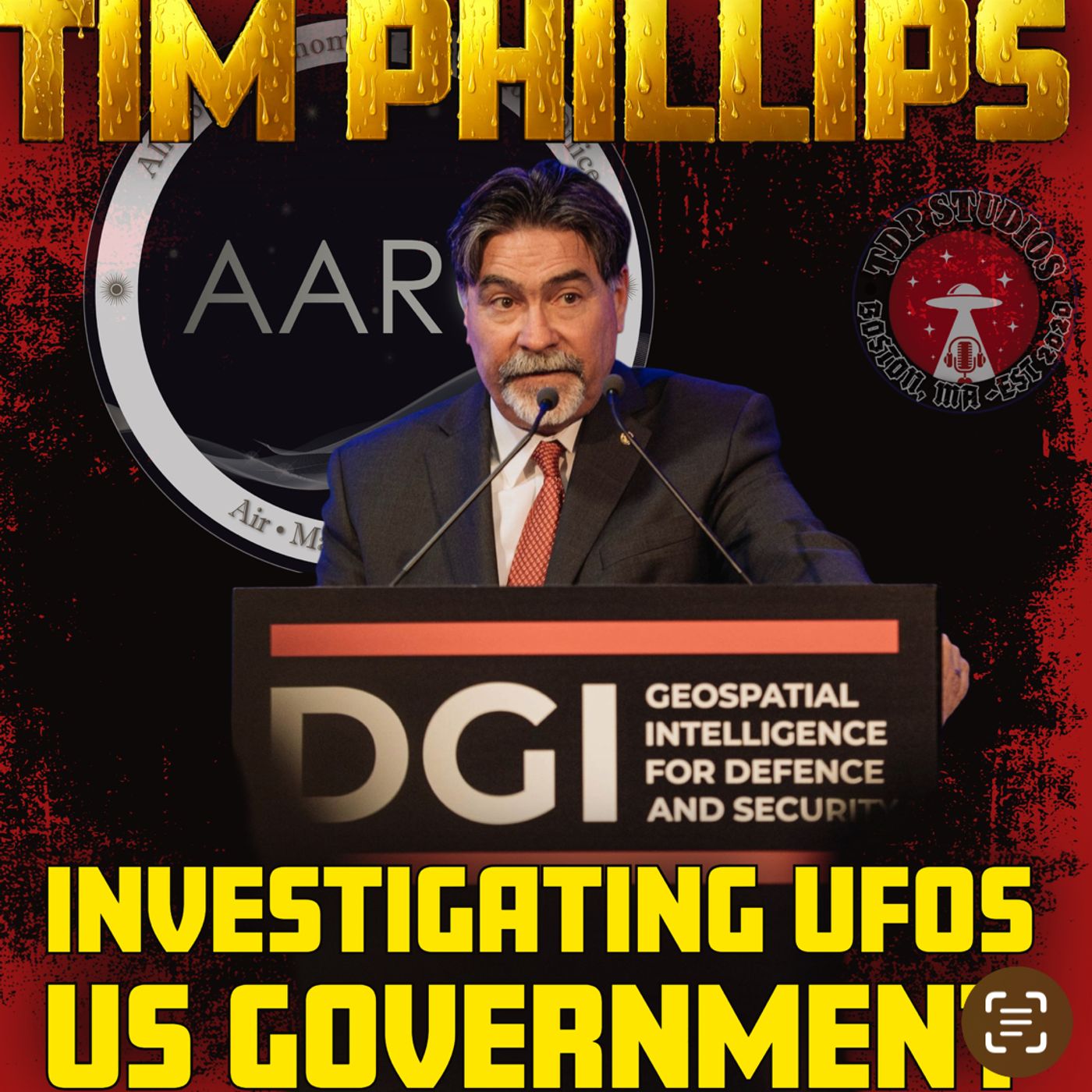
Investigating the UNKNOWN: Former Acting Director of AARO- Tim Phillips
LINK THREAD—https://allmylinks.com/total-disclosure
Subscribe to the channel on YouTube—— www.youtube.com/@totaldisclosure
Support TY and TDP Studios directly VIA PayPal (No FEES)— https://www.paypal.me/TDPstudios767?locale.x=en_US
YOUTUBE MEMBER—-https://www.youtube.com/channel/UCy2Cra7aLAAMVxkA9rSYCxg/join
PATREON MEMBER—https://www.patreon.com/Total_Disclosure?fan_landing=true&view_as=public
Follow On X—- Www.X.com/@DisclosurePod
Instagram—- www.instagram.com/DisclosurePod
Facebook----Facebook.com/@ty.totaldisclosure
KARI LINDSAY(SPOOKY)—www.x.com/@firesoftruth
*-------SPONSORED LINKS & SERVICES USED BY TOTAL DISCLOSURE--------*
USE OUR CODE AND SIGN UP FOR TUBE-BUDDY TO START UTILIZING THEIR AMAZING TOOLS, LET TUBE BUDDY DO THE WORK FOR YOU!-——https://www.tubebuddy.com/POP
Sign Up for VIDIQ and Get Tons of Creator Content Tools, SEO Boosts, Keyword Scores, Title Suggestions, & So much MORE! VIDIQ can be integrated seamlessly into your Browser and Youtube Channel, Start utilizing this tool now, Sign up with TDP’s—— Link-www.VIDIQ.com/TotalDisclosure
🎙️ New to streaming or looking to level up? Check out StreamYard and get $10 discount! 😍 https://streamyard.com/pal/d/6146221734887424
PODCAST PLATFORMS LISTEN DIRECTLY TO THE SHOW ON THE “SPREAKER” App, & help support the show DIRECTLY—— https://www.spreaker.com/show/total-disclosure-ufos-cover-ups-and-cons
Listen on Apple—— https://www.podcasts.apple.com/us/podcast/the-pop-culture-corner/id1544297063?uo=4
Listen on SPOTIFY——— https://open.spotify.com/show/0Yq6Iceyh7o24DG8tq4kvO
LISTEN ON AMAZON(AUDIBLE)——<a...
Speaker 1: Did you hear the claims that Jim Mkatski did make about breach the whole of an unknown craft that did not originate from here. He was running the offset program. Have you heard that claim?
Speaker 2: We've heard claims a lot of that was compressed in value move.
Speaker 1: There was a person he came to Arrow with a story.
Speaker 2: We had a referral when I was the acting director chairman of one of the oversight committees, asked us to meet with an individual that claimed to have reported to us a UAP partner or that was so shooken up so experience that she resigned from the program.
Speaker 3: He was asked to deliver doctor.
Speaker 2: Photographs at the Nevada test site, what a lot of the public refers to.
Speaker 3: As various fifty one.
Speaker 2: We know that the Soviet Union in the Cold War came up UFO Storia to try to undermine Americans confidence in their government's ability to protect them and tell them the truth about aliens.
Speaker 3: And I had.
Speaker 2: Mentioned that the black triangles, because we've known it's a proven engineering design. It helps you know the fly and we'll move from these triangles the flying wings. Unexplained that the true UAP cases.
Speaker 3: Which I mean I agree with you. About two percent of our cases.
Speaker 2: It's very, very small, but we can confirm they're there and we don't know what they are.
Speaker 1: Welcome back to Total Disclosure. My name's Ty and I'm your host and creator. We're pulling back the curtains on one of the most secretive programs inside the US government, the All Domain Anomaly Resolution Office, better known as ARROW. My guest today is Timothy Phillips. He was the former acting director of ARROW, the man who stepped inder doctor Sean Kirkpatrick or some col um doctor evil after his departure. In this exclusive conversation, Tim and I dive into what ARROW really does, how he got involved in the explosive allegations that came with extortion of the program, potentially into internal pressure within the office itself on how to do this stuff and go public with it.
Speaker 1: If you're ready to hear from someone who's been on the inside, someone who's seen the data, the politics, and the truth behind the headlines, you're in the right place. Hit subscribe, turn on notifications, and if you're listening on Apple Podcasts or Spotify, drop that five star review, because what we're about to hear you won't find anywhere else I'm asking the harder questions. We're talking about UFOs and nukes and how the fiery orbs and black giangle craft are among the most anomalists and Aro doesn't know what those are, which contradicts what the Wall Street Journal put out.
Speaker 1: Now, Tim does try to talk about this hazing ritual that the Wall Street Journal also talked about, and I did challenge him pretty hard on that. And when it comes to using specific language like aliens and not little gray men but for lack of a better term, instead of non human intelligence, is that a way of lying biomission these are tactics that they would have to be used. He even mentions that there are things that Arrow did and this doing that won't be unclassified for seventy five years. So we had a lot to discuss in this part one interview.
Speaker 1: Next time he'll be in studio. I really hope you enjoy it. I'm super excited I'll see you on the other side.
Speaker 4: This is total disclosure, a right welcome back.
Speaker 1: As I said in the intro, we are joined today by Timothy Philip. Welcome. I'm so happy to have you here.
Speaker 3: Tim, It's great to be today.
Speaker 1: I listen. I think and I and I've I've interviewed lots of people, lots of you know, And I'm not like like show voting or trying to like, you know, blow smoke up my own ass. But I've interviewed, like, you know, my fair share of big hitters, and nothing has gotten the anticipation and the people in the community as riled up as doing this interview. I don't know what it is about you, but people, Uh, people are paying attention to people are paying attention. So I wanted to start off the conversation and listen, we talked about this in a in a pre phone call.
Speaker 1: So I just because so many people have talked about it, and so many people have put out these clips about these things, I'm not gonna start anyway. I want to start the way I always wanted to start. And Uh, if you can introduce your self to my audience, to the people who may have not heard you on shows I think you did on the Green Street, which we will touch on with Micwest, which you will touch on. We don't have to get too far into it, but can you tell me, I mean, who is Tim Phillips.
Speaker 3: I'm a retired government bureaucrat now, but.
Speaker 2: I kid from an Air Force family, son of an airman, grew up Europe and Asia, and my dad retired from the Air Force team seventy three.
Speaker 3: Tucson, Arizona, where I attended my last year of you know, started my college career at the University of Arizona. Joined the Marine Corps.
Speaker 2: Been about two years as a Marine, travel all over the world. Nine to eleven happened still in uniform, I had decided to retire a lot of the rules change concerning transitioning from active military to civil service. They needed people with qualifications and current accesses and clearances, and.
Speaker 3: One day I was a lieutenant colonel.
Speaker 2: On the next day I was the GS fifteen Division chief, working at the time at the Defense Information Systems Agency. And then shortly after I put my hand in the air and swore in I would, I was asked if I would volunteer for an assignment.
Speaker 3: And I asked them what it was, and they told me they couldn't tell me.
Speaker 2: So I went to the Pentagon and found out that I'd be invading a rock again in two thousand and three. So that was the introduction to the intelligence community. I was with DES for about four years and then when they were standing up the office, the Director of National Intelligence had worked with the staff of Ambassador MEGAPANI there and Baghdad. I became part of the OD and I as they were standing up, and had almost a twenty three year career as a senior National Intelligence Service executive and a senior Intelligence Service officer, so I got to work with our servant CIA.
Speaker 2: I was at DIA, the National Geospatial Intelligence Agency, So I had a pretty diverse career, and probably the most bizarre assignment I ever had is when my boss at the time, Lieutenant General Cruise, walked among. My last assignment and government service was the deputy and then serving as the acting director of ERROW, which was probably the most fascinating assignment during my forty five year career. I knew absolutely nothing about the UFO UAP world. I knew a lot about technical collection, national security, you know, I was very very aware of that.
Speaker 2: Did a lot of deployments down range in Iraq and Afghanistan, so I used to work in an war zone. But I had never been part of a large investigative team looking at anomalies and the maritime, air and space domain.
Speaker 3: So learned a lot about it worked with some amazing people.
Speaker 2: Never had the scrutiny that we enjoyed reporting back to twelve different committees, committees both the Senate and House.
Speaker 3: Side, never had anything like that before.
Speaker 2: And we kind of had a We had two bosses, the deputy you know with the Deputy Secretary of Defense and then working for the principal Director of National Intelligence, and often the Director of National Intelligence would be there and when we went back and briefed them on our developments or investigations. So work.
Speaker 1: Let me ask you, Let me ask you a question. So were you aware of when were you as being around not around the topic, but just being in the military and being up to speed on things. Did you I mean, before you were ever asked to be a part of Arrow, had you ever thought about UFOs? Had you ever, you know, thought about them in a more serious capacity, maybe even after the twenty seventeen New York Times article and the you know pentagon and the confirming you know all but confirming that there are unidentified had it ever peaud your interest as just a general person beforehand.
Speaker 3: Not so much the uf or UAP issue.
Speaker 2: Remember, I was working counter terrorism and dealing with counter proliferation of nuclear weapons, so I had a pretty defined problem set that I was working. We did have a couple of cases downrange, working in Afghanistan where we became aware of the danger of UASS. So we were able to find some moranean systems that had crashed outside some of our facilities in Afghanistan and we realized that we were being surveilled. They're using them for ISR, not strike at the time, but we realized how easy it would have been to weaponize these things and how vulnerable we were.
Speaker 2: The fact that these things had been flying against our basis for months at a time and we were unable to detect them. So kind of aware of having situational awareness domain was very, very important. And then I've got three years at sea, flew a little bit and I wasn't an aviator as always a grant officer, so you would see things you couldn't understand, you know, I couldn't identify what they were. But since there was never any aggression towards us, it's really never really thought about it.
Speaker 5: I had enemies who wanted to kill us I had to worry about, so I wasn't about u A, you know, UAP or UFOs during my time in the service or the intelligence community before I served.
Speaker 1: With ARA interesting, you know, because you know, I find that a lot of people and I asked that for obviously specific reason. I'm trying to set your character up as someone who is you know, and how would you if if I were to ask you before you took the job an arrow your thoughts on and and I'd like you to be as honest as possible. If I were to ask you before you ever heard of arrow, before you ever step foot in any investigation capacity, if I were to ask you, are we alone in the universe? What would I mean?
Speaker 1: What would your answer be? Would it be yes or no?
Speaker 3: I would know.
Speaker 2: I have never had any you know, personal experience myself. I know there's credible people that have experienced things they couldn't understand and their their assessment was with some type of supernatural event.
Speaker 3: But to that.
Speaker 2: It never bothered me. I honored I knew these people professionally, they saw things they didn't understand. And during my generation, to report a UFO incident that could be queer ending. If you're flying and you reported something, the next thing you know, you're talking to the shrink. You're talking to the surgeon and you could be losing you know, your your tickets to fly.
Speaker 1: Right, you'd be flying a desk for the rest of your career exactly.
Speaker 2: My father flew. And that's just not something they discussed. They saw something they didn't understand, they kept it to themselves unless it was a threat, right, And I would say that's one of the great things we tried to do with the Office to remove that stigma, and that encourage military and intel personnel to report what they saw. We're not going to understand it unless people are free to report, you know, their experiences and working with DAFT J three and actually you know, getting directives out there to the Apartment of Fense saying if you have, you know, u a p u FO incident, you will report it.
Speaker 2: And more just as importantly, you're going to restain you know, retain data.
Speaker 3: You know.
Speaker 2: Part of the frustrating aspect of this job as we were looking back at cases twenty twenty five years old, the fact that there was no direction to the force actually to preserve data. So it was very frust used to go back and understand the cases. And of course our scientists want to work with the original data set. You know the zero ones and you know, apply tools to try to extract you know, some type of intelligence from what we were seeing. Right, So that was probably the biggest change, is the fact that you remove the stigma there was you know, there was actually a directive to report, and the fact that you could report these things without your credibility or sanity being questioned or you know, risk losing access or a security clearance.
Speaker 2: That was a that was a sea change in the government. Didn't happened before, right.
Speaker 1: Right, And this is you know, and then Congress has mandated, you know, Congress mandates the Arrow Office, and things are changing in the world, and I think, you know, the UFO community, on one hand, you know, we're really spoiled in that way that you know, twenty years ago, any one of these hearings, any one of these offices being established like Arrow, you know, aside from maybe you know, post Project Blue Book, of course, but you know this, it would be it would be the only thing talked about for years and years.
Speaker 1: And now it's you know, things are happening every day, and a lot you know, I know people don't think that Arrow does a lot, but you know, part of why we're here is to explain that you know there is or to to find out, like should should ARROW continue to be funded? And so when did so? When were you asked to be a part of Arrow? And why?
Speaker 3: Going back we've been with the fall of twenty three is when.
Speaker 2: I was actually asked to be part of ARROW. So I think I got there in October of twenty twenty three is when I showed up as the deputy and then Sean left the government in December of twenty twenty three, and then I became the acting Well maybe we've been the following year twenty four, because say it's twenty five, Yeah, it would have been. I was there about eighteen months, so it would have been all of twenty four and it started in October twenty three working with Sean.
Speaker 1: So why do you think they asked you to be a part of that.
Speaker 2: They wanted a career intel officer that was absolutely neutral on the subject. I knew nothing about it. However, I was the former director of Technical Collection and OD and I I had worked a number of.
Speaker 3: Sensitive reconnaissance operations.
Speaker 2: I maintained the book for it to the SRO program. I was an expert with a lot of both airborne and overhead.
Speaker 3: National technical means.
Speaker 2: I knew a lot about collection and orchestrating collection, working with other INTEL collectors, working with foreigners, and as I talked to Sean about the possibility of working there, I saw as a hard problem, kind of fascinating wonder if you were to take all the elements of national you know, power, are capabilities to kind of understand this phenomenon. There has never been an organization that the government has established to actually investigate UAPs similar to ERROW. You know, if you go back at Project Bluebook and the derivatives after that, they never had They never worked at the cabinet level, They never had access to information any classification level the way ERROW had.
Speaker 2: They never had the authority to go out and have joint duty assignments and be able to recruit some of the best and brighters from throughout the government. Arrow had people come to us from NASA, DHF, FBI, all of the o D, all of the intelligence community. At one time we had four senior executives on the staff at ARROW. We had a lot of horsepower, we had a lot of expertise, We had an amazing, amazing budget, the very very well resourced and probably most important importantly, we had the support of the most senior members of the Department Offense and the inteligence community.
Speaker 2: So when I would go in and brief the Director of National Intelligence or the Deputy Secretary of Defense, I would always be asked, Hey, is there anything we can do for you?
Speaker 3: Is there anybody not cooperating?
Speaker 2: Just unprecedented support and access to any program. You know, at one time we were investigating claims of over forty special access and controlled access programs allegedly dealing with the recovery or the exploitation of.
Speaker 3: UFO materials or uap.
Speaker 2: Okay e t that those are the claims that we were We had UH supporting investigations with both the Department Defense i G and the i C i G. We had a secure reporting mechanism were current and former government employees or our contractors could contact us securely. We would maintain their.
Speaker 3: UH anonymity absolutely absolutely.
Speaker 2: We'd give them a random number and we would protect their identities. And that's when I first realized that, you know, there were there were Americans that were scared to death to talk to us.
Speaker 3: They were very concerned about being harmed.
Speaker 1: I mean, I think that brings up a really good segue. And because and and and I I think if all of this was just light in the sky, I don't think people would be scared for their life to come forward and to want to, you know, gain nothing from it. I mean some of the people that like you said that you had come to you, that they literally they feared for their life. Now I know that we I think most people in the UFO community, if they're smart, right, if they're up to speed, we know that ninety five percent of what seen can be prosaically explained.
Speaker 1: There is a five percent margin, and if I'm being very generous, two percent of that is really anomalous in my in statistical means, that is a very small percentage. So you know, arrows it seems what arrow is is at least mandated to do. Or the idea and the mission was to sift through all the data and find that two percent and the people that are coming to you that are fearing for their lives. I mean, it's got to make this pretty real, right, Well, it was.
Speaker 2: Real to them what we got from these individuals and be able to align that with hard evidence and data that we can scientifically examined to understand the phenomena. Really wasn't there a lot of these people who came in with these amazing claims that the government had recovered and were reverse engineering or exploit exploiting alien technologies. We never could find any hard evidence to back any of that up. There were a lot of drives.
Speaker 1: Can I ask you something sure when you say alien, this is something that arrow does and this is something I do want cleared up for myself. When you say alien, and when Arrows reports say extraterrestrial, why be so.
Speaker 2: We would refer to material sentient beings from a planet other than ours extraterrestrial using that that term.
Speaker 1: But wouldn't that so? But if you say you found evidence of ultra terrestrial something that that had been here for you know, somehow is been developing alongside us, and somehow, you know, is of avoiding us. Like and I'm just I'm really asking this as a question, and I I if something you know, to suspend a little belief here to walk with me. You know, if something had been here and maybe is now what people see as UFOs and it had been here the whole time, I mean by definition that would not be extraterrestrial.
Speaker 1: So what I mean is why be so specific because some people think that is Arrow trying to pin it on aliens in green men and then not address the fact that you know, angels and demons are non human intelligence. They're not aliens, but they're by definition non human intelligence, and I think that's what we should be looking for, not aliens, because that's specific.
Speaker 3: Okay, I see your point. We had no evidence of.
Speaker 2: Anything that we recovered or was given to us that we examined to come from any other planet.
Speaker 3: Than our own.
Speaker 2: The technologies that we did examine, the phenomenons that we did observe, were designed and operated by human beings. One of the things that was I think frustrated a lot of people didn't understand what was the value of ERROW. Errow produced quite a bit of new understanding of foreign technologies and new capabilities.
Speaker 3: So two of Arrow's missions that were not widely known.
Speaker 2: Was technological and operational surprise. ERROW would pick up we would have the services of the intelligence community using their operational platforms or ISR systems, would pick up a signature that didn't correspond with something known. So we would have a partial signature of a system that did not correspond with, say the enemy order battle capability. We didn't know what this was, so it would be reported to as a UAP and then we would throw a lot of science, a lot of sensors. We would put together some integrated collection plans trying to find exactly what is that, and then working with the community, try to put together the pieces to understand the puzzle.
Speaker 2: And there was and there was intelligence reporting, Okay, that originally started off as a UAP incident report. So we would have an F thirty five platform would pick up an unusual signature of something we didn't understand, and then Errow, working with the community, would go after it, and then we would able to produce new understanding of say a new or emerging foreign you know, aircraft capability that we just observed for the first time. Errol did a lot of that. Now that's going to be classified reporting, the public's never going to see it, and that was one of the frustrating things.
Speaker 3: People are saying, what does zero do?
Speaker 2: Erol did quite a bit, but you're not going to be able to see it declassified for seventy five years, so it's going to take a while for that to get out there. But we did work very very closely with the service Intelligence Lab, so we would work on the National Air and Space Intelligence Center or the National Space Intelligence Center. We would get reports and we look at it and the first thing that we would do is is there any other system that may have detected that incident? So we would start in space.
Speaker 2: Can we do a lot of space surveillance?
Speaker 3: Okay?
Speaker 2: Can we establish a track? Did anything de orbit? Was there any data that we could get from web radar? Okay, from air traffic control, radar, surveillance, radar, biostatic, you know, processing, So we can So there's an incident. Now we have hard data that can prove the exist and now we've got a heading, we've got a speed, we've got an altitude. So now we can build a track. And now we haven't observed of what happened. Where then can we take those facts and kind of have an understanding of what the incident was.
Speaker 2: Errol did a lot of that, and most of the data that we needed was available. We just never had the network or the tools to be able, you know, to exploit it. So we're talking large data. You needed to have an architecture fast enough and large enough to take this data and you aggregate the data so now the data is going to be at a higher classification level than any individual data stream to kind of understand and build that common operational picture. So you can say, yeah, okay, that incident corresponds with that track what is it?
Speaker 1: And and I totally understand why ARROW in all of the ways that you just described doing that actual legwork is actually is really valuable. However, I can't help but hear a natural flaw in the process because if you had and and and forgive you know, not forgive me, but forgive me if I if I don't say the right words, because all the acronyms are they're sometimes a little bit confusing when you're trying to jumple them all. But you guys had title is it Title fifteen and title.
Speaker 2: Intelligence, Title ten is Department Offense, that's military, okay, okay. And then you would have legal authorities from law enforcement through the FBI or DS Title eighteen, Title fourteen, So we would work together in a task force. There would be an incident, and you would bring in officers from these other agencies. They would bring their authorities. ARROW would would be the aggregated think of AARROW as taking all these legal authorities inc but we have permission to work with everybody in their data and we could produce a common operational pitchers to kind of layout this is our understanding of what is going on, and then from that, if it's domestic DHS, FBI, local tribal, they could respond operationally got it.
Speaker 3: So that was kind of the work that ARROW did. Primarily when we would have.
Speaker 2: State, local tribal dhs, they would pick up things that they thought were UAPs, But as we got in and started to examine the cases, we realized there were uass So we started actually developing and researching a lot of counter UAS systems that were kind of that short range detection system. There's a lot of great systems out there that we would incorporate with our answer grids and our active sensors, so we would have passive and active emitters. So we would go into an area where we had a UAP incident and then we would try to capture it in near real time to understand what was going on.
Speaker 2: And since ERO is a DoD organization okay, partnering with the intelligence community, we were looking at it from a national security perspective. So we have detected some airborne system operating and restricted airspace. Okay, why is it there, who's operating it? And what are their interests? That was a great concern to us, because, as you can imagine, there's a lot of sensitive sites that our country wants.
Speaker 1: Which I will want to get to. But so what I what I meant by all that was now say Arrow, and again here here we go down down a little bit of the rabbit hole. Okay, say I'm Arrow as an entity, and I come across because I have the clearance, I come across a unacknowledged special access program, something that's deep black, deep covert, right, and I learn about something, And I mean, i'd like to have you probably address this. But even guys like Jim Lakatski have claimed that OSAPP breached the whole of a UFO.
Speaker 1: And I'm sure Green Street had brought that part up to you, But if they had, if you had come across something that was deep dark, and and you've already said it, some of the stuff that Arrow's done, we're not going to hear about seventy five years. So how do we know that you didn't find anything? And it's not just I mean, wouldn't you be required by law by your oath and by your duty to lie to me like and lie to and and I'm saying this really honestly, and and and in the most sincere way, Like, wouldn't it be your duty to tell me that you didn't find it for operational reasons?
Speaker 2: Well, ERROL never was a originating classification authority, so we didn't have a classification, but we provided guidance on how to classify UAP related topics. So the fact that a UAP exists or was detected wasn't necessarily classified or sensitive. However, if that incident occurred in restricted airspace or acknowledge some type of failure in a surveillance or a defensive system to protect that restricted or protected site, that would be a little bit sensitive. If ERROL had actually found a system that was not man made, and you know, we came across a you know, a crash site or you know, remains or some hard evidence that there was something an advanced capability or system that was not you know, engineered, manufactured and operated by humans.
Speaker 2: The fact that that existed, we actually talked with Public Affairs and thought that would well go well beyond the authority of the Aero Director and there'd be a lot of coordination with the executive and the White House on how they wanted to share that with the American people. That probably wouldn't be the director of VERO sharing the fact that we found remnants of a spacecraft that we couldn't identify with attributes of new technologies and capabilities that were not human made. If that happened, and it did not happen, we would probably kick that up to the White House and let them share that information.
Speaker 1: But you see my conundrum here, right, You do see my conundrum here, Probably I do.
Speaker 2: But part of the the task that Aarrow had from Congressional oversight, they were looking and as as federal officers, you know, we we had gun carrying law you know, federal law enforcement officers on our staff.
Speaker 3: So if we found evidence of a crime, if we found.
Speaker 2: A program that was being concealed from overside where they were using you know, federal funds without authority, that's a crime. And Congress was very very sensitive to that, and we actually had you know, a hotline. We had a way that people could call in their belief that there was a undeclared sapper cap that was being concealed from oversight, and we aggressively researched those and investigated those cases.
Speaker 3: And we did it in parallel with.
Speaker 2: IG with both the Department Offense and with the intelligence community. We would weekly meetings where we would say this is what we heard from the witness and we would go back and forth, you know, without comper minding our you know, our ability to honor NBA's and they're and agreements we had with witnesses. We would always protect those making protected disclosures. But there was a lot of coordination and there were plenty of JAG officers and attorneys with an Apartment of Justice to give us legal guidance on how to pursue these cases.
Speaker 1: Great, which is great, and that kind of brings me to a point here which I think is good. Uh it is now Uh With that being said, what what? And I want to wrap this in a bit ribbon here.
Speaker 1: Did you hear the claims that Jim mccatsky did make about preaching the whole of a craft of a of an unknown What he said, and this is again this is verbatim, breached the whole of a of an unknown craft that did not originate from here, and he was running the offset program. Have you heard that claim?
Speaker 3: We've heard claims.
Speaker 2: A lot of that was addressed and volume on of the historical report, which we did in a very compressive amount of time.
Speaker 1: Of course, Oh yeah, we got it.
Speaker 2: I'm sure there's an ademdum to it. With some new findings on that report after Sean left and some of the fallow up investigations that we had, and new claims that were brought in, new interviews, new referrals from Congress and the IG. We continue to research these claims because it was of interest both to the Cabinet Secretary and to the oversight officials and the committees that we worked with up on the hill. But we never, even when we had materials delivered or claims that these materials came from a non human craft or system.
Speaker 2: In every case where we had independent labs verify the you know, the identity of the materials, we never discovered or were able to validate any claim that that material came from a craft, not you know, a non human craft that did not happen during my time in era. And we spent millions of dollars doing these analysis of these materials.
Speaker 3: Okay, I'm getting I was muted.
Speaker 1: I was muted. That was my fault. I wanted to give you the floor. So with that, with that being said, so with materials, I find that to be very interesting because obviously guys like doctor Gary Nolan are saying different things. You know him at Stanford. What he's saying is they've come across any materials that the isotopic ratios don't match anything on Earth and they're atomically layered. Were you guys given any of those materials to also analyze and come up with maybe, you know, any collaboration with that effort.
Speaker 2: We didn't work with him. The labs that we used to do the material analysis were basically the old Manhattan programs, the Department of Energy Labs San Dia, Oakridge, we worked with.
Speaker 1: Do you think do you think is it possible? Is it I mean, I'm I'm and I'm really genuinely curious. Is it possible that there are there are metals or parts out there, uh, that people do have that may still be anomaloust.
Speaker 2: Nothing that was ever shared, There was no materials that was ever shared with Marrow that have any unusual characteristics.
Speaker 3: Everything now we looked at came from this planet.
Speaker 1: Okay, okay, and that's fair enough. I definitely think you know, you guys should run down I mean because because Gary Nolan, I'm pretty sure, uh is it works with the CIA, and or at least has worked with the CIA. So I'd be I'd be interested to find out why a guy like that would make claims like that, knowing and and and that had there's there's other stories.
Speaker 2: U a p UFO crash. Parts wanted to come to Aryon and say, hey, this is the pedigree. One of the one of the challenges we had when people had parts is we would go back and almost like it was evidence using a trial, so you know, proper custody and document who possessed it.
Speaker 3: You know, how was it controlled.
Speaker 2: And It's funny as you were getting closer to the the actual incident where the material was collected, a lot of that, you know, the details seemed to be lost.
Speaker 3: You know.
Speaker 2: We we had materials were sitting on a warehouse in a shell for the last forty years. But as we try to get back to where that matuial was collected, the trail would go cold. And we did have people that contacted er. We actually had citizens that went to their congressional representative and they wanted er to validate the fact that they actually had a UFO crash card. So I want to go on the road, and they wanted that seal of approval from RYW. You know, we're not in the business help people make money.
Speaker 2: However, if there was an entity that had worked with a part of the US government and they claimed they had material that was part of some type of UAP or UFO incident, Ero would love to help them go back and actually identify the material.
Speaker 3: We can do that. We have an active program.
Speaker 2: We've invested millions of dollars in equipment and clean rooms and procedures where we could take custody of a piece of material, do a double blind study, have different teams work on different you know, parts of a you know, a piece of material and come up independently with what they thought it was.
Speaker 3: And we love that.
Speaker 2: And but every time that that was done, the materials came from this sort.
Speaker 1: Of okay, and and that's and that's fair enough. I want to I want to you know, speaking of parts and evidence. Uh, there there was this claim made and people have asked me to and we talked, like I said, we talked about this on the phone and you you had just brought up that's you know, Arrow try or someone tried to get Arrow's seal of approval. There was another claim made that there was a person and he now goes by whistling mic on on X I believe, and he's made some claims, and Burlison has said he's an interesting person and he's a defense contractor who's trying to get contracts with the US government and he came to Arrow with a story.
Speaker 1: And what you say is that there was an attempt at extortion. Can you address this and clear this up what happened there?
Speaker 2: Well, Errol doesn't comment on people that come to them with UAP incident claims. We protect their identities, but what if.
Speaker 1: They blow their identity.
Speaker 3: Well, that's up to them.
Speaker 2: We've had we had a referral when I was the acting director chairman of one of the oversight committees asked us to meet with an individual that claimed to have reported to US a UAP part. When we actually met with this individual, what we realized is the claim was that he recovered a part that fell from an advanced US Dealth aircraft. So the part that he recovered was actually a piece of government property.
Speaker 3: This individual came up with a new.
Speaker 2: Manufacturing process to duplicate the part, wanted, found a or developed a procedure to be able to detect these advanced aircraft. At one point there was a claim that wanted us to purchase the part or there was going to sell it to another foreign entity, such as the Chinese. To US, that sounded like it stortion, and that's how we treated it, and we referred it off to the FBI. But that was kind of the end of that. The fact that someone recovered apart from America raft, that right there means it's not it's not an arrows mission set.
Speaker 3: Aero investigates u A P right, if it's a US advanced aircraft, has nothing to do with you, ap.
Speaker 1: Okay, So there, there's so what And we don't have to talk about any We don't have to infer anyone. So what what the What the scenario was was there was a person who claimed to have a part. You discovered that it was from a next gen fighter, but it already been They claim.
Speaker 3: It was from an advanced concept.
Speaker 1: Oh gotcha, gotchat.
Speaker 2: The individual had some images, never shared any of those videos with us. We we'd asked for them we did from the the chairman, we did get a still image of a aircraft and advanced allegedly it was advanced stealth you know, aircraft that was in development. Congress was concerned that there's been some type of compromise and that these images of this aircraft that got out into the public. Was very concerned about a leak. That's one reason I was asked to go out to the Nevada Test Range to actually meet with the program managers that were developing the sixth generation aircraft out there, and I did that.
Speaker 2: We analyzed the image and the image looked like a promotion video that had come from an aircraft manufacturer. It kind of looked like an F one seventeen on steroids. The vast majority of our aerospace engineers thought it was, you know, a photoshop version of something that was in a promotional video. And that's what we reported back to the Hill. And again, it wasn't a UAP, it was a stealth aircraft. So it really wasn't in our lane.
Speaker 1: So so did this person ever even make it to a skiff?
Speaker 3: Yes, to talk to us?
Speaker 1: Okay, So there so there was a meeting and a skiff with that individual and then it was referred to federal law enforcement because there was a concern by Congress that there was a breed somewhere in that. Yeah.
Speaker 2: No, No, the concern was an extortion attempt. The other concerned Congress had it they could have had a compromise and you yeah, an individual with a you know, an image of an advanced concept aircraft, right, that was the concern. But again that's really not Arrow's mission set. We'll turn that over to you know, a d o DC will let them work that.
Speaker 1: Yes, totally totally understandable. And you know, I think that you know, that just goes to say uh or it goes to show at least how many So it does show that ARROW is working really and intently uh with other agencies. So you guys are cooperating and have in law enforcement that is working with you. That that that you you're able to refer these things too.
Speaker 3: Well.
Speaker 2: Absolutely, as a you know, as a country, we really really have to federate and work with state, local tribal authorities to understand the phenomena. We looked if we were working with North kom because one of the things that we were working that we were developing was a UAP record plan as you can imagine.
Speaker 1: Oh, an actual recovery plan.
Speaker 2: Because I was asked when early on members of Congress, a committee chairman came to me and wanted to see the plan. And I was pretty new to this business and Sean had left, so I had gone back and asked, do we have is there a UAP recovery plan?
Speaker 3: Can someone show something to me?
Speaker 2: So there was some things we found that they thought were part of the majestic program and the a was it was fake. But we had actually working with d O D in the Northern Command actually to put together an actual recovery plan. Is as you know, you know, we do have organizations that recover you know, fallen satellites or objects from space as things re entry into our atmosphere. Often they have had are just fuels or payloads and it could be dangerous. So we have doo D teams on standby actually to fly out and work with state, local, tribal authorities to help clean these things up.
Speaker 3: We do that, but.
Speaker 1: This could also I mean, is it safe to say that one of these protocols, if ever there was an incident with a crashed legitimate UFO, that this one of these recovery plans could be utilized in case of that kind of scenario.
Speaker 2: Yeah, yes, because to agree that DoD does extremely well is planned.
Speaker 1: Right, and that's what I think we've all assumed, you know, happened, but you'd.
Speaker 3: Have a plan.
Speaker 2: So Errol was work with Northcomb to put together a plan, and we realized the actual person you know, probability of a UAP landing on federal property or a military base is actually pretty small. It would actually land in the farmer's field or in state property, and then you have DoD providing support to domestic authorities. So that's why we had partner with the Northern Command because that's what they do.
Speaker 3: They're a defense of the homeland.
Speaker 2: And that's another way that Errow kind of got into the counter UAP or UAS mission.
Speaker 3: After the Langley incident.
Speaker 2: You're actually asked during the incident by the Joint Staff J three if we could bring some of our sensors and our scientists and help them recover and make tracks so the law Enforcement pass Force could narrow down their search area where they thought these uas is being launched from. You know, what was the past and what were the uas is interested in surveilling.
Speaker 3: So we had partnered.
Speaker 2: With MIT that were the British that helped invent radar and World War two, and we were helping reconstruct, you know, the forensic radar tracks, trying to make us make sense of what happened down in Langley a couple of years ago, and Aero developed and expertise. You know, we had our Grimlin systems that we would put out. We do long term surveillance of a fairly large area and of course we're looking for UAPs, but we would detect uass So what we want to do is have the ability to pass that track to that local commander responsible for the sense of the military installation, saying we've detected the uas in real time and passing the information so they could deal with it.
Speaker 3: That's not really our mission.
Speaker 2: In the same time, if they were to tech at UAP they're looking for uas as when they find a craft, they don't understand they know it's much larger in uas, they passed that.
Speaker 3: Todds, I am.
Speaker 1: So jumping back in tim I I I was listening to your interview and right at the end with Stephen Green the Street, you started talking about black triangles and the possibility that these so because Arrow, I mean Arrow did find some interesting things and you made some interesting comments about these triangles, and and let's be fair, Uh, these black triangles have been seen for a long time, a long long time by people. They've been reported the famous nineteen ninety seven Phoenix lights incident.
Speaker 1: Uh, that was a big you know, black triangle, if you will. There's also been a lot of of of reports of even up to this day, guys like Dylan Borland Uh just sat in front of Congress uh and testified to the fact that he and uh, you know, I'm just using that as an example. Many other people have seen these triangles. What what can you elaborate on on what you were saying with Steven in that interview and why the black triangles stand out you specifically.
Speaker 2: Yeah, the delta wing or the triangle or shape wing aircraft is the proven design. So he had asked me about, you know what, what what bothered you?
Speaker 3: You know what what we concerned about?
Speaker 2: And I had mentioned that the black triangles because we know it's a proven engineering design. It helps you know, the fly and we'll move from triangles to flying wings. You know, it actually has some inherent stealth characteristics.
Speaker 3: It minimizes to ratear cross section.
Speaker 2: I know that the first time I ever saw an F one seventeen uh Yuma, you know, before I knew what the hell they were, it looked like a flying black triangle from the angle the aspect I had on the ground. So when we detect force protection and security personnel at very sensitive site, that's a national security issue for me because we know that we have produced aircraft in systems that look like black triangles.
Speaker 3: It works, and.
Speaker 2: Our adversaries, you know, probably have as well. So when we have UAP incidents and we get credible reporting that it's a trianglar shaped aircraft, that's a.
Speaker 3: Huge concern to us. The other thing I had.
Speaker 2: Mentioned about is the corona or the plasma type discharge from a airborne system. We thought maybe that could be a form of stealth, using some kind to say a force field, to provide that minimize or of that small radar cross section, because that was another thing in the unexplained the true UAP cases, which as and I agree with you, it's about two percent of our cases. It's very very small, but we can confirm they're there, we can measure their speed and blossopy. We don't know what they are and we're trying to do much better to be able to detect and track these things.
Speaker 2: But those are the two things, the two shapes that I was concerned about, the triangular shape objects and then the fiery shares speeds.
Speaker 3: As relate to us by the witnesses.
Speaker 2: And one of the things I do want to say about the witnesses, we had some you know, early on during the historical report, people are coming to us and we wanted them to report on any reverse engineering, you know, or alien spacecraft exploitation programs. And we had some pregnary contractors, some dood personnel and talked about the amazing things that they saw and we listened to their claims.
Speaker 3: Then we thanked them for.
Speaker 2: The patriotism, remind them of the lifelong obligation under the non disclosure agreements they signed, and set them on their way, and then we would have to start the investigation what is this? And their descriptions were very, very accurate for the most part. We would actually get the videos, so we get the reports from what was being tested to develop and we saw the videos. Now we can understand the description. And there was one it was a spacecraft. It was on a launch platform that was described as an alien spaceship by a contractor.
Speaker 2: A support contractor was lawfully present but not part of that test, so it wasn't read into the program. But we looked at that and you grew up, you know, looking at fine By, you know sign you know science fiction movies, and you saw this craft, you.
Speaker 3: Would think it was an alien system. I think with Stephen, I think it was getting pretty late and I said.
Speaker 2: It looked like an alien you know, desh ship or something.
Speaker 3: But you look at it and you can understand.
Speaker 2: And we wanted that image in the sap CAP version of the historical report. So we had a version of that report which was about eighty five percent of it which was public releaseable. Then there was a top secret sci version of that report, and then primarily for the Gag of eight, there was a.
Speaker 3: Sap CAP version of that report that got into some of these.
Speaker 2: Systems that we really really wanted to protect where people had assessed that they were part of some type of.
Speaker 3: You know, alien exploitation program that the government was running.
Speaker 2: Okay, we had about forty claims forty five claims that we had to research And another thing that was unique about the work we did when we would have an incident and it was actually, you know, we we couldn't cross reference it was something known a known air aircraft or some type of events such as exactly, we couldn't correlate it with that. Then we would have to do Blue Force deconfliction. Then we would have to go out into the R and D and they had the Research and Development of Science and Technology world and say were you all flying something or demonstrate in the system in this area at that time?
Speaker 2: And you had to be very very precise as you went back into that community to ask them because they're not going to They're really not going to give you anything, but you have to be very descriptive and give them very precise days and times places to get anything out of them, to kind of understand what they were doing because they wanted to compartmentalize and minimize exposure of these systems so they couldn't be compromised. And we understood that, but what we need to we needed to confirm that it wasn't one of our blue systems that was detected.
Speaker 3: It was truly a UAP.
Speaker 1: This brings me to one of my biggest points to uh. Tim And and you know, I again, I have so much respect for you. You are a true patriot and I sincerely, sincerely say that. But I've also worked with other true patriots and I The Wall Street Journal published an article and they claimed that the the Malmstrom uh nuclear shutdowns uh were part of a directed e m P. And I'm gonna go, I'll get this all out so you can kind of we can just have a general discussion about this because it ties into it, you know, so the Malmstrom case being an e MP training of some sort, and then you know, uh, but but Malmstrom is not the only uh nuclear base that you know dealt with these things?
Speaker 3: Uh?
Speaker 1: Why not?
Speaker 4: Uh?
Speaker 1: And they what they're saying is this, the fiery spheres are are are a very common thing, from Mario Woods at Ellsworth to Lowering Air Force Base in Maine to Langley to Malmstrom mine not Vandenberg nuclear witnesses have come forward. And and when those guys come forward, and I know some of them have testified to Arrow because they've been open about it. We don't have to go into any names, we don't have to go into any specifics. But these guys I find to be at least of the most concerning credible people.
Speaker 1: So when looking at that, how did how did the Wall Street Journal come to that conclusion? And people think that doctor Kirkpatrick was was giving information to them about that, So I just want to kind of clear that up because there's very conflicting reports.
Speaker 2: This now that was the fiery orbs was probably one of the most intriguing, most concerning cases we had because there seemed to be consistency and the visual, you know, descriptions from various very credible security personnel at these nuclear a lot of more nuclear weapon sites, not only here but overseas as well, and their descriptions of what they observed was very consistent. So I can see how the Wall Street Journal would have a story on it because they probably introduced some of the same witnesses we did.
Speaker 2: And we have actually partnered with, you know, organizations in the Apartment of Defense and Apartment of Energy to help improve the technology to be able to detect and you know, actually track these objects. In one case, at a very very sensitive location, there was a ground security force that actually followed one of these fiery orbs for you know, I would say fifteen miles and the ORBS was hovering, was moving slowly, a small car sized object in the air, hovering above a road, and when a truck departed main side was coming out on that range road, the system actually got off the road and hovered and turned off its NAB lights.
Speaker 3: There were red lights on the back of it that the security personnel could see.
Speaker 2: Not sure what it is, but the fact that it was following roads it attempted to evade detection, okay, and then after the threat, after the truck had passed, it got back on its merry way and headed back toward the main test area.
Speaker 3: At this location, to me, it tells me that there was a human in the loop.
Speaker 2: The concern was the distance from public access into the range, So how was it being control and what was the nature of that you know, that aroar or that that discharge around the object.
Speaker 1: So you guys are saying that you don't know, We don't know.
Speaker 3: And we found that to be very very alarming.
Speaker 2: And the people who observed it and tracked it, and then in one case there were two departments that had detected it actually went from the range one range onto another range and was detected by two or two independent organizations, so it tells us something's there.
Speaker 3: I'm not sure what it is.
Speaker 2: I think it's a an adversary capability or system, but there's not.
Speaker 1: You're not ruling out say something else, because it's still on.
Speaker 3: We don't know what it is, and now it'd be foolish to rule anything out. We need to understand it. We need to be able to detect it, Bill Tracks and the mediate it to deal with it.
Speaker 1: Okay, have you have you heard this other narrative that's going around in the Washington Street Washington Street Jesus Wall Street Journal tried to say that there is a hazing ritual that has been going on in special access programs. You know, hazing recruits UH to these special access programs telling them there are UFOs. But then you know, in my these in my experience with hazing, you the hazer becomes the hazy, becomes the hazer and they get let in on the joke. Have you heard these claims and did you guys hear anything similar.
Speaker 2: We actually came across the program, we investigated it, We passed it back to the d O, d I G and the service IG to actually investigate it, and we actually thought that that could be the origins of a lot of these UFO stories where we had the time. It was an Air Force Special Access Management Office, the SAP GO office that had come up with a.
Speaker 3: False SAP.
Speaker 2: Originally they were going to use it for training purposes, so they didn't want to use a real SAP, so they came up with a fake SAP program.
Speaker 3: I actually saw it. It was beautiful, beautiful graphics.
Speaker 2: It didn't say anything about a UFO or UAP in it, but you had the image was a classic nineteen fifty flying saucer hovering in a lab being surrounded by technicians and white lab coats, and it was an anti gravity motor or device, and that was the SAP.
Speaker 3: It was used. It was created as a training program. It went wild.
Speaker 2: It was probably in existence for over twenty twenty five years, where you know, personnel assigned to the base Special Access Program Management Office were read into were aware of this program without knowing that it wasn't a real program. So you probably had you know, thousand, possibly tens of thousands of military personnel who were exposed to a false SAP dealing with this anti gravity motor that came from you know,
Speaker 2: another world, you know, exraterrestrial exploitation that we possessed, and some people thought that that could be the basis for all these allegations that the US government has had these unacknowledged SATs and caps dealing with recovery and exploitation of alien technologies or.
Speaker 3: Non human technologies. So I mean, but that we actually.
Speaker 2: Found that the program had morphed a bit, had got out to a different combatant command, had gone off into a different servous, so that we were aware of a false SAT program that was in existence for twenty years. We never really we knew it got back into the nineteen eighties.
Speaker 1: You don't find that. A. That's ridiculous to try to say that that would explain every UFO sighting, But B that would also mean that anyone who was hazed, wouldn't they have a pretty good wouldn't they have a pretty good lawsuit against the the.
Speaker 3: Progress It was it was a joke and then they signed an NDA.
Speaker 2: So these are service members that were managing a SAP office and they would have in their portfolio, they could have hundreds of different SAPs that were in existence that are operational at that base from facility, and they would just read people in and read people out. They didn't actually participate in those programs. They were just administering the clearances then and then writing people off after they you know, had no longer had a need to have access to that program.
Speaker 1: I guess we'll we'll have to probably agree to disagree on this because I find that to be I find that to be really unethical to not let because what if what if you got what if you got told that there was UFOs and you see these amazing graphics and then you live your life and no one no one tells you, Like, isn't the best part of the joke when they find out it's a joke. And now we have one hundred thousand of these guys running around thinking there's aliens out there and at any day the world would you know, erupt into an intergalactic star wars that would cause some psychological issues.
Speaker 1: Don't you take it.
Speaker 2: Well that that was the concern of some cabinet officials. They were how extensive, you know, was this hazing? How many people were exposed to it? And it could be could that be the basis for these claims? Your reaction to discovering that this program existed was the same as some you know Senny confirmed Cabinet officials when they were briefed on the programs, they were actually concerned and angry about it. And we had another we actually had another I never could get the photos, but we had allegations that.
Speaker 3: They're at one of the test sites.
Speaker 2: They actually had a room, they had a gurney and they had like a big rubber arm, like a you know, a reptilian hand sticking out from underneath the white sheet on a gurney. And there was a group of military personnel going by and they haven't just a glance in and see this, and then the staff rapidly went up and shut the door and cut, you know, pull the sheep back over the arm. And we heard in one incident there was a young officer that was so shooken up so in that of experience that she resigned from the program.
Speaker 3: That was a claim.
Speaker 2: We also had a claim of a retired Air Force flag officer that worked at one of the national test sites where he was asked to deliver doctored photographs at the Nevada test site what a lot of the public refers to as Area fifty one's of traditional UFOs flying over the test site and those photos, those images were delivered to a bar to the east of the base. There where a lot of the UFO observers and you know, the people interested in this topic would go out to eat and and you know discuss their experiences as they observed the Nevada test site out there.
Speaker 2: So we've we've got you know, witnesses that claim programs like that occurred. We know that the Soviet Union in the Cold War actually came up with UFO stories to try to undermine Americans' confidence in their government's ability to protect them and tell them the truth about aliens. There's been a lot of disinformation when it came to UAP UFO, and that's why I thought it was so brilliant to actually establish an arrow office for the first time. He had an organization with the horsepower working for the right people, with a budget and the you know, the authority to work across the US government that you know, to investigate these claims and try to understand what's going on.
Speaker 2: And I know there's a lot of frustration with the public that you know, we didn't show them the Amian bodies or the you know, the UFO crash site despite people who have sworn under oath in Congress that you know they have observed you know, you know, alien spaceships or non earth you know, non human spaceships, and they found non human remains.
Speaker 3: We looked for that.
Speaker 2: We investigated virtually every credible claim we had. I know that our investigators hosted congressional delegations wanting to go out to Dayton, you know, going to write Patterson to personally investigate the claims that there was some type of UFO power source that was hidden underground at.
Speaker 3: The base there. We know that we've hosted.
Speaker 2: Investigators that wanted to go out to other ranges to be able to investigate claims that were made under oath the Congress. And we were part of that, and we had authority to go anywhere to look. And I will tell you during my tenure there, we never had anybody attempt to block access to information or locations or materials.
Speaker 3: Why you know, I worked at Arrow. That never happened.
Speaker 1: So you're saying that no one and is it conceivable?
Speaker 2: Is it?
Speaker 3: Is it? At least community.
Speaker 1: A lot of people think you were fired from Narrow. That doesn't seem to be the actual case.
Speaker 3: I wasn't fired from marrow.
Speaker 1: Right, And I wanted to clear correct. I know, I know, but people online said that you were fired. They put these graphics up. But you were also given one of the highest service honors and like a huge, like nice commendation, and it seems like it was just your time for retirement and you and the d O D for lack of a better term, split up. Now, can you clear that up? Because people think people like to say that you got fired.
Speaker 3: I want to make sure no, none at all.
Speaker 2: Errol worked with the under Secretary for Intelligence Security and as a senior executive, we actually had to come up with the criteria on how we would rack and stack, how we would prioritize a new intelligence officer assigned to the department of a sense. So we came up with the criteria on how if we had to executed a reduction in force, who we would fire first. So I was part of the working group that came up with the It was almost a matrix on how we would rack and stack, how we would fire our officers who were still on probation.
Speaker 2: So we would spend a lot of time assessing recruiting training. They had a two year probationary period. And I just thought that by doing that, by you know, firing these junior officers that never really had an opportunity to work in the community, that we were consuming our feed stock. I had forty five years as military and as a civil servant, and I had already told the D and I that I was going to retire when my tour was up, and my tour era was going to be up in October of this year. So when they came out with a deferred resonation program, we did not know what the number was if you were looking for an eight percent or ten percent reduction in force.
Speaker 2: So I thought I had a full career and I was willing to give up my feat so a new officer that we had recruited and brought into the intelligence community could serve.
Speaker 3: So that's what I did.
Speaker 2: And I had talked to John, and I didn't want to leave him high and dry, but we had actually gone out and solicited. We put out an advertisement, and we were actually interviewing people as the new deputy. I was actually recruiting my replacement the same way I recruited you know, John to bring him in as the director. We were actually you know, try and ensure we had continuity, and.
Speaker 3: That was the plan.
Speaker 2: But the delay that we had in getting the new administration's political officers confirmed through the Senate flowed things down to get you know, to have people come in and approve and make the appointments as a deputy and they understand. The officer that we had recruited replaced me got frustrated and he took the DRP and he resigned. So I was actually I took the resonation program and left Arrow and April, so I had already left Arrow and then later on in July. One of the programs that we have when you're on the DRP all.
Speaker 3: The rules that you have to follow.
Speaker 2: As a title fifty Intel officers, You've got to report foreign contacts. We've got to report our financial activities and trains over a certain amount of money.
Speaker 3: You have to report if you have.
Speaker 2: You're publishing, you have to go through a published review process to make sure that you're not revealing any sensitive.
Speaker 3: A classified information.
Speaker 2: And if you have contacts with the media, you have to go up and you've got to ask permission to do so. But to do those outsize activities, you have to be in the system to get on and into the database and say, hey, I've got this reporter that wants to talk to me about this subject to get permission to do so, you're outside of the system to do that. That was one of the limitations about this DRP. It's a very very weird thing because you're read out of the programs. You're basically on terminal leave until thirty September.
Speaker 2: When you were you know you would you would be over and then you retire in one October. It's kind of the plan. So I had made some interviews and I thought I had followed the procedure. There was only one one time where I was told not to proceed in the interview with somebody, but I said something that irritated somebody at the DNI, and then I got called into the DNI. I had the counter intelligence and the HR people pulled me in. Why I'm on leave. I had already checked out, and I got a very nice worded letter from the Director of National Intelligence tell me that it was no longer in the interest of the government for me to be employed with the Office of the Director of National Intelligence.
Speaker 3: And I was terminated and then I was put on the retired roles.
Speaker 1: So it's safe to say it was like an amicable split up.
Speaker 2: They just decided that they no longer required my services as a senior National Intelligence Service officer and they retired me.
Speaker 1: Yes, yeah, yeah, so pretty amicable because then you go on and you're also given, uh, what was the the medal you were given?
Speaker 3: Well, I actually got to this year. I got one.
Speaker 2: It was kind of like a civilian Achievement or Meritorious Service medal. Henry Clinton got one. I got one, and then I got the Secretary Defense Exceptional Service Medal. I think I got two of them. One was civilian service and one was as a d o D. I got the highest ranking award they could give me.
Speaker 3: So yeah, I got that. So yeah.
Speaker 2: But it was the Department one of the Department Offense that terminated me. I didn't work for the Department Offense. I was on a joint duty assignment to the Apartment Offense. I was an O d N I employed at the time when the Director of National and Talent and gave me the letter saying that my continued service was no longer required.
Speaker 1: So if you could change. We have two more questions and we'll wrap up on this on this part one, we'll call it if you could change one thing about how the Pentagon handles this topic specifically, what would that be?
Speaker 2: I think the way John and the last time we were up on the hill, and I believe that was around March, we came out of the skiff and then and what what what John is the director decided to do, is just to go public and actually admit that there were actual UAP cases that we didn't understand. Another thing I think I would have done much earlier is solicit
Speaker 2: or our attempt to come up with a crowd sourcing UH reporting of UAP and incidents.
Speaker 3: These states have state fusion.
Speaker 2: Centers to kind of control state level response to incidents.
Speaker 2: We thought state, local, tribal. They're normally the first responders if they hear or see something, you know, how can we how can we operationalize that and get that reporting back to ERROW as fast as possible so AERO could respond. We had people on standby that could deploy the same day to try to understand an incident, to gather evidence and maybe capture the phenomenon near real time. I would have solicited the support of the American public sooner we've been working on a public reporting mechanism, and with the change and the trend of amid frustration and the transitions, we had to have some forms approved by GSA, you know, as part of how they would report to the government.
Speaker 2: I would have loved to have that in place and using some of the large data, some of the machine.
Speaker 3: Learning, the algorithms we developed to try to.
Speaker 2: Speed the detection the building attracts and the operational response to UAP incidents. And we were working very very hard to get that capability in place in partnership with an all the government reports, you know.
Speaker 3: Response.
Speaker 2: We found that Department of Homeland Security, especially CBP along our country's borders, they have an amazing network of sensors where they were willing to share us, share the feeds. As we looked at the administration's desire to enhance air defense and the cotton United States, you know about the Golden Dome initiative, Well there's data there.
Speaker 3: Okay.
Speaker 2: If I know they're looking at threats, they're looking at cruise missiles, are looking at ballistic missiles uass. But if we invest in that sensor technology, we're going to pick up things that may not be threats, but it's information, it's anomalies that aero needs to investigate so we can have an understanding. There was a little bit of frustration because we had a bias in our collection because we tended to put censors out in defenses around things that we wanted to protect.
Speaker 1: That include nuclear sites.
Speaker 3: Absolutely included lucra sites.
Speaker 2: But how do you know if we have a higher number of incidents around nuclear when you don't know what's going on over the cornfields of Nebraska. So one of the things that we are actually researching was investing in a series of unattended sensors. We were thinking of working with Department as Interior and the Bureau of Land Management where they have a series of towers. They're primarily looking for fire detection and disasters at the national parks. But if we could put out sensors staring up at the stars, you have the networked you know, maybe we can detect anomalies before the public sees them and start having a more comprehensive understanding of what's going on because we don't and I talk a lot about what's going on in the air domain.
Speaker 2: That's where we had a lot of sensor capability and understanding on in tools to be able to exploit what's going on in the EO and IR.
Speaker 3: Oh, but we were working in space.
Speaker 2: We actually had a definition of what a UAP incident was in space, and we were actually work gaming with space Com and the Space Force, you know, trying to say, how do we get UAP incidents that they detect in space and at mission speed past those tracks to ERROW so ERROW can apply some machine learning from AI, so maybe we can detect things as they approach our solar system, our planet and maybe re entry into the atmosphere. You know, we wanted to kind of tie it together and do it at operationally you know speed.
Speaker 2: It was frustrated to be reactive or to go back and have to investigate a USP case from twenty years ago when there's no data. Another domain where frankly we didn't have a lot of success were just starting was in the maritime environment. So there were incidents that's in the maritime environment, but the community is even more compartmentalized than they are in space, and their primary concern was the sound of metal moving through water.
Speaker 3: That's what they were.
Speaker 2: Focused on, and if it didn't really correspond, it wasn't part of that threat.
Speaker 3: They didn't care.
Speaker 2: Well, we care, and we partnered a couple of times with the Maritime Committee and help them. We actually had worked with some cases with them, but we really didn't have a good foothold there. We were most our success tended to be in the air domain. We were starting to build some partnerships and space, but we were the all domain Anominate Resolution Office, and we were still addressing the maritime domain. And when I separated and I went into retirement, but there's a lot of work to be done. Another thing that we thought was fascinating and had a lot of potential.
Speaker 2: I talked a little about crowdsourcing. NASA used to have these public competitions where they would have a problem.
Speaker 3: They would have non classified, nonsensitive.
Speaker 2: Data and kind of give a science problem to the public and ask them, hey, you know, what can you do to help us solve this. We would like to do that with UAP cases, and I know the current John was actually working on how do we do that? And a lot of things got slowed down due to the transition and the changing government, the fact that we no longer had the politicals to report to and get permission to execute from Hey, I'm actually on low battery right now. We've been talking for about ninety minutes and I'm going to have to get off or I'm going to lose the signal.
Speaker 2: But I would love to do this again, but I'll make sure on a computer next time, or we're face to face to do this.
Speaker 1: Yeah, well real quickly. I just want to say thank you for being a patriot. I know we have differing views, and I know that there's much more to be to be spoken about. You know, I know what I've seen, and uh maybe you know we can help educate the community on you know, what what UAPs really are and how how to investigate them. And I really hope that some people get something out of this and learn who you really are, because you're you're you are a hard skeptic, but I don't think you're opposed to the actual evidence being shown.
Speaker 1: And if it shows that there is something non human, I think you'd be Is it fair to say you'd be at least open to it?
Speaker 3: Oh?
Speaker 2: Absolutely, Let the evidence speak for itself. We like diversity of thob We don't want group think care, but show us the evidence. If you make a you make an amazing claim. You should have the evidence to back it up up. So don't come to me when you've got to claim and say I can't tell you because it's classified, or you get sick when we invite you into a skiff, or we fly fifteen hundred miles to interview, and now you get squarely on us. Look, if you you believe in something, share with us. You know, we're I hope we all are in a search for the truth, and we shouldn't let the truth, you know intimidators.
Speaker 2: Intimidators are scared of us.
Speaker 3: We want to know the truth.
Speaker 2: I look at it as a you know, as a retired marine, as an intel officer. I'm concerned for the national you know, security issue here. Something we don't understand that's operating, you know, in close proximity to sensitive locations or operational forces.
Speaker 1: I want to know what the hell it is because we don't and we need it, so.
Speaker 2: We don't and it's a concern. And maybe next time we get together we'll start on that. But I'm gonna lose you. All right, It's been great. I hope you got enough to you know, add this and put put something together.
Speaker 1: Oh, don't worry. I definitely did, Tim, So we will uh well, we'll we'll talk soon. And again you're you're a patriot, and again you know, I think, uh, we need not surround ourselves in echo chambers, and we have to talk to people that you know, are skeptical and have opposing views to to my own. And you've been in the official capacity. So thank you for your service, Tim, and thank you everyone for being here. Tim, you can get out of here. I know your battery is gonna die. That was Tim Phillips, everybody, former acting director of Arrow and now retired looking for his next adventure.
Speaker 1: So with that being said, make sure to like, share, subscribe, and if you want to be able to watch early access to these episodes, please become a member and help support the show. It is not free to run this kind of program and it is not easy. So with with all that, I love you guys, and I'll see you on the other side and back.
Speaker 2: Yeah,
 Apple Podcasts
 Castbox
 Castro
 Goodpods
 Moon FM
 Overcast
 Pocket Casts
 Podbean
 Podcast Addict
 Podcast Republic
 Spotify