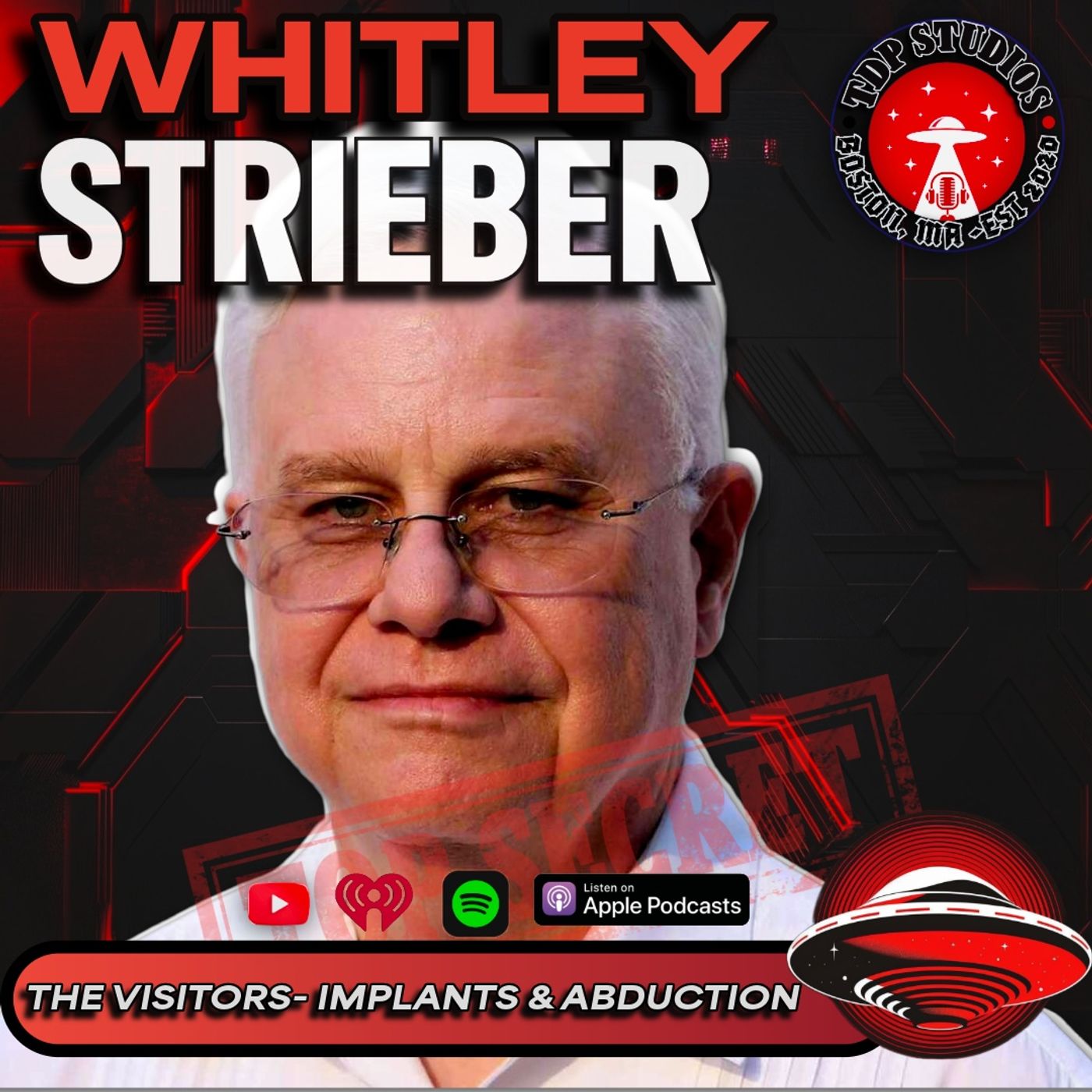
Whitley Strieber on Alien Contact, Physical Evidence & the Case for Congressional Action
LINK THREAD—https://allmylinks.com/total-disclosure
Subscribe to the channel on YouTube—— www.youtube.com/@totaldisclosure
Support TY and TDP Studios directly VIA PayPal (No FEES)— https://www.paypal.me/TDPstudios767?locale.x=en_US
YOUTUBE MEMBER—-https://www.youtube.com/channel/UCy2Cra7aLAAMVxkA9rSYCxg/join
PATREON MEMBER—https://www.patreon.com/Total_Disclosure?
fan_landing=true&view_as=public
Follow On X—- Www.X.com/@DisclosurePod
Instagram—- www.instagram.com/DisclosurePod
Facebook----Facebook.com/@ty.totaldisclosure
Become a supporter of this podcast: https://www.spreaker.com/podcast/total-disclosure-podcast--5975113/support.
CONTACT TDP DIRECTLY For Collaboration, Use of Segments/clips, or any other media produced by “TDP” —[email protected]
Special Thank you to all of our PODCAST/YouTube Channel Members for your continued support, and dedication to seeking the truth, together. We can’t do this WITHOUT YOU!
-COPYRIGHT-2020-
Copyright Disclaimer: Under Section 107 of the Copyright Act 1976, allowance is made for "fair use" for purposes such as criticism, commenting, news reporting, teaching, scholarship, and research. Fair use is a use permitted by copyright statute that might otherwise be infringing. Non-profit, educational or personal use tips the balance in favor of fair use. Total Disclosure Podcast Copyright 2020 and … segments, early access to interviews, and a yearly gift autographed by yours truly!thank you in advance now, Let's explore the unknown together!
Speaker 1: All right, So I am here. I'm the host of Total Disclosure. We're in DC for our continued coverage. I'm sitting here with the man. Communion was the first book that my mom ever handed me after I had my own sighting. It sent me down the rabbit hole. You've inspired me, You've inspired so many, Whitley, How are you doing.
Speaker 2: Oh, I'm doing good, thank you? Yeah, yeah, absolutely, And it's just been an exciting, extraordinary day. I think that James Fox has accomplished a tremendous.
Speaker 3: Thing here and I'm very, very glad to be here.
Speaker 1: How does it feel for you as an experiencer? What are some of the next steps that you think, you know, members of Congress need to take to get these people like your self who've had this continued contact with this.
Speaker 2: Members of Congress and the rest of the government need to face the fact that they're not just flying around and looking down on us. They are, of course here in our lives, and a lot of people not only are they in our lives.
Speaker 3: We're getting kind of good at dealing with that.
Speaker 2: Contact is evolving and it's not crazy or too far out, but I think that the Congress needs to begin to take a clear headed, careful look at it. There are problems with this, which the primary one is there has not been enough real solid neurological research into this phenomenon and how it affects people for us to really be able to say, well, this is imaginary and this really happened to this person, and you're not going to sort that out on a committee in a congressional committee meeting, but we do need.
Speaker 3: To sort that out.
Speaker 2: I'm working on a foundation right now that will be primarily oriented toward understanding from a biological and neurological standpoint, what is happening to these close encounter witnesses, and that will be a good grounding.
Speaker 3: For serious exploration in Congress. Prior to that, they need to dip into.
Speaker 2: This to at least hear from a few witnesses, probably not necessarily in a public setting, yet to hear get a flavor of what they are saying they had in terms of experience, people like let's see Terry Lovelace, meet Terry Lovelace, possibly Chris Bledsoe. There are a lot of people out there in the public space already who are very articulate and have different, different stories to tell. Those people should maybe come together, be engaged with by Congress in some way, and then at the same time, hopefully we'll get the money together to really dig into the biology and the neurology of this, so we can see what is going on in the brain and body of these people.
Speaker 1: Well, I think one of the most interesting aspects of saying you in particular not just communion the story, but you have physical evidence.
Speaker 2: Right, Yeah, it's living in my ear, and there's a video that shows conclusively that it's the normallest object.
Speaker 3: And if I'm.
Speaker 1: Mistaken, correct me. But when they went to remove it, it evaded.
Speaker 3: It evaded the doctor.
Speaker 2: The doctor describes it, he experiences and describes its movement from here down into my ear lobe, and he closes the the incision, all on video. Therefore, it's proof positive that this is the normalous object. It came back up, by the way after a few days, and it hurt like hell when it did too. But the point is this, that's proof that in the normalous object was placed into the ear of a human being and that they are you said, it helps you communicate, Oh no, it's it's a it's like a research tool.
Speaker 2: When I'm in a in an interview with a lot of complex things to talk about. It helps me with my memory enormously, and when I'm writing, what it does is it brings up memories that are not at the surface anymore.
Speaker 3: It draws them up from below and.
Speaker 2: Incredibly enriches my work because of course, the more you remember about a given subject, the better the ideas and the more clarity you.
Speaker 3: Can bring to it. Absolutely. Yeah, so that's what it does.
Speaker 2: It is not a download thing or something meant to control my mind or dominate my mind at all.
Speaker 3: Not at all.
Speaker 1: When was roughly I mean that you don't have to give me any dates or anything, but when was the last time that you had an encounter?
Speaker 2: Like?
Speaker 3: How often is this stuff? Oh, it happens all the time.
Speaker 2: The last time I had a physical encounter was about four months ago, and I don't remember much about it.
Speaker 3: But there is this place on my leg here. Yeah, I can see it. Come in and look at that.
Speaker 2: This was placed on my leg by the visitors about twenty years ago, and you can see these marks on it. They will come in and insert a needle in there every once in a while and for a few days it's read on the around where the needle was inserted.
Speaker 3: And it is.
Speaker 2: They've communicated to me that it's health related and that it helps keep my body strong.
Speaker 3: Wow, And so I mean.
Speaker 1: You're I mean, if if there was a zero point zero zero zero one percent chance of what you're saying is true, you are all we need essentially.
Speaker 2: If yeah, if I get any agency, I'm I'm certainly proof positive that something is here and that the end that they are interested in us physically.
Speaker 1: Are you I never quite got this from any of the conversations that you've done, and that's not your fault. But are you a Are you a religious man?
Speaker 2: That's interesting that questions come up quite a number of times today. I wouldn't define myself as a religious man in the sense of following a specific doctrine.
Speaker 3: I am.
Speaker 2: I consider myself a Catholic, But you know, Catholic. That's a very complex thing to be a Catholic. You know, not that that doesn't necessarily mean you have to be a strict Catholic. And I'm not a strict Catholic, but I'm basically a believer in the validity of the commune of Communion. Yeah in my book, yeah exactly. But but and of the teachings of Jesus. I wrote a book called Jesus a New Vision, which is about It's basically a book to communicate the value of the teachings of Jesus to people who have abandoned religion and are now in the secular community.
Speaker 2: Right, And I have really abandoned religion, and I go to Mass occasionally and I'm comfortable with it.
Speaker 3: I'm not uncomfortable with it at all.
Speaker 2: I feel the presence of the I feel the presence of of of something when I go to communion, definitely right, And I think, I mean.
Speaker 1: Has this has this given you a more of a sense of peace with not knowing?
Speaker 2: That's an interesting question because you know, I live in a world of questions. I live in a world of unanswered questions. I am a living unanswered question. I mean, what does.
Speaker 3: That really do? What does this really do? Who were they? I'm my body is I'm living proof that they're real?
Speaker 2: And what does that all mean in the larger sense?
Speaker 3: Exactly? Should I be afraid? Very afraid?
Speaker 2: Should I believe the one who said to me early on that you're the luckiest of the lucky? I really come down to this that maybe that was true, and maybe I am damn lucky to.
Speaker 3: Have ended up where I am.
Speaker 1: I would love to bring you to Boston, you know, and have a proper sit down, you know, a long form discussion with you podcast. One last question. I know we have a lot to get done here. If tomorrow the President stepped on the podium and said, my fellow Americans, we're not alone. What do you think the next question would be from people to the government.
Speaker 2: Are we in trouble or not? That would be the next question, And he can't answer that. Yeah, are they dangerous or not? And if they're dangerous, can you do anything about it? The answers would be, I don't know whether or not they're dangerous, and no, we can't do anything about it. And that's why I have a feeling he's not going to be stepping on that podium anytime soon. But then again, the president is now Donald Trump, and you never know what might happen, and he could he could push this out on truth socially at three o'clock some morning, right.
Speaker 3: Right, just on a on a vet, right right.
Speaker 1: Yeah. And I just think that you are a living I think you are one of the most important people in this topic and I think, you know, I really do think that if Congress could take a chance on anybody, they need to bring you in and at least have.
Speaker 3: You examine it. Yeah, they sure do and.
Speaker 1: Examined in what sense medical physiological.
Speaker 3: Look at these implants.
Speaker 2: Yeah, yeah, that that could be the thing about the implant is they're very sensitive about it.
Speaker 3: They don't want it touched again, that was going.
Speaker 2: The visitors are someone like I was talking to a neurologist about the implant a few weeks ago on Zoom. She was wanting to know, you know, get my story about it. And helicopters circle the building that house the entire time we were having the conversation. And so somebody is very concerned about my talking about the implant. That said, I will as always do it anyway.
Speaker 1: You're revel with a cause.
Speaker 3: Yeah, I'm not going to stop.
Speaker 2: They they if they wanted someone who would stop, they should have chosen another guy, because I have no intention of stopping.
Speaker 1: Should should we be inherently afraid of the visitors, don't?
Speaker 3: I don't know. I think we should definitely cut the cards.
Speaker 2: Uh. We should keep our own counsel and and preserve our agency and our integrity and our separateness. We don't need to go looking at them as gods or saviors or anything. We need to be looking at them as people who are different than us, who have different possibility, different capabilities, and probably different ambitions and needs, but are still people.
Speaker 3: Whitley, thank you so much. You're well. I would really like I said, I'd love to have a long, long well, yeah, get into you have my I have email? Yeah, where can people?
Speaker 1: Because I know you have you do your own channel?
Speaker 2: Oh yeah, I have a website called unknown Country dot com and we desperately need subscribers, so please do that.
Speaker 3: Uh.
Speaker 2: And I have a YouTube channel. I'm on Instagram, Dreamland. Quitley Streaber is YouTube. I'm on TikTok Instagram.
Speaker 3: I have a.
Speaker 2: New book coming out which we've discussed I believe, Yeah, Transformation twenty twenty six.
Speaker 3: So I'm out there.
Speaker 2: There's lots of ways to get through to me, and you can always write me at Whitleystreaber dot com and I will respond if I can.
Speaker 1: Yeah.
Speaker 3: Sorry, So Whitley, thank you so much. Yeah what up?
Speaker 2: Said John P.
Speaker 3: Good. Thanks?
Speaker 2: Thank you Banks on the book about boot Boa on the
 Apple Podcasts
 Castbox
 Castro
 Goodpods
 Moon FM
 Overcast
 Pocket Casts
 Podbean
 Podcast Addict
 Podcast Republic
 Spotify